
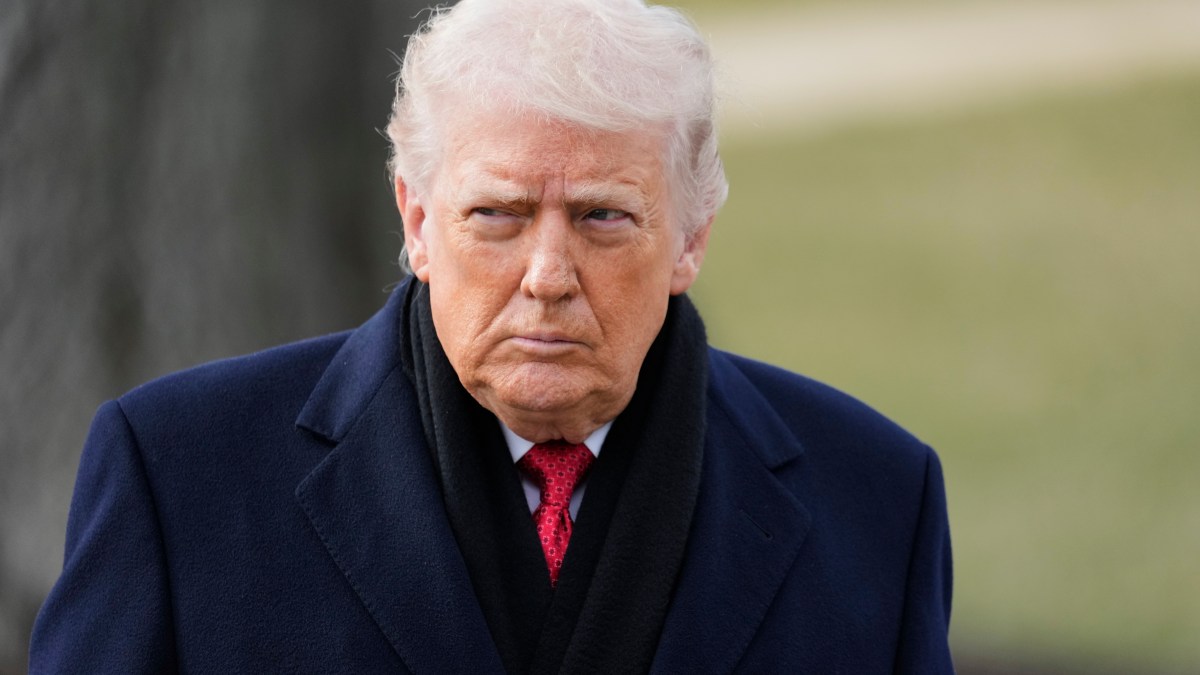

President Trump has divided Nato with his demands
ALEX BRANDON/AP
Donald Trump will no doubt feel that he is entering the lions’ den at the World Economic Forum this week. The annual talkfest in the Swiss ski resort of Davos celebrates multilateral diplomacy and the successes of globalisation, both bugbears of America’s president. Enter — for the first time since 2020 — Mr Trump, fresh from demanding that Nato should do more for his country while insisting on “complete and total” control of Greenland, a dependency of alliance member Denmark.
Mr Trump’s irritation with the European allies’ refusal to roll over on the annexation of the self-governing Arctic territory by the United States has been expressed in a threatened new tranche of tariffs on the UK, France and Germany, among others. Such economic coercion by Washington on its allies has not been witnessed since Suez. Some European Union countries, unsurprisingly led by France, are now considering a hard-hitting response: up to €93 billion worth of retaliatory tariffs and restrictions on US tech companies. This threatens a mutually destructive and wholly unnecessary blow to growth.
Despite Mr Trump’s provocations, Sir Keir Starmer is right not to associate himself with the threatened EU “bazooka”. There are pressing issues for the Atlantic alliance, including a rebalancing of Nato in favour of a greater European contribution, and they are not going to be solved by an acrimonious trade war. Certainly, presenting an in-person ultimatum to Mr Trump at Davos would be unlikely to produce the desired result: a cooling of the Greenland row and the restoration of stability in an alliance shaken by one of the most acrimonious disagreements in its 76-year history.
For European leaders, the best approach is probably to paint two scenarios. In one, the US gains sovereign control over bases in Greenland but does so with the co-operation of Nato allies. In this way Mr Trump achieves many of his declared aims. He might be given the right to restrict third-party access to ports and other critical infrastructure; he could block unwanted (Chinese) foreign investment and enjoy easier access to rare earth deposits. All this could be done by adjusting rather than overturning current arrangements.
The alternative is that the US annexes all of Greenland by force and ruptures Nato. This would cause problems for Washington as well Europe. In addition to the possible loss of European bases vital for US power projection, ventures in Greenland could be denied the use of European and Canadian supply routes, ports and repair facilities. The US relies on Finland to build its icebreakers.
In addition to the opposition of Europeans is the scepticism of most Americans. Mr Trump will be aware of polling that suggests even Republican voters do not favour his threatened land grab. There are other inhibiting factors suggesting Sir Keir is right to keep his powder dry. The US Supreme Court could be about to constrain the president’s hitherto uncontested control over tariffs, weakening his ability to deploy them as a coercive tool. There is also a strong chance that November’s midterm elections will hand control of the House of Representatives to the Democrats.
However the Greenland saga plays out, America’s allies must accept that the security order established after 1945 is at an end. With the US security guarantee now seriously open to doubt, Europeans are going to have to spend more on their own defence. The prime minister still has his head in the sand on this, refusing to acknowledge the truth in his press conference on Greenland yesterday. Labour’s current commitment to spending 2.5 per cent of GDP on defence by 2027, followed by 3.5 per cent only by 2035, is wholly inadequate. An increase to at least 3 per cent is needed in this parliament. If America and Europe are indeed about to divorce, leaders of the latter need to start thinking about the unthinkable.