
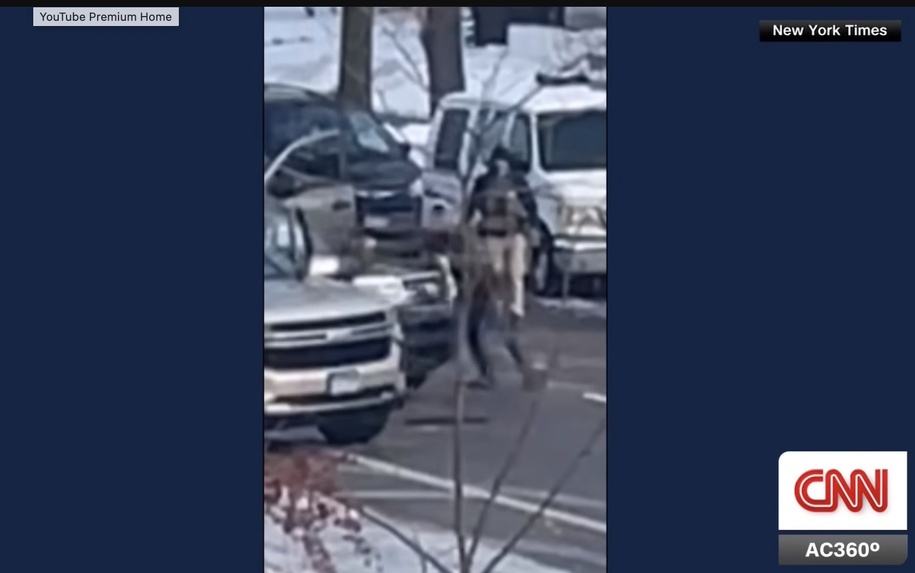
Much like my own previous analysis of the video, the NyTimes reveals that Renee Nicole Good did not “run over” Agent Ross, but there was contact between the hood of her car and the phone in his hand.
President Trump and members of his administration have said that Renee Good, the woman killed by a federal agent in Minneapolis on Jan. 7, “weaponized her vehicle” against the agent who shot her — an interpretation they claim is confirmed by the agent’s cellphone video.
“She didn’t try to run him over,” Mr. Trump said on the day of the shooting. “She ran him over.”
That description has been contested by local and state officials, who have blamed the federal government for the tension, saying aggressive tactics that violate police protocol had stirred unrest. Demonstrators have taken to the streets nationwide to protest the killing of Ms. Good, a U.S. citizen. The administration has responded by sending 1,000 additional agents to Minnesota.
In a video analysis, The Times focuses on some of the key contested moments of the agent’s cellphone video alongside other footage. More videos are likely to emerge, but the visual evidence shows no indication that the agent who fired the shots, Jonathan Ross, had been run over. The footage provides visibility into the positioning between the agent and Ms. Good’s S.U.V., and the key moments of escalation. It also establishes how Mr. Ross put himself in a dangerous position near her vehicle in the first place.
This is a critical point. Ross chose to stand in front of her vehicle, putting himself in harm’s way as she tried to do a 3-point turn to leave. She wasn’t “trying” to hit him, because if she had been, she would have. She was trying to drive around him.
As Good starts to drive forward, Agent Ross leans forward into the car as it approaches him. He doesn’t chose to move out of the way, instead he unholsters his gun and places his left hand down against the hood. Since he’s filming with the phone, this requires him flipping his hand over, and the video also flips upward to show the sky and part of his own face. You can hear in the video the sound of his phone impacting the car. His arm collapses into his chest as the car moves closer.
Then you hear the gunshots.
The car is moving forward and turning past him as he fires. While leaning forward against the car, he takes two hops backward. The first hop is directly back, the second hop is to the side as he fires the last shot. He does not walk back, he’s being pushed by the car.
The car doesn’t impact anything other than his hand, as from the various angles you can see he maintains distance between his torso and his feet from the car.
By the time he fires his first shot, he’s been push to the side and is positioned by the left front tire. At this point, there is no way that Good’s car can still hit him. He’s been moved and hopped out of the way. She is no threat to him in this position, but he fires anyway, with the shot going through the lower left side of the windshield and going across her body to hit her in the right side of her chest. The fact that the bullet travelled diagonally from the left to the right also indicates that from that position, next to the front tire – he was in no danger.
Firing his gun at this point does nothing to protect him, all it does is injure Renee Good. As he’s being moved away and to the side, he fires twice more, hitting her again in the chest and the right side of her head, which was most likely the fatal wound.
If he’s simply stepped to the side instead of learning into the car, drawing his weapon and firing – he would have been fine, and Renee Good would still be alive.
This was not “self-defense.”
As I’ve previously written Ross was implementing a documented CBP strategy of deliberately standing in front of a fleeing vehicle in order to justify shooting the driver.
The Los Angeles Times obtained an internal review of US Border Patrol’s use-of-force policies, which US Customs and Border Protection has refused to release publicly (members of Congress have seen a summary). While the Times did not offer the report in full, the paper did publish previously unseen snippets that portray a law enforcement agency operating under loose use-of-force standards and little accountability.
The review was completed in February 2013 by the Police Executive Research Forum, a nonprofit that develops best practices for law enforcement use-of-force policies. It examined sixty-seven use-of-force incidents by federal border agents near the US-Mexico border that resulted in nineteen deaths.
Here are some key findings of the review, revealed by the Times Thursday:
Border Patrol agents have intentionally and unnecessarily stepped in front of moving cars to justify using deadly force against vehicle occupants.
Agents have shot in frustration across the US-Mexico border at rock throwers when simply moving away was an option.
Border Patrol demonstrates a “lack of diligence” in investigating incidents in which US agents fire their weapons.
It’s questionable whether Border Patrol “consistently and thoroughly reviews” incidents in which agents use deadly force.
The report is especially scathing in its critique of agents who’ve stood in front of moving vehicles, recommending that they “get out of the way…as opposed to intentionally assuming a position in front of such vehicles.” The authors add:
It should be recognized that a half-ounce (200-grain) bullet is unlikely to stop a 4,000-pound moving vehicle, and if the driver…is disabled by a bullet, the vehicle will become a totally unguided threat… Obviously, shooting at a moving vehicle can pose a risk to bystanders including other agents.
This was a deliberate strategy that he employed. He was previously trained as a member of CBP at the time this policy was implemented. He put himself in danger specifically so that he could justify shooting the driver.
Ross is the one who needs to be investigated and presecuted, not Becca Good, Mayor Frey and Governor Walz.