
Image credit:
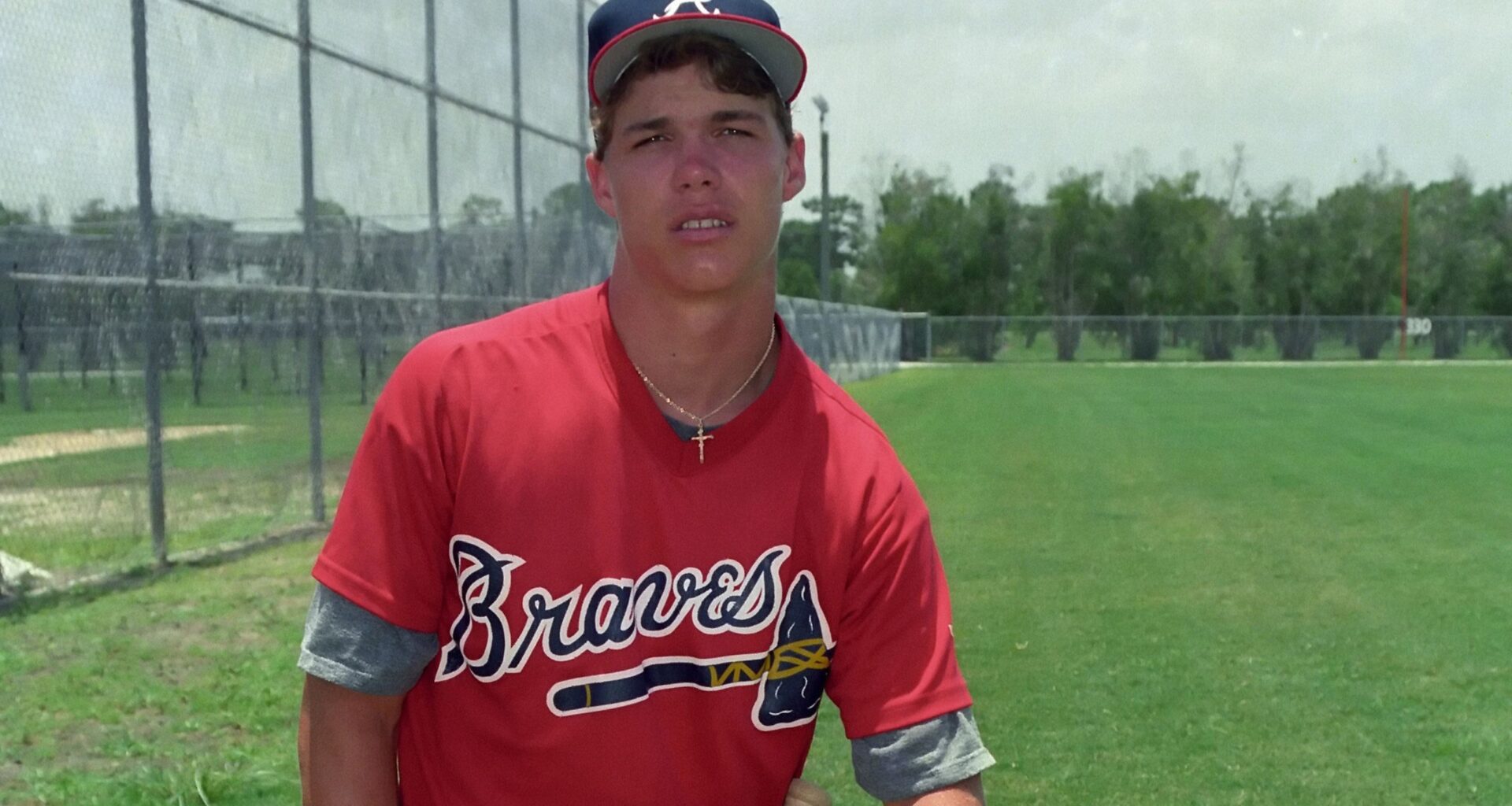
Chipper Jones (Photo by Cliff Welch/Icon Sportswire via Getty Images)
As Baseball America prepares to roll out our 37th annual preseason Top 100 Prospects list tomorrow, we wanted to answer a pretty important question: Why do these Top 100 Prospects rankings matter?
There will be clear mistakes in this year’s Top 100. There will undoubtedly be rankings we will come to regret. Every year, there are prospects who end up being less than we projected. If Brien Taylor or Brandon Wood or Jesus Montero or Yadier Alvarez didn’t pan out, why should readers pay attention to the Top 100? Assuredly, there will be a prospect who pops this season who should have made the Top 100 to start the year.
Baseball is a game where perfection is an unobtainable goal. Even among veteran free agents with long track records, MLB teams make wrong decisions every year. Some free agent will fall apart just after signing a big-money deal. And some MiLB free agent with an invite to MLB spring training will turn into a key contributor. It’s impossible to bring certainty to a very uncertain game, but we can strive to do our best to get better and better at projecting the future.
After studying the MLB production of players from our previous 36 Top 100 Prospects lists, I want to flip the perspective. While not every prospect at the top of the Top 100 will go on to be a star, those players that did become stars almost certainly ranked highly on the Top 100.
That’s the goal Baseball America aspires to when we produce the Top 100 every January. We want to identify the stars of tomorrow—today.
So, how have we done? Let’s take a look.
Today’s MLB Stars Were Yesterday’s Elite Prospects
When it comes to the best of the best, the Hall of Famers, etc, BA’s Top 100 Prospects rankings have done an excellent job spotlighting future greats.
Since Baseball America unveiled its first Top 100 back in 1990, there have been 22 players inducted into the Hall of Fame who were eligible to be ranked. Only two inductees—a pair of relievers in Mariano Rivera and Trevor Hoffman—out of those 24 failed to make a Top 100.
Of the other 22, 10 ranked in the Top 10. Another five ranked in the top 20.
Hall OF Fame
InducteeBEST
TOP 100
RankHall Of Fame
InducteeBEST
Top 100
RankJoe Mauer, C1Scott Rolen, 3B13Chipper Jones, 3B1Billy Wagner, LHP14Vladimir Guerrero Sr., OF2Mike Mussina, RHP19Adrian Beltre, 3B3Frank Thomas, 1B29Derek Jeter, SS4Jeff Bagwell, 1B32Ivan Rodriguez, C7Mike Piazza, C38CC Sabathia, LHP7Larry Walker, OF42Ichiro Suzuki, OF9Jim Thome, 1B51Pedro Martinez, RHP10David Ortiz, DH84Todd Helton, 1B11Mariano Rivera, RHRPDid Not RankRoy Halladay, RHP12Trevor Hoffman, RHRPDid Not Rank
That so many former Top 100 members would go on to do great things isn’t surprising when you consider this other stat. Looking at players who were prospect-eligible from 1990 onward, the top 20 in career Baseball Reference’s Wins Above Replacement (bWAR) all ranked in at least one Top 100 list in their prospect careers.
PlayerbWARTOP 100 RankAlex Rodriguez117.41Albert Pujols101.242Adrian Beltre93.73Mike Trout87.52Chipper Jones85.31Pedro Martinez83.910Mike Mussina82.819Justin Verlander81.78Clayton Kershaw80.97
Of the top 10 in WAR, eight ranked inside the top 10 on a Top 100 Prospects list, and all 10 ranked in the top 50. Everyone in the top 20 for WAR from 1990-2025 also made at least one Top 100 Prospects appearance, and 17 of the 20 ranked among the top 50 in our Top 100.
The trend remains just as clear when you look deeper into the top players of the past 35 years. Of the players who debuted since 1990, more than 80% of the Top 100 players (as measured by WAR) over that stretch were Top 100 Prospects. Of the top 300 players, nearly three in four were Top 100 Prospects. Even if you expand it out to the Top 1000 players, more than half are Top 100 Prospects.
There have been 1,536 MLB players over that timeframe who have produced 5-plus career WAR. More than half of those (768) were Top 100 Prospects.
bWAR
RANKPlayersRanked ON
TOp 100%Ranked IN
TOP 20%Top 101010100.0%880.0%Top 202020100.0%1470.0%Top 50504386.0%2958.0%Top 1001008181.0%5050.0%Top 20020014773.5%8241.0%Top 30030021772.3%12040.0%Top 40040027568.8%14035.0%Top 50050032965.8%15831.6%Top 1000100057757.7%23923.9%5+ WAR
(Top 1536)153676850.0%29919.5%
As you might expect, of the 6,351 MLB players who have produced less than 5 career WAR since 1990, the vast majority never made the Top 100. While there are 940 Top 100 Prospects among that group, since we’re dealing with career WAR, some of the players still playing who haven’t reached 5-plus WAR may eventually reach that mark. For example, Roman Anthony, Shane Baz and Samuel Basallo all are among those 940.
Top 100 Prospects Who Didn’t Make It
Looking more broadly, the hit rate on Top 100 Prospects making the major leagues is quite high. That said, we have never had a “perfect” Top 100.
To chart this, we looked at our Top 100s from 1990-2022, as there are players on normal development tracks from the 2023, 2024 and 2025 lists who have yet to reach the majors. While some players from the 2019-2022 Top 100s may still reach the majors, those are prospects whose ascent has been somewhat delayed.
Because players can appear on more than one yearly preseason Top 100 list, there are only 1,794 individual players ranked in the 3,300 Top 100 spots from 1990-2022. Of those, 1,636 reached the majors and 158 did not. So, 91.2% of eligible players reached the majors.
That’s a good rate, but we have gotten even better over the years.
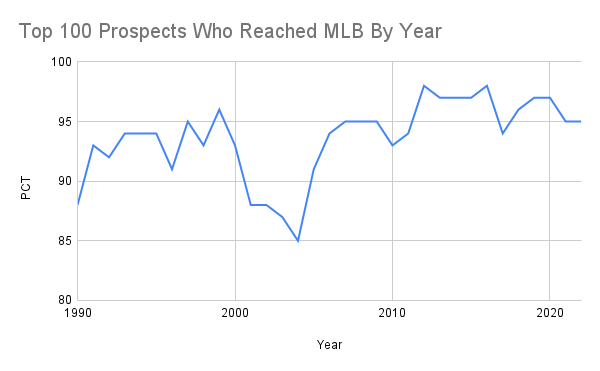
Examining the Top 100 rankings by decade, there is a general upward trend. The 2000s saw a dip, but since 2010, 96% of Top 100 Prospects have become big leaguers.
Decade% WHO
REACHED MLB1990-199993.02000-200991.12010-201996.12020-202295.7
Looking at the ranks of who made it to the majors, there is a decline in how many players make it as you move down in the rankings. But even in the worst bucket, a Top 100 Prospect still has an 89% chance of being a big leaguer historically.
Rank% Who
REACHED MLB1-1097.58%11-2097.27%21-3096.97%31-4095.76%41-5094.85%51-6091.21%61-7093.94%71-8088.79%81-9090.00%91-10089.70%
The Top 100 Finds Future Regulars
While those hit rates are impressive, just making the majors is a low bar for a Top 100 Prospect. That’s not the goal we aim for. As we said before, we want to identify future MLB regulars and, even more so, impactful stars.
So, if simply reaching the majors isn’t what we strive to identify, career WAR can be a useful metric. We’ll start with a relatively modest threshold. On average, nearly half (46%) of Top 100 Prospects will post 5-plus career WAR. As we noted above, that’s something only 19% of major leaguers have accomplished from 1990-2025, so there’s a clear difference between Top 100 Prospects and non-Top 100 Prospects.
If we raise the threshold to 10-plus career WAR, we find that 33% of Top 100 players still reach that mark. At 20-plus career WAR, it drops to 18%, while 9% of Top 100 Prospects have reached 30-plus (so far).
Remember that this is only a snapshot. Since career WAR is a cumulative stat, we can expect that the percentages for many of these Top 100 lists over the past 10-plus years will climb as these players continue to play.
Top 1005+ WAR10+ WAR20+ WAR30+ WAR199049352112199141362111199239321691993473120121994472919819954737241419965039281619975241271819984834221219995338217200043311662001433120122002423218122003513924132004433020920054535221120065440291720075541211220084335171020095035159201052331592011554015820125741241620136045201020145137177201555381472016473817520173927123201841271322019412580202034213020213020202022251430
Conclusion
In summary, it’s clear the Top 100 Prospects list is where the vast majority of future stars reside. Of the 66 MLB players with 50-plus WAR since 1990, 53 made at least one Top 100. Naturally, we agonize over the 13 we missed on: Robinson Cano, Paul Goldschmidt, Jim Edmonds, Mark Buehrle, Tim Hudson, Jose Ramirez, Mariano Rivera, Jeff Kent, Jose Altuve, Johan Santana, Luis Gonzalez, Brian Giles and Jason Giambi.
We will work to miss fewer players in the future.
But overall, the hit rate for our Top 100 Prospects rankings has been quite solid ever since Allan Simpson and the BA crew first compiled the rankings in 1990. While we have much more video, analytical data and in-depth statistics now than was available in 1990—or even conceivable—we’re proud to say our Top 100 Prospects lists have always been a very useful tool for finding tomorrow’s stars today.