
Follow The Athletic’s Australian Open coverage
Welcome to the Australian Open briefing, where The Athletic will explain the stories behind the stories on each day of the tournament.
On Day 4, a high-profile player said she needs to change her game, rain delays caused tension and a breakout star’s Melbourne journey ended.
What is in Emma Raducanu’s tennis future?
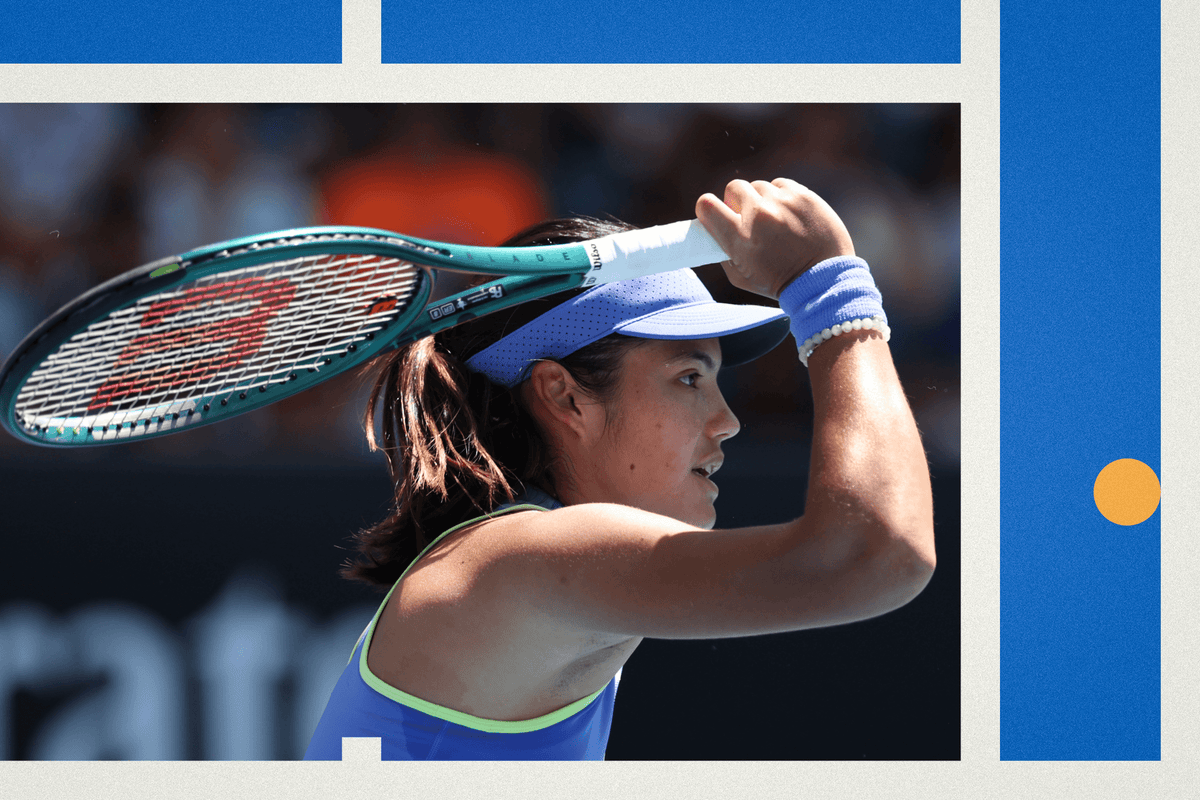
For the 12th time in the 13 majors she has played since winning the U.S. Open in 2021, Emma Raducanu failed to reach the second week. On this occasion, off the back of a truncated pre-season because of a foot injury, the No. 28 seed was beaten 7-6(3), 6-2 Wednesday by Anastasia Potapova.
To return to the level she reached during those crazy few weeks in New York more than four years ago, Raducanu said she needs to simplify her game — like she did back then.
“At the end of the day, I just want to hit the ball to the corners, and hard,” Raducanu said in her news conference. “I feel like I’m doing all this variety, and it’s not doing what I want it to do. I need to just work on playing in a way more similar to how I was playing when I was younger.
“I always just changed direction, took the ball early, and went for it. I think I do have the ability to do many things on the court, but I feel like, as I’m learning all those skills, it’s like I need to stick to my guns a bit as well and work on that.
“For me, it’s pretty simple.”
Raducanu gave the impression that the technical adjustments she’s been making under coach Francisco Roig have left her confused and caught between two styles. Her forehand has been a particular work in progress in the opening part of 2026, and she said Wednesday that “I think I want to be playing a different way, and I think the misalignment with how I’m playing right now and how I want to be playing is something that I just want to work on”.
When she started working with Roig early last August, Raducanu spoke of being more proactive and not just scrapping from the back of the court. The plan initially appeared to be working, but the Brit lamented on Wednesday that in the first set against Potapova, all she was really doing was hanging in there, despite the difficult conditions.
Next up for Raducanu, after analyzing what went wrong in Melbourne, will be next month’s Transylvania Open in Cluj-Napoca, Romania — her father’s home country.
— Charlie Eccleshare
A player’s journey ends — after an even longer one for his coach
Michael Zheng, the Columbia University senior who beat talented fellow American Sebastian Korda on the opening day of this Australian Open, saw his run come to an end Wednesday when he was forced to retire with an adductor (groin muscle) strain.
Zheng, 21, had won the opening set 6-3 over No. 32 seed Corentin Moutet of France, showing off the aggressive baseline game that got him the win over Korda and made him a back-to-back NCAA singles champion in 2024 and 2025.
But the five sets against Korda, on top of three wins in qualifying and then a comeback from Moutet was too much.
Zheng had to receive treatment on the court during a medical timeout early in the third set. He came out from that strong, but shortly after was incapacitated once more and retired with Moutet leading 3-6, 6-1, 6-3, 2-0. “It was shaping up to be a good match, you know, split sets,” he said in his news conference.
Zheng was battling Moutet to earn a shot against Carlos Alcaraz, which would have been a tough task for a college player anyway. Still, Zheng would have liked that shot.
“You get the chance to play the No. 1 player in the world, it doesn’t happen very often,” he said. “Hopefully I’ll get the opportunity again in the future.”
Zheng earned about $150,000 for his efforts during the past 10 days in qualifying and the main draw. According to his coach Howard Endelman, who traveled for 25 hours from New York to arrive for the Moutet match Wednesday morning, he should be allowed to keep it, since he is a graduating senior.
Accepting money beyond $10,000 plus expenses would ordinarily make him ineligible to play college tennis, but that would only take effect next year, after he has left school.
Zheng is scheduled to finish his degree in psychology this spring while attempting to help Columbia to a team NCAA title. Endelman is now scheduled to fly all the way back to New York.
— Matt Futterman
How did rain add to the tension?
Weather discussions so far this tournament have tended to focus on the Melbourne heat, which was punishing on Tuesday, and is forecast to reach about 104F (40C) Friday.
On Wednesday, conditions were generally pleasant — until around 8:50 p.m., when the heavens opened. For a few of the players involved, the rain could not have come at a less convenient time.
America’s Emilio Nava and British No. 26 seed Cameron Norrie were in a tiebreak on Court 7, with the latter leading two sets to one and three points from victory. While on 1573 Arena, the Czech No. 19 seed Karolína Muchová was up 4-2 on Alycia Parks, with the American serving at deuce.
Alexander Zverev and Alexandre Muller were getting into the meat of their match, with the No. 3 seed a break up in the third set having split the first two, but they were at least on one of the three courts at Melbourne Park that has a roof. They returned pretty quickly, and Zverev closed out a 6-3, 4-6, 6-3, 6-4 win.
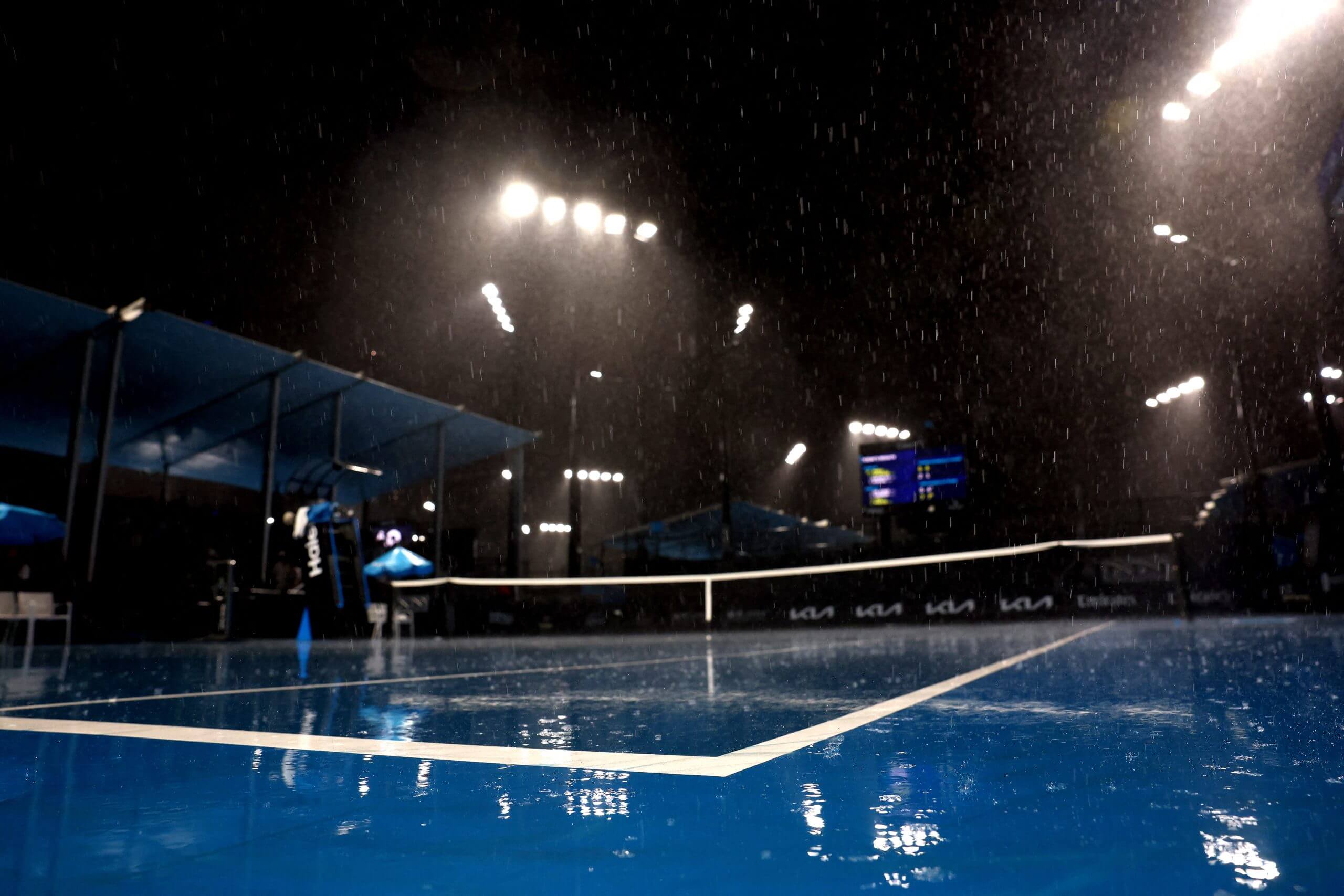
Wet weather left players waiting to resolve some tight situations at Melbourne Park. (Martin Keep / AFP via Getty Images)
For the others, there was more than an hour to wait. More than an hour of that familiar dance tennis players have to do of trying to keep warm and remain focused without overthinking things and getting stressed.
Norrie seemed to get the balance right, winning three of the five points on the resumption to clinch the tiebreak and a 6-1, 7-6(3), 4-6, 7-6(5) victory. Likewise Muchová, who held twice to seal the deciding set and triumph 4-6, 6-4, 6-4 at the second opportunity after missing three match points the previous game.
For Parks and Nava, thoughts will now inevitably drift to whether the outcomes would have been different were it not for one of tennis’ great variables.
— Charlie Eccleshare
How did a home favorite withstand a barrage?
Alex de Minaur delighted the Melbourne crowd with a four-set win over Hamad Medjedovic Wednesday night.
The Australian’s 6-7(5), 6-2, 6-2, 6-1 triumph was Novak-Djokovician in its ruthlessness. After dropping a close opening set, de Minaur dialed up his deadliest forehands and dug in on defense. No matter what Medjedovic tried, he found the ball back at his feet, and he was beaten mentally well before de Minaur converted match point with an ace.
The No.6-ranked player on the ATP Tour has historically been underpowered, having to scrap for all his victories. That he has made enough incremental improvements in his game to close a potentially complicated match in such clinical fashion is astonishing.
Still, Medjedovic might be the more interesting character in the story. The 22-year-old won the NextGen ATP Finals in 2023 and is ranked 90th in the world. He boasts a sledgehammer serve and forehand, with which he had de Minaur scrambling on his heels for much of the night, and Djokovic, who also represents Serbia, has helped him during his development.
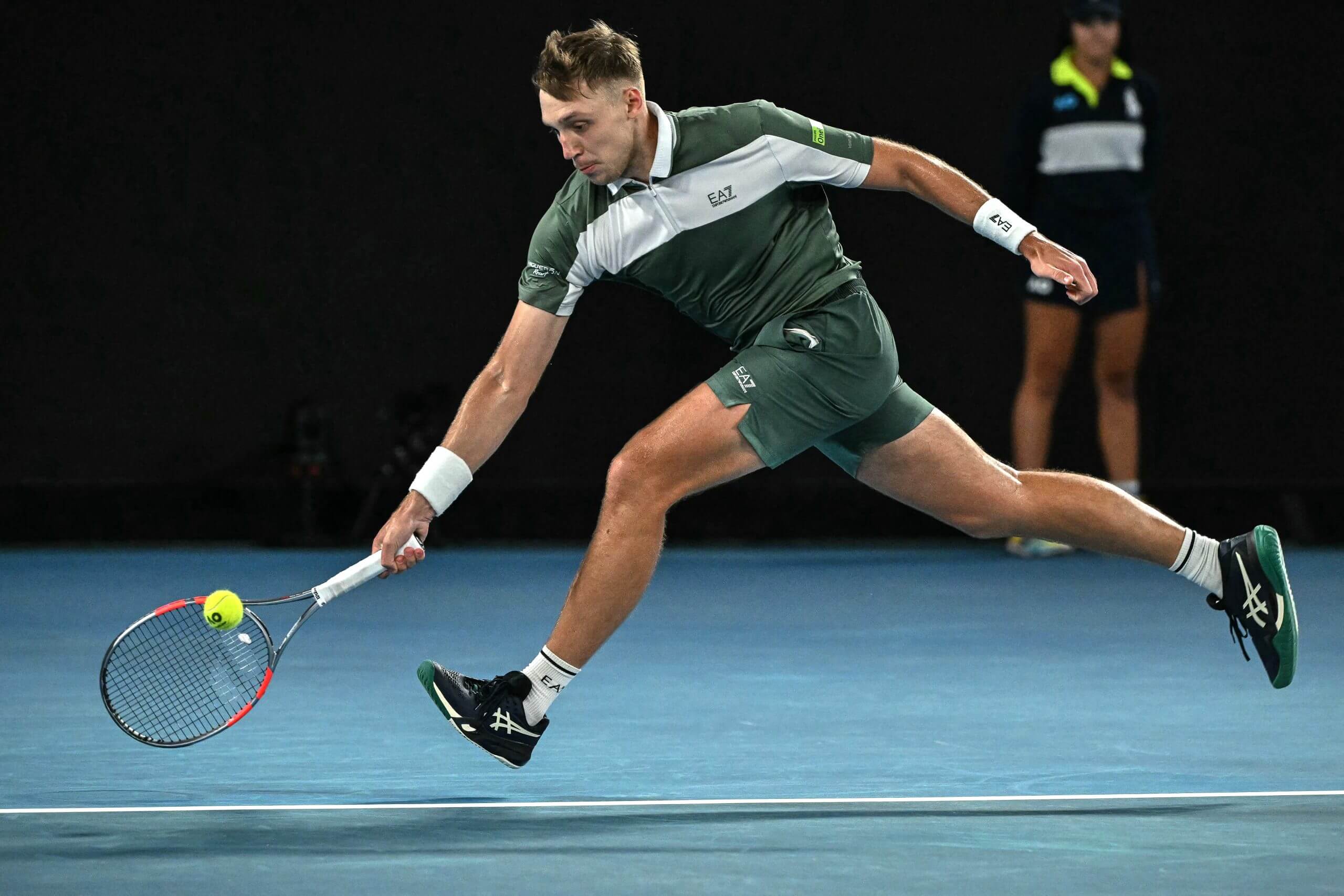
Hamad Medjedovic was unable to sustain his impressive level from the first set. (William West / AFP via Getty Images)
But Medjedovic is a glass cannon, and Wednesday night he shattered more quickly than expected. Though the match may have gone four sets, Medjedovic had enough gas to make it competitive for about one and a half.
By early in the final set, Medjedovic was putting his back into every mammoth groundstroke, in the hopes of ending points as soon as possible. His attempts to hit the perfect backhand slice often died on his own side of the court, short of the net. Medjedovic’s flagging stamina even allowed de Minaur to momentarily channel prime Roger Federer, hitting three aces en route to a 45-second hold of serve at 4-0 in the third set.
To compete with top players like de Minaur, who can play at a high intensity for a full four or five sets, Medjedovic has a few steps to go. In the meantime, he’ll make for entertaining danger to anyone he meets in draws — at least, until he gets tired.
— Owen Lewis
Other notable results on Day 4:
Coco Gauff (3) made light work of a potentially testing matchup. She let Olga Danilović‘s left-handedness play into her backhand — which is Gauff’s best shot — and cruised to a 6-2, 6-2 win.
Yannick Hanfmann gave Carlos Alcaraz (1) something of a going-over with his heavy ballstriking, but the top seed emerged unruffled in a 7-6(4), 6-3, 6-2 win.
The first set was more up-and-down than the scoreline suggests, but Aryna Sabalenka (1) eased past Bai Zhuoxuan (Q) 6-3, 6-1.
And Mirra Andreeva (8) produced some of the best tennis of the tournament so far in a 6-0, 6-4 win over Maria Sakkari.
Shot of the day
Quentin Halys may have lost to Daniil Medvedev in four sets, but pulled off this remarkable backhand pass from nearly in the stands:

(Worldwide World of Sports)
Drop Shots
👗 Naomi Osaka‘s stunning walk-on outfit for her first-round win over Antonia Ružić reminded the world of her place at the forefront of tennis fashion.
📺 For some U.S. tennis fans, ESPN’s coverage of this Australian Open has been a frustrating and unexpectedly expensive experience.
🇺🇦 Oleksandra Oliynykova pushed defending champion Madison Keys to her limits early in their first-round match, but left an even deeper impression with her news conference about life in Kyiv during Russia’s invasion of Ukraine.
🦩 Gauff wants to dictate her tennis matches, playing on the front foot. It’s a forehand she hits on her back foot, on one leg, that tells players and fans how she is feeling about her tennis.
Up next: Second round continues
🎾 Women’s singles: Jessica Pegula (6) vs. McCartney Kessler
7:30 p.m. ET on ESPN Unlimited, ESPN+
From doubles partners to singles opponents for American compatriots Pegula and Kessler. This is a tricky second-round assignment for Pegula, with Kessler having been on the cusp of being seeded for this Australian Open. In their only meeting to date, the No. 6 seed triumphed in the ATX Open final last March, but familiarity in tennis can be a curse as much as a blessing.
🎾 Men’s singles: Tomáš Macháč vs. Stefanos Tsitsipas (31)
2:30 a.m. ET (estimated) on ESPN Unlimited, ESPN+
A potentially thrilling matchup between two very pure tennis players, one of them on top form (Macháč) and the other building back. The Czech’s flamboyant shotmaking and talent are clear, but his body has let him down on myriad occasions since he broke through. Tsitsipas himself is still recovering from a back issue that had the 27-year-old Greek contemplating retirement at its lowest depths.
🎾 Women’s singles: Tereza Valentová vs. Linda Fruhvirtová (Q)
2:30 a.m. ET on ESPN Unlimited, ESPN+
Czechia’s production line of incredibly talented women’s players is one of the most exciting things in tennis, and two of the country’s rising players, with vast potential, now meet in Melbourne. Fruhvirtová, 20, was inside the WTA top 50 as early as 2023. She reached the fourth round of the Australian Open that year, before a run of indifferent results stayed her progress. Valentová, 18, has also had to slow down. In 2023, she was at the top of the junior field before choosing to take time off to manage an abdominal injury. Since then, she has won and won and won in the tennis minor leagues, before stepping up to the WTA Tour last year.
🎾 Men’s singles: Jaume Munar vs. Casper Ruud (12)
4:30 a.m ET (estimated) on ESPN Unlimited, ESPN+
A repeat of one of the best matches of last year’s Australian Open. A five-set win for Ruud that said more about Munar than the Norwegian, forecasting the Spaniard’s vastly improved form on hard courts that lasted for the duration of the season. Ruud still starts as favorite, but is living on a timeline more important than his tennis one: his fiancée, Maria, is days from giving birth, and Ruud has said that he will leave the tournament when it happens, win or lose.
Australian Open men’s draw 2026Australian Open women’s draw 2026
Tell us what you noticed on the fourth day…