
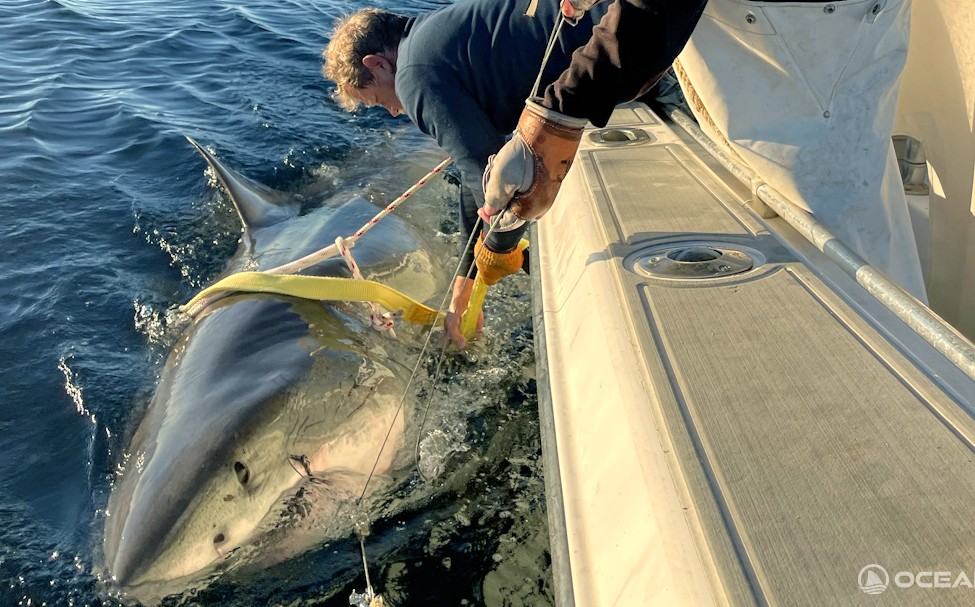
“Contender,” the largest male white shark ever recorded in the Atlantic — at 13 feet, 9 inches and 1,700 pounds — has returned to Florida waters after a yearlong migration.
And the tracking device attached to his dorsal fin is helping researchers uncover secrets about the elusive apex predator.
Contender was first tagged by Ocearch, a marine research nonprofit, off the Florida-Georgia coast on Jan. 17, 2025, and fitted with a SPOT (Smart Position or Temperature) tag that will remain on the shark for about five years.
The tracker pings location data whenever the shark surfaces, revealing the animal’s movements and migration patterns.
Ocearch’s interactive online tracker shows that Contender has certain preferences, and that he makes big moves up and down the east coast.
During winter of last year, he hung out offshore along the drop-off of the continental shelf between Cape Canaveral and Vero Beach until mid-March. This area is a boundary between the flow of the deep Gulf Stream and shallower nearshore waters, and attracts marine life of all sorts.
In early spring, Contender then shot up to the Carolinas, where he loitered along the continental shelf drop-off until June.
Like many of his fellow great whites, once the water warmed he made a move north to Cape Cod, Massachusetts, where sharks of his size are known to hunt seals along the beaches. His last ping there was July 17. He then disappeared for two months.
It’s not clear where he was during that time, but he next surfaced 800 miles away on Sept. 29, very close to shore in the Gulf of St. Lawrence, between Quebec and Newfoundland.
The area was along the shore of an Indian reservation at the mouth of the Natashquan River, 1,800 miles from his wintering waters off Florida.
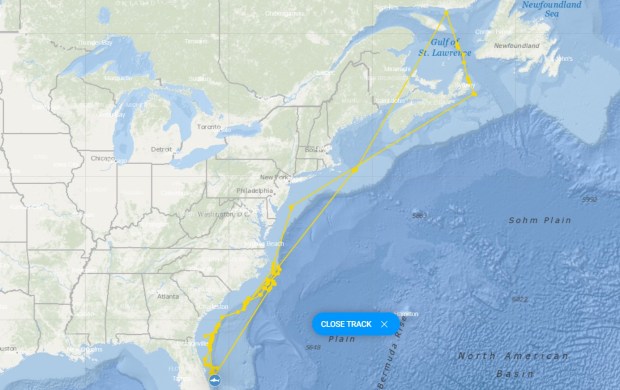 this map shows the journey, in yellow, of Contender, a 13-foot 9-inch great white shark as he traveled more than 5,300 miles over the past year before returning to Florida waters. (Courtesy Ocearch)
It’s known for harbor and harp seals, as well as a famed run of Atlantic salmon that occurs in summer and fall.
Seal populations in Canadian waters may be attracting more and more great white sharks. According to Whales Online magazine, the Quebec Marine Mammal Emergency Response Network has observed a notable increase in cases of seal predation by sharks over the past few years.
“In addition to the sharks being protected, the food that they eat has also been protected — the seals especially,” John Chisholm of the New England Aquarium told City News Montreal. “It’s a combination of factors that are contributing to increased numbers.”
Just before Halloween, Contender pinged off the eastern tip of Nova Scotia, then vanished for 13 days and showed up off New Jersey. By mid-November, he had reached the Carolinas and has been moving between Cape Canaveral and Port St. Lucie since Jan. 1.
All told, Contender’s yearlong round trip covered at least 5,300 miles, equal to driving across the U.S. twice. The SPOT tag only shows where the shark has surfaced, and does not reveal all the twists and turns he may have taken to get there, or how deep he’s descended in pursuit of squid, tuna and other prey.
Ocearch also fits the sharks with pop-up satellite tags that float to the surface after six months. “They tell us where he spent time when beneath the surface, what depths he visited and what temperatures he preferred,” said Chris Fisher, founder of Ocearch. Great white sharks have been recorded at depths of 3,700 feet, presumably to feed.
Seals and large tuna are abundant in Canadian waters, but what do these large sharks eat down south? Monk seals, once widespread on the Florida coast, are now extinct.
Oceach data analyst John Tyminki said that there’s still much unknown about the great white’s winter diet, but it could include schooling mackerel, larger fish such as tunas and jacks, sandbar sharks, marine mammals such as young dolphins, and prey that hides in deep water during the day, such as squid.
Ocearch captures great white sharks and other species at different locations during different times of year and fits each one with a SPOT tag. Their studies of migration patterns of 48 Atlantic great white sharks indicate that these animals are habitual, using the same sites each year.
Each site performs a function: Long Island seems to be a summer nursery area for yearlings. The Carolinas are a winter nursery. Florida and the Gulf are wintering areas, New England and Canada are for summer foraging.
One of the missing puzzle pieces is where the elusive sharks breed. Ocearch is looking for clues.
“One of the tell-tale signs would be observing a mature female with definite signs of mating,” Tyminki said. “For white sharks, this would be bite wounds around the gill area where males would latch on during courtship or copulation (sharks use internal fertilization).” Researchers can also check for sperm when tagging male sharks.
They also draw blood samples while they have the sharks boat-side. “Through blood samples, we also look at hormone profiles from sharks at different times of the year. With enough samples from different areas, we can get a sense of the cycling of their reproductive hormones,” said Tyminki.
Unlike most sharks, white sharks are able to elevate their body temperatures above the surrounding water temperatures.
Despite this warm-blooded ability, water temperatures initiate these migrations, and the sharks adapt their diet accordingly as they travel, said Neil Hammerschlag, marine ecologist and president of Atlantic Shark Expeditions in Nova Scotia.
“They migrate south because the water gets too cold for them,” he said. “They act like a snowbird and migrate south for the winter.”
Several of the great white sharks Ocearch tagged this fall near Nova Scotia are now near the Carolinas, but at least two seem to have made express moves to the Gulf of Mexico, and one, Ripple, has made it all the way to waters off New Orleans and is headed back toward Florida’s Big Bend.
Researchers at Ocearch estimate that Contender is in his early 30s just entering his reproductive years.
Fisher said his team is focused on any potential interactions Contender might have with other mature sharks they’re tracking, such as the 13-foot Goodall, a 1,400-pound female, and Breton, a 13-foot 1,400-pound male.
Breton, who was tagged and measured in 2020, may well be as large as Contender at this point. He last pinged off Jacksonville just after Christmas.
Goodall, who spent quite a bit of time off Nova Scotia this fall, pinged off Charleston, South Carolina, earlier this week. Who knows, maybe she and Contender will become more than just two sharks that pass in the night.
Bill Kearney covers the environment, the outdoors and tropical weather. He can be reached at bkearney@sunsentinel.com. Follow him on Instagram @billkearney or on X @billkearney6.