
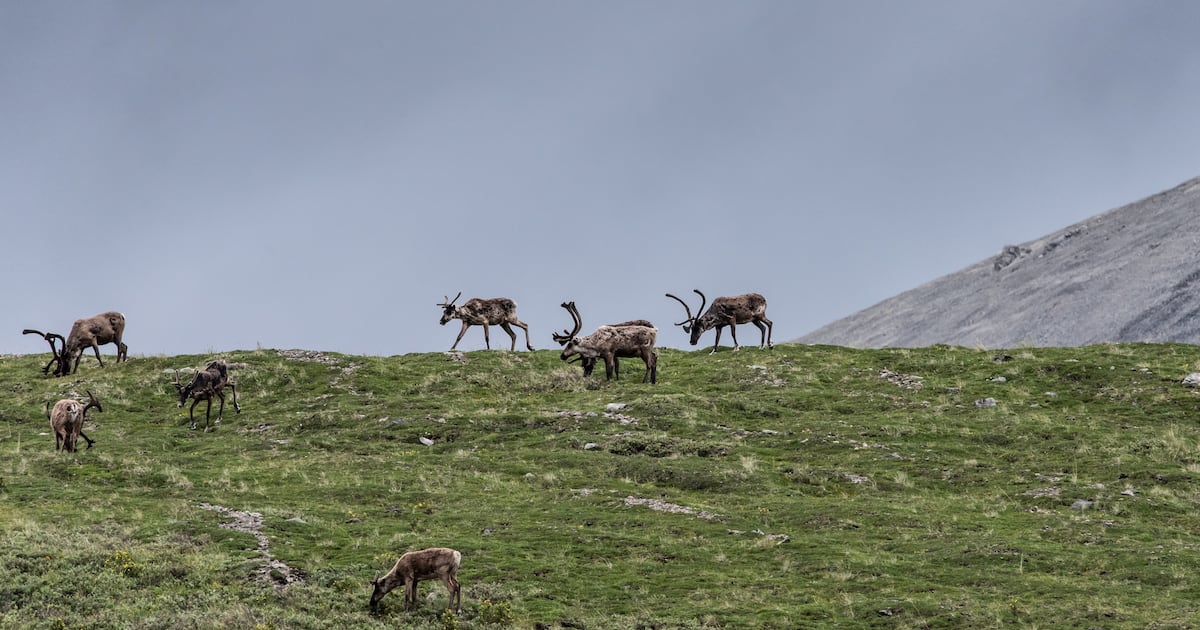
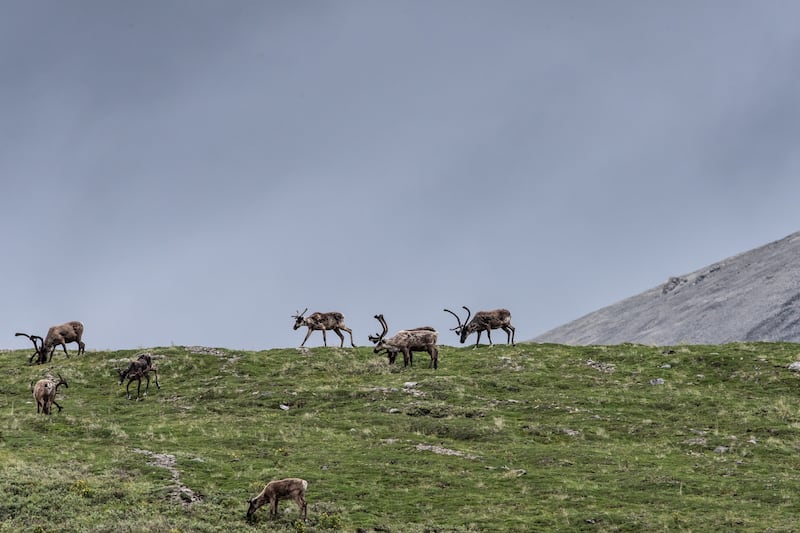
 Caribou forage near the Hulahula River in the Arctic National Wildlife Refuge in 2019. Much of the debate over oil development in the refuge focuses on the Porcupine Caribou Herd, which calves in the same coastal plain targeted for drilling. (Alexis Bonogofsky / U.S. Fish and Wildlife Service)
The caribou herd that is at the center of the debate over oil drilling in the Arctic National Wildlife Refuge has declined by about a third over the past eight years, according to state biologists.
The Porcupine Caribou Herd, which ranges in territory that spans the Alaska-Yukon border, is now estimated at 143,00 animals, according to the Alaska Department of Fish and Game. That compares to the all-time high for the herd of 218,000 animals, estimated in 2017.
The new total is based on a photocensus completed in July. The work, which uses analysis of aerial photographs to estimate population sizes, is the first completed for the Porcupine herd since the all-time high was recorded in 2017.
Despite its decline, the Porcupine herd maintains its relatively new status as Alaska’s largest caribou herd. The Western Arctic Caribou Herd, which peaked in 2003 at 490,000 animals, is now down to 121,000, according to the latest estimate. While the Porcupine herd has declined by about a third since 2017, it fared better than the Western Arctic herd, which declined by more than half in that same period.
The Porcupine herd has likely been declining for several years, but weather problems and other logistical challenges in the animals’ remote territory precluded completion of a new photocensus until last summer, said Mark Nelson, an Alaska Department of Fish and Game biologist based in Fairbanks.
The decline is not surprising, Nelson said. The new population estimate falls within the herd’s cyclical pattern over the past decades, he said. “If you look back in time, this decline right now is exactly what you would expect would happen about now,” Nelson said.
In 1979, the herd was around 106,000 caribou. It grew to 178,000 in 1989, declined to 123,000 in 2001, and then increased to 218,000 in 2017.
Named for the Porcupine River, a tributary of the Yukon River, the herd is comanaged by governments on both sides of the border and the subject of a U.S.-Canada treaty. Nelson is a member of a technical committee that operates under the treaty.
The debate over oil development in the refuge coastal plain — generally the region the herd uses to give birth to calves — has split governments involved in the treaty. While state political leaders in Alaska and the federal government under the Trump administration are pushing for leasing and drilling, the federal, territorial and tribal governments in Canada have been staunch opponents.
The debate has split Indigenous groups in the region as well, with North Slope Inupiat organizations supporting oil development because of potential economic benefits and Gwich’in Athabascans in Alaska and Canada opposing it because of potential damage to the Porcupine herd and the general environment. Some of those groups have sued to block leasing, and last week amended complaints were filed in three of the cases challenging oil development.
Indigenous opponents of oil development said the new caribou population estimate shows the urgency of their cause.
“Decline of the Porcupine Caribou Herd highlights the need for greater habitat protection,” said the headline of a Jan. 7 news release issued by the Vuntut Gwitchin First Nation of Canada.
The decline “does not, in itself, constitute a crisis,” but it shows the importance of intact habitat, the release said. “For this reason, VGFN strongly condemns decisions by the Trump Administration to open the entire Coastal Plain of the Arctic National Wildlife Refuge in Alaska, the critical calving grounds of the Porcupine Caribou Herd, to drilling.”
Inupiat groups, however, contend that oil development would not harm the Arctic environment. Among them is Voice of Arctic Iñupiat, or VOICE, a nonprofit organization of local and regional governments, Native corporations and other entities. “We understand that responsible onshore development and our cultural traditions can coexist, as they have done for more than 50 years,” Nagruk Harcharek, president of VOICE, said in a Dec. 12 statement supporting action by Congress and the Trump administration that paved the way for oil leasing.
Possible food limitations
The reason for the Porcupine herd’s decline has not been identified.
Nelson said there is no indication that hunting pressure is a problem for the herd. While the hunt is very important to communities like Arctic Village in northeastern Alaska, the herd’s range is very remote, making it difficult for non-local hunters to access, he said.
The herd’s size remains well above any threshold that would trigger limits on Indigenous hunting, according to the Porcupine Caribou Management Board, a Canadian advisory panel with representatives from the First Nations, territorial and federal governments. The board is set to hold its annual harvest meeting on Feb. 11 and 12 in Inuvik, Northwest Territories.
Nelson said a possible reason for the decline is a limit on available food that followed the herd’s growth to the all-time population high.
Some evidence supporting that theory could be in the herd’s reproductive pattern. It takes a lot of food to give an adult female caribou the energy and strength to give birth to calves, and the birth rate has fallen among younger adult females in the Porcupine herd, Nelson said.
Meanwhile, wildfire patterns could have reduced available food, he said.
The Porcupine herd’s range is a region where wildfires are common and part of the normal forest cycle, but there is a long-term trend of more frequent and intense wildfires that are burning more deeply into the ground. That means lichen and other tundra plants that are prime caribou food may be in shorter supply, Nelson said.
“It takes a long time for that stuff to come back,” he said. “And sometimes it doesn’t come back as lichen, like it was before.” Sometimes what grows are plants like shrubs that are “kind of caribou food, but it’s not like their main ideal kind of food.”
More than a decade ago, scientists from the U.S. Geological Survey and University of Alaska Fairbanks projected that increasing wildfires in the Alaska-Yukon border region, driven by climate change, could significantly diminish lichen habitat used by the caribou there. The Porcupine herd could lose about a fifth of its winter lichen habitat by the end of the century, according to that study, published in 2014.
Elsewhere on the North Slope, another caribou herd has declined, according to an Alaska Department of Fish and Game photocensus also completed in July.
The Central Arctic herd is now estimated to have 26,600 caribou, down from the 34,600 estimate that resulted from the previous photocensus, which was conducted in 2022, according to the department. The Central Arctic herd peaked in 2010 at 68,400 caribou, but it declined to 22,600 in 2016, according to the department.
The department’s goal is to maintain a t herd size between 28,000 to 32,000 caribou, Nelson said. “Over the last 10 years, it’s basically kind of bounced up and down around our management objective there. Now it’s just a little bit below,” he said.
A new population estimate is not available for another North Slope herd.
Efforts to complete a photocensus of the Teshekpuk caribou herd were hampered by bad weather, said Joelle Hepler, a Department of Fish and Game wildlife biologist. The most recent Teshekpuk abundance estimate is from 2022 and stands at 61,593 animals, she said.
A few years ago, the Teshekpuk herd, known for spending the entire year on the North Slope rather than migrating south in winter, and the Porcupine herd were only two North American major tundra-dwelling herds at or near their population peaks.
Throughout the Arctic, caribou and reindeer populations declined by 65 percent in the past two to three decades, a trend likely driven by climate change and habitat loss, according to the 2024 Arctic Report Card released by the National Oceanic and Atmospheric Administration.
Originally published by the Alaska Beacon, an independent, nonpartisan news organization that covers Alaska state government.