ROCHESTER — Patty Hanson, Rochester Public Utilities’ director of customer relations, said it’s not been unusual to field calls about monthly energy bills, even before the recent 4% rate increase.
But she said some concern stems from not seeing the complete picture when the bill arrives.
“I don’t know if it’s just the electric bill itself or the bill as a whole,” she said of complaints. “Even with my own husband, he’s like ‘Oh my gosh, our RPU bill is so expensive,’ but when you break it down, your electricity is not that expensive at all.”
She pointed out residents’ bills include charges for water service from the utility, as well as sewer and stormwater charges from Rochester Public Works. The percentage of the bill related to the electric service can vary, based on electricity and water usage.
For residential customers who consume average amounts of electricity, charges for electric service might hover around 50% of the overall bill, but water usage and other choices made during warmer months can quickly shift the percentages.
“It’s important that customers not just look at the bottom line of their bills,” said Josh Mason, RPU’s manager of marketing and energy services. “If their water usage has gone up or if their electric usage has gone up, you can find out really what’s contributing to that bottom line when you look at the components of the bill, like what you’re actually being billed for in terms of consumption.”
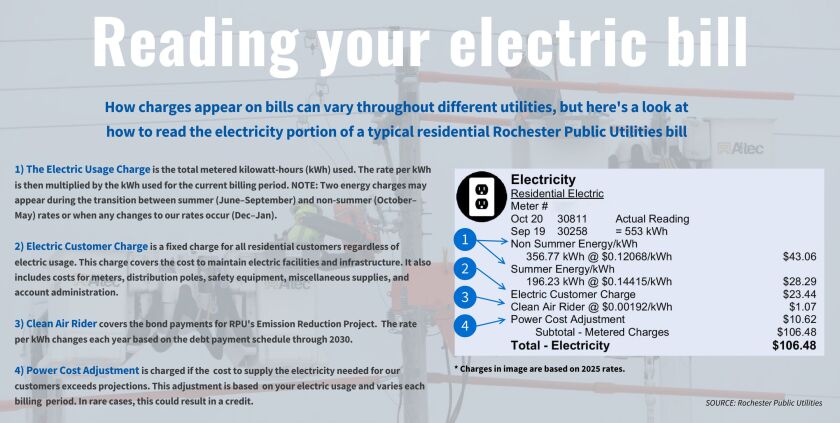
Details related to the electricity portion of
a typical residential RPU bill
are found at the top of the second page.
Generally, there are four charges linked to the customer cost of electric service: The usage charge, the customer charge, the clean-air rider and the power cost adjustment.
The electric usage charge is based on the actual energy used. Measured in kilowatt hours, Hanson said the average RPU residential customer used 557 kWh per month in 2025.
By definition, a kilowatt hour is the energy consumed by running a single 1,000-watt appliance for one hour. For comparison,
Xcel Energy reports 1 kWh would run a typical dishwasher for an hour
or keep an LED lightbulb lit for 100 hours.
That kilowatt hour will cost RPU customers nearly 15.1 cents from June to September this year and 12.6 cents during non-summer months. Those rates are up from 14.4 cents and 12 cents, respectively, in 2025. The rates are based on the estimated wholesale energy costs.
While the usage charge is based on energy consumed, the customer charge is a flat rate paid by all RPU customers.
“That’s the price you pay for being connected to the grid at all times,” Mason said, noting it pays for maintaining facilities and infrastructure, as well as staff and supply costs.
With the 2026 residential customer charge increasing by $1 to $24.44 in 2026, Mason said pulling an electric meter is the only way to avoid the charge, but such action comes with its own expenses, since a licensed electrical inspector would need to be paid by the homeowner if the disconnection lasts more than 90 days.
Additionally, RPU would charge a reconnection fee, and the potential for unforeseen complications exists when disconnected.
“For the price of the customer charge, I would think most people would seek to eliminate risk and just keep the service there,” Mason said.
Hanson pointed to options people can take if they want to reduce electric use while a home is unoccupied. They range from using power strips to turn off several items at the plug or even turning off circuit breakers to avoid what is known as a “phantom load,” which is a slow energy use that continues when some electronics are not used for long periods but remain plugged in.
While usage and customer charges are established as set rates on an annual basis, the actual energy price can fluctuate on a daily basis, with a variety of variables in play amid demand shifts and transmission costs.
The fluctuations, most often tied to the wholesale price of purchased power, appear in the monthly “power cost adjustment” calculated monthly
“The power cost adjustment essentially just helps smooth out those fluctuations,” Mason said, noting it avoids needing to reset basic rates to make sure RPU revenue covers cost without requiring tax support.
While the adjustment, which has hovered around 1 cent to 2 cents per kWh in recent years, routinely increases a bill, it can result in a credit when the wholesale costs drop below anticipated levels. Hanson said that last happened for RPU customers in February 2022.
The fourth charge on a typical RPU electric bill, the Clean Air Rider, recovers costs related to a 2009 project aimed at reducing emissions at RPU’s Silver Lake Plant.
The rate fluctuates annually in connection to debt payments tied to the $34 million project. While it started at nearly three-tenths of a cent per kWh in 2104, it’s dropped to less to two-tenths in recent years.
Based on average use, the Clean Air Rider would cost a typical household $1.01 a month this year, down from $1.07 in 2025.
Homeowners outside RPU’s city territory, whether served by People’s Energy Cooperative, Xcel Energy or any of the other providers beyond Olmsted County’s borders, will find similar charges on their bills, but they can fall under different names.
For instance, the equivalent to RPU’s customer charge is known as a “basic service charge,” but People’s President and CEO Gwen Stevens said they serve the same function by covering the cost of providing electricity service to a customer, regardless of the amount used.
Since People’s serves a larger variety of customers, with some living in urban areas and others in rural areas requiring more distribution lines between customers, the co-op’s board of customers sets two basic rates each May.
The current rates are $41 for condensed urban residential service and $61.50 for rural service with a larger spread between customers.
Citing a temptation to compare the rates to the $24.44 paid within Rochester city limits, utility officials warned an apples-to-apples comparison is difficult, since actual usage rates also vary.
Where Rochester’s flat fee is lower, its 15 cents per kWh summer rate is higher than People’s 12.7-cent rate.
For Xcel customers in Byron and other parts of the region, the customer charge is $6 for residential customers, with a summer rate of 13 cents per kWh, but other charges can also affect the bottomline.
Mason, who works for RPU but lives within People’s service territory, said the comparisons are challenging, but he’s noticed his monthly electric bill doesn’t stray much from what he’d expect to pay for similar service within Rochester city limits.
“If I were to compare my rates and put them against RPU, they’re very close,” he said of his cooperative bill.
While it’s difficult to make a one-to-one comparison of specific charges within a bill, one southern Minnesota utility has been producing bill comparisons for more than two decades, with the results shared by participating utilities that include municipalities, co-ops and the privately owned Xcel Energy.
“We try to pick the rate that we think our customer would be on if they were in that location,” Owatonna Public Utilities General Manager Roger Warehime said of the comparisons that include RPU but not People’s Co-op.
By taking into account all the adjustment factors seen at each utility in a given year, the Owatonna municipality seeks to see where its customers’ bills stand every six months, but he noted there are nuances that cannot be addressed.
“We are tracking against our (customers’) average consumption, so if one utility has a high customer charge compared to the other utility, then depending on how much energy the customer uses, that can obviously make a little difference in the bill,” he said.
Still, he pointed out it’s a single source of comparison, and it’s one that’s been routinely used by RPU when considering rate adjustments.
High in region, low nationally
The most recent report, looking at the 12-month period that ended in June 2025, puts RPU’s estimated bill – based on nearly 7,700 kWh during the studied period – as the second-highest among the 14 utilities compared, with Steele-Waseca Cooperative Electric customers estimated to have the highest bills.
The recent $1,392 estimated 12-month expense for a RPU customer puts the municipality’s bill higher than Xcel’s for the first time since at least 2021. The estimated Xcel annual cost was $4 lower than RPU’s.
It puts the average monthly electric bill at roughly $116 for Rochester customers, as well as surrounding Xcel Energy customers, with both groups paying close to the statewide estimate of $110 reported in the latest U.S. Energy Information Administration data.
The 2024 federal data put the national average residential electric bill at $142 a month.
At the same time, smaller municipalities saw estimates as low as $879 in annual electric bills.
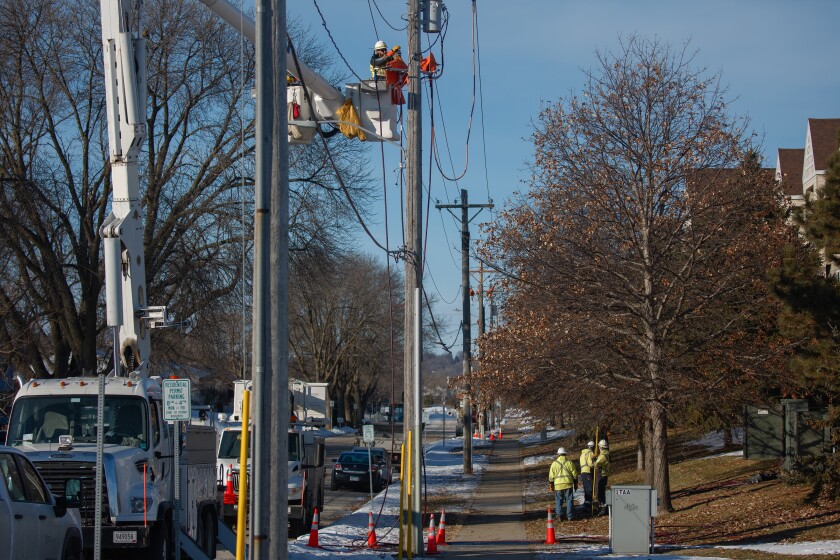
A Rochester Public Utilities crew works near the intersection of Second Street Northwest and West Frontage Road Northwest on Monday, Jan. 12, 2026, in Rochester.
Joe Ahlquist / Post Bulletin
RPU General Manager Tim McCollough, when asked recently about why Austin Utilities was seeing a 1.9% rate reduction in 2026 while Rochester customers faced a 4% increase, pointed to the size of the utilities as a factor.
Municipal utilities, like cooperatives, are designed to meet the needs of their customers without the need to generate revenue beyond expenses, which is expected by investors of private utilities.
However, McCollough said aligning revenue with costs varies based on customer expectations and growth.
While RPU secures energy from the same wholesale provider – Southern Minnesota Municipal Power Agency – that offered Austin a chance to reduce rates, McCollough said Rochester has a different bottom line as a community that has grown by roughly 10,000 customers since 2015 and is seeing a need to make energy investments.
“We’re seeing wholesale rate relief, but we’re also taking on new debt to build a replacement power plant at the same time,” he said, noting some of the added local expense is tied to a shift to renewable energy sources, but the pace was scaled back to reduce impacts.
As a result of recent rate shifts, Austin residential customers are paying $19 as a basic customer fee and 12 cents per kWh, which could broaden the $196 estimated annual gap reported in Owatonna’s comparison of RPU and Austin residential rates.
As Rochester moves to end its wholesale energy contract with SMMPA in 2030, McCollough said RPU will continue to look for ways to reduce its costs while meeting reliability expectations in a growing community.
At the same time, he and others in the industry have pointed to a variety of challenges in the future, from legislative requirements to natural gas price fluctuations created on the global market.
“Who knew that geopolitical events in the world would impact electricity prices in southern Minnesota, but they did, and I believe they will continue to do so in the future,” Dave Geschwind, executive director and chief executive officer of Southern Minnesota Municipal Power Agency, said during a recent forum on energy prices.