
Follow The Athletic’s Australian Open coverage
Welcome to the Australian Open briefing, where The Athletic will explain the stories behind the stories on each day of the tournament.
On Day 7, the Melbourne weather defined the day, a legend said farewell and more.
How did players cope with the extreme heat?
Extra sleep, trying not to think about it, and tweaking their rackets.
These were among the steps players were taking ahead of a 100-degree day at the Australian Open Saturday.
Hydrating well and fueling as much as possible from the night before were also on the agenda, with Jessica Pegula, the American world No. 6, saying that for her team, pre-fueling is even more important than nutrition on the day.
Whatever she did seemed to work, as Pegula set up a fourth-round match against compatriot and defending champion Madison Keys with a straight-sets win over Ukraine’s Oksana Selekhmeteva. Keys went to bed early — as did Lorenzo Musetti ahead of beating Tomáš Macháč — and played with a racket strung a pound heavier, with more tension, to prevent the ball flying off the strings in the quicker and bouncier conditions. This also seemed to do the trick, as she beat Karolína Plíšková in straight sets.
Other players had rackets strung to a tighter tension in their bags. No. 4 seed Amanda Anisimova likes the experience of an ice bath, and took one after her training session on Friday, as well as before and after beating Peyton Stearns in their third-round match Saturday.
One of the biggest challenges the players faced was not becoming too anxious about the prospect of playing in the searing heat. Jannik Sinner, who cramped against Eliot Spizzirri and was thankful for the roof closure mandated by the tournament’s Heat Stress Scale, said in his news conference that he struggled to sleep the night before. Ben Shelton, a straight-sets winner against Valentin Vacherot, said it was a case of trusting his preparation whatever the conditions.
Another potential distraction for those starting earlier in the day, like Anisimova, was trying to get the match done before the temperature really ratcheted up.
“Going into the match, the one thing I tried to tell myself and stick to was to really not spend my energy on thoughts coming in and out of frustration or negativity or things that just didn’t matter, like closing the match or stressing out about not finishing the match,” she said in her news conference.
“I knew that when it’s really hot, it brings you even more down and it takes a lot of your energy.”
Fortunately for Saturday’s players, they won’t have to deal with this kind of heat for the rest of the tournament. Another scorcher is forecast, but for Tuesday, when the other half of the draw will be in action.
For Sinner especially this will surely be a big source of relief.
— Charlie Eccleshare
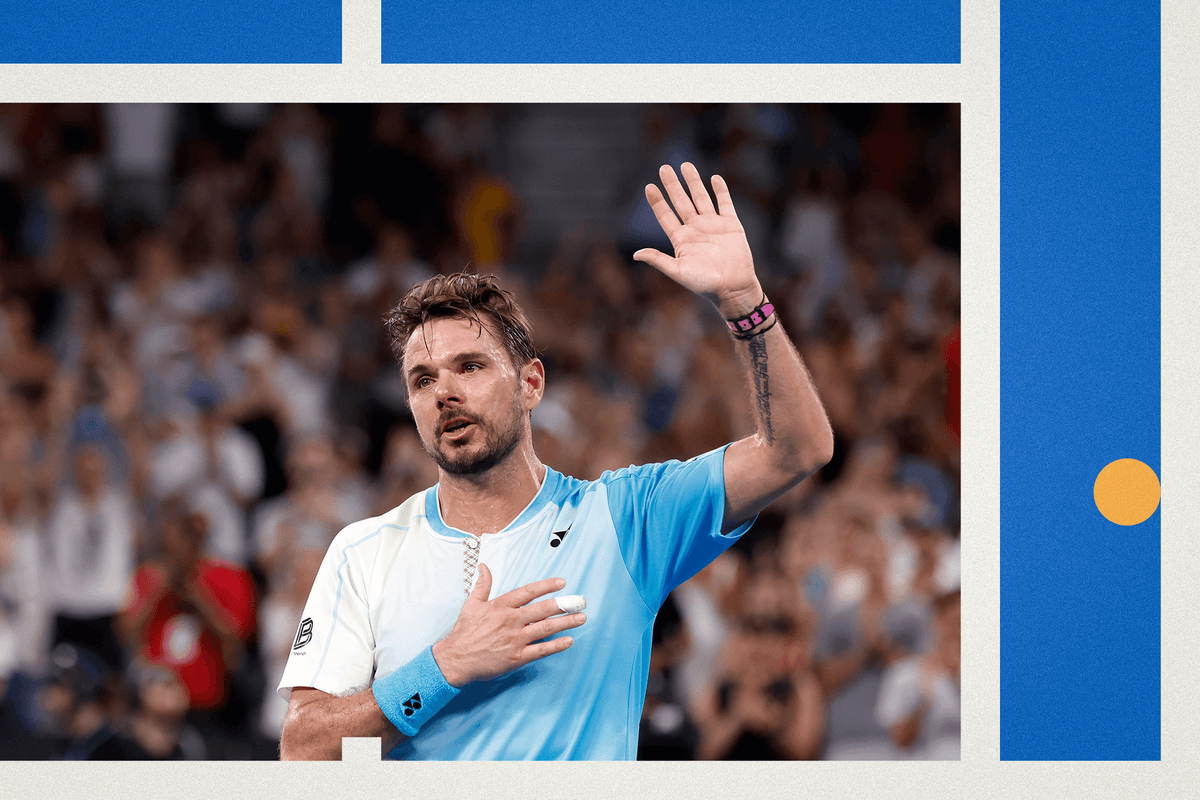
How did Stan Wawrinka say goodbye to the Australian Open?
The last Grand Slam stands of top tennis players can be depressing affairs.
Roger Federer’s bagel final set at Wimbledon in 2021 and Rafael Nadal’s sputtering loss to Alexander Zverev at the 2024 French Open come to mind, joyless affairs all.
Andy Murray limped off Centre Court at the All England Club after losing a doubles match with his brother, barely two weeks after spinal surgery. It was not good.
Stan Wawrinka’s third-round loss to Taylor Fritz, the No. 9 seed, in what he says is his final Australian Open, was valiant and thrilling, just like his whole week here in Melbourne. The 40-year-old, a wild card nightmare for younger opponents and the 2014 champion, produced an outrageous five-set comeback win over 21-year-old Arthur Géa for the right to meet Fritz, winning a deciding tiebreak with aplomb on a raucous Kia Arena, and getting to it with vintage shots like this one:

The party moved to John Cain Arena Saturday, and Wawrinka showed up once more. He pushed Fritz to a first-set tiebreak and slaughtered him in the second set, 6-2.
The legs pretty much went after that, but there was the man nicknamed Diesel, for his endless energy, lunging at volleys, rolling that magic backhand and kicking serves onto the lines until the end. The 10,500 fans at John Cain, the rowdiest crowd on the grounds, loved every second.
“It’s amazing what he’s doing,” Fritz said of Wawrinka on court when his 7-6(5), 2-6, 6-4, 6-4 win was over.
Then Wawrinka took to the center of the court and watched a tribute video of his 2014 triumph and his moving about the grounds the past two weeks.
Then it was Wawrinka’s turn.
“I’ve had so many emotions here the last 20 years,” Wawrinka said. “The reason I was still playing was because of you,” he told the crowd.
Then he ran to the courtside cooler, pulled out two beers and cracked them open with Tennis Australia’s Craig Tiley.
Now that was a last stand. Three more to go.
— Matt Futterman
A tale of two lucky breaks?
For both Jannik Sinner and Novak Djokovic, Saturday brought adversity and fortune.
Eliot Spizzirri, the former Texas Longhorn, was giving Sinner fits on Rod Laver Arena as temperatures climbed. The two-time defending champion was severely cramping midway through his third-round match against the American world No. 85. With temperatures approaching 100 degrees (38 Celsius), Spizzirri broke serve to go up 3-1 in the third set, after winning the first and losing the second, with Sinner barely able to move or serve.
But during the game, the Australian Open’s Heat Stress Scale (HSS), which takes into account air temperature, radiant heat (or the strength of the sun), humidity and wind speed, ticked up to 5.0.
Tournament rules mandate that once it does, play stops at an even number of games, and with four played in the third set, it was time to close the roof on Rod Laver Arena and for the players to exit the court. When they returned, Sinner’s ball speed had dropped and the conditions were cooler, meaning Spizzirri, who had been redirecting pace and counterpunching to brilliant effect, had to readjust.
“I was using his pace pretty well, I thought. When he reduced his ball speed, it was challenging for me to stay aggressive and keep moving around as much as I wanted to,” Spizzirri said in his news conference.
Sinner won in four sets, 4-6, 6-3, 6-4, 6-4.
Later on the same court, Novak Djokovic smacked a forehand in anger despite having won a point against Botic van de Zandschulp and narrowly missed a ball kid in the process.
He risked being disqualified, the most serious penalty for ball abuse, but tennis tends to take an outcome-based approach to the offence which means that players are not punished if no one is struck — or in some cases, hurt — by the incident. That was the case here, and despite some serious resistance from Van de Zandschulp toward the back end of the third set, the 10-time champion prevailed 6-3, 6-4, 7-6(4).
“That was not necessary and in the heat of the moment,” Djokovic said in his news conference. “Yeah, I was lucky there, and I’m sorry for causing any distress to the ball kid or anybody.”
— Charlie Eccleshare
Other notable results on Day 7:
Madison Keys (9) and Jessica Pegula (6) set up a tantalizing fourth-round clash by cruising through their respective matches. Defending champion Keys beat Karolína Plíšková 6-3, 6-3, while Pegula defeated Oksana Selekhmeteva 6-3, 6-2.
Luciano Darderi (22) outlasted the famously durable Karen Khachanov 7-6(5), 3-6, 6-3, 6-4 to face Sinner in the fourth round.
Amanda Anisimova (4) won another all-American tie, beating Peyton Stearns 6-1, 6-4 in a match less straightforward than the scoreline suggested.
Iga Świątek (2) bounced back from a redlining set from Anna Kalinskaya to win 6-1, 1-6, 6-1.
And to end the day, Jakub Menšik (16) overcame Ethan Quinn of the U.S. 6-2, 7-6(5), 7-6(5), while Casper Ruud (12) beat Marin Čilić 6-4, 6-4, 3-6, 7-5.
Shot of the day
Valentin Vacherot did not win this point, but the style points are off the charts:
 Drop Shots
🤕 For most players, a Grand Slam tournament is the pinnacle of their career. For some at the Australian Open, they are just grateful to play at all.
🎒 College tennis is fast becoming a reliable proving ground for elite players. There’s a reason why they’re “dogs.”
🥵 In 100-degree weather in Melbourne, play was suspended on outside courts due to the tournament’s heat rule.
❌ Croatian tennis player Jana Fett has been provisionally suspended after testing positive for three banned substances last November. She maintains her innocence.
Up next: Fourth round begins
🎾 Women’s singles: Aryna Sabalenka (1) vs. Victoria Mboko (17)
7:30 p.m. ET on ESPN Unlimited, ESPN+
Sunday in Australia brings the start of the last 16. With so few upsets, the lineup is stacked, and the day kicks off with Aryna Sabalenka against Victoria Mboko. Sabalenka doesn’t really lose in Australia. Mboko, the 19-year-old Canadian, is brimming with confidence, and she should be. She’s hitting the ball hard and true, and she’s already won a WTA 1000 on a hard court. Beating the world No. 1 at a Grand Slam would be the biggest win of her short career. A year ago she was in ITF matches. Now she’s on Rod Laver Arena playing for a sport in her first Grand Slam quarterfinal. Pretty good.
🎾 Men’s singles: Carlos Alcaraz (1) vs. Tommy Paul (19)
Not before 9:30 p.m. ET on ESPN Unlimited, ESPN+
Carlos Alcaraz and Tommy Paul have played some beautiful tennis matches. Alcaraz is the most dynamic player in the game. Paul, healthy once more, is once again floating across the court and digging balls out of corners with ease and grace. He’s done that before and was a top-10 player a year ago. But then he often runs into the likes of Sinner or Alcaraz, wins or gets very close to winning the first set, and then gets beaten. That may yet happen Sunday, but it might be kind of a beautiful to watch as it goes.
🎾 Women’s singles: Coco Gauff (3) vs. Karolína Muchová (19)
Not before 10:30 p.m. ET on ESPN Unlimited, ESPN+
Coco Gauff shouldn’t win this match against Karolína Muchová. She’s been struggling with her serve. Her forehand isn’t all that reliable, though on Friday she felt more comfortable with the forehand than the backhand. That’s not a good sign, because her backhand is her steadiest shot. Muchová, like Paul, is healthy and once again floating across the court like Roger Federer. She got pushed by Alycia Parks in the second round, but survived in three sets, then thrashed Magda Linette, 6-1, 6-1. Now comes Gauff, who has a 4-0 record against Muchová. Maybe she should win after all.
🎾 Men’s singles: Daniil Medvedev (11) vs. Learner Tien (25)
12 a.m. ET on ESPN Unlimited, ESPN+
Daniil Medvedev and Learner Tien staged an epic battle at last year’s Australian Open, playing into the small hours of the morning, when Tien came alive and won in a match tiebreak. They will start at 4 p.m. Sunday, so it should be an earlier finish. But it may very well be arduous. Medvedev fights to the end, almost always. Tien is getting that reputation as well. His serve has improved significantly. And their other two matches after that first Melbourne meeting have been tentacular, sweaty battles.
Australian Open men’s draw 2026Australian Open women’s draw 2026
Tell us what you noticed on the seventh day…