
MELBOURNE, Australia — Ben Shelton used to be a lonely man after the first couple of rounds at a Grand Slam, the rare college tennis player able to find his way to the business end among the professional lifers and junior prodigies.
A lot changes in a few years. During the middle weekend of this Australian Open, Melbourne Park has turned into a convention of former NCAA champions and standouts.
There’s Shelton, the 2022 men’s NCAA singles champion, alongside Peyton Stearns, who won the women’s title that year. Ethan Quinn, who won the following year, is there too. But championship pedigree is hardly a prerequisite.
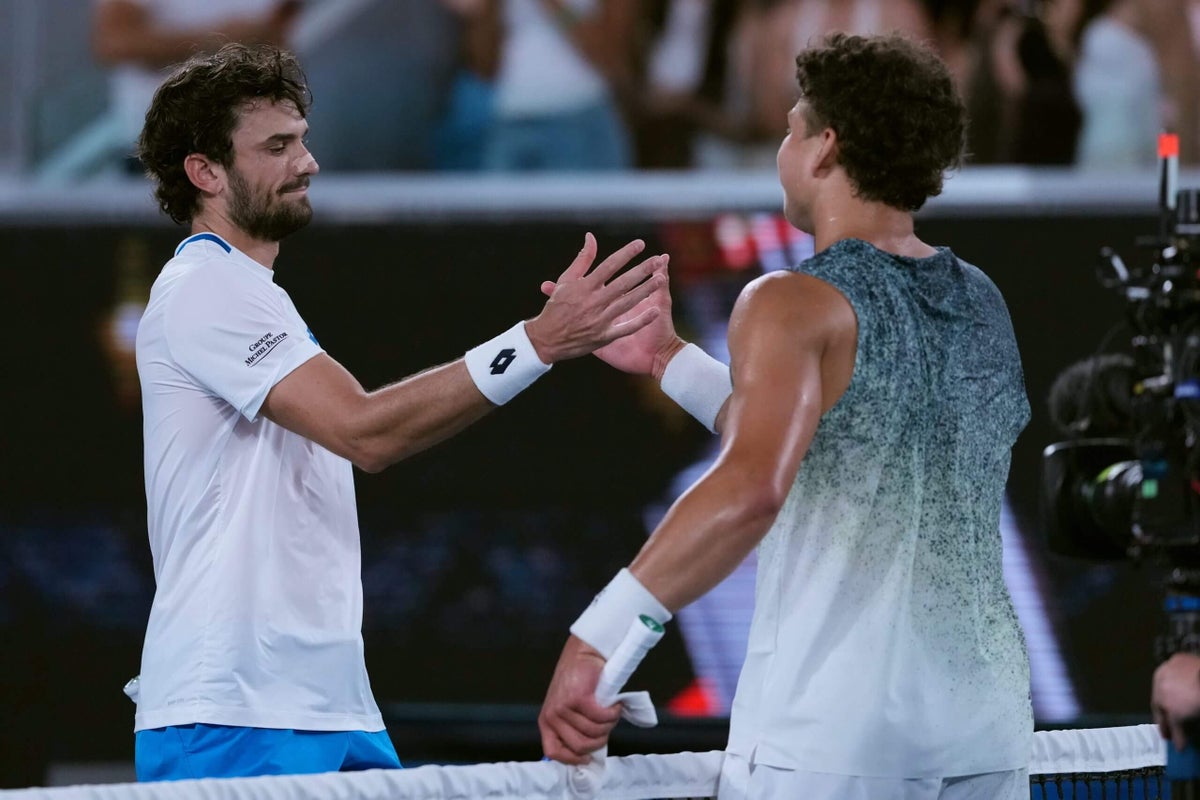
When Shelton, a former University of Florida Gator, looked across the net Saturday afternoon during his third-round match, he saw an old rival, Valentin Vacherot of Monaco, who played for Texas A&M. He said playing a college guy provided extra motivation in his 6-4, 6-4, 7-6(5) win. Another rival, former Texas Longhorn Eliot Spizzirri, gave defending champion Jannik Sinner fits on Rod Laver Arena, as the sun beat down on the hottest day of the tournament so far.
Spizzirri, who played in the heat of Texas and often trains in the swelter of South Florida, had Sinner out on his feet, tied at a set apiece early in the third set, before the heat rule that closed the roof and changed the conditions helped to save the cramping defending champion from a possible exit.
Shelton isn’t surprised.
“College players are dogs for the most part,” Shelton, who still pumps his first and lets out an away-match “YEAH!” when his opponent makes an error on a crucial point, said after his first-round win over Ugo Humbert.
“Dog” is about the highest compliment Shelton can give to a fellow player. It’s a player who fights to get what they want rather than ask for someone to give it to them. A player who puts in extra work on the practice court, someone who’s willing to stick for a buddy, who won’t pull out of a doubles match even if they have just gone the distance in singles and would rather do anything than hit more balls.
In college, a dog was a player who kept up his grades, gave teammates pep talks, and knew the coach had 10 guys to worry about, not one.
“Going into a college team, if you think everything is about you, life is not going to be fun and the guys on the team aren’t going to like you,” Shelton said.
“I think that it definitely builds character.”
Increasingly, it’s also a place to build a tennis career among the elite.
Go back 15 years, or maybe even just a decade, and college tennis players were in large part the sport’s lower class, who had somehow made the show in spite of the NCAA experience rather than because of it.
Go back five years, or even just a few, and much of the tennis world regarded their success as a kind of happy accident, like Cameron Norrie becoming a Wimbledon semifinalist and Indian Wells champion after four years at Texas Christian University, or Danielle Collins, who became a Virginia Cavalier because she couldn’t afford to turn professional out of high school, landing in the Australian Open final.
These days there’s a growing consensus that unless a player is the next Sinner, Carlos Alcaraz or Mirra Andreeva, spending anywhere from a semester to five years on an American college campus feels like the smartest choice in the world.
There were 25 men and nine women with college experience in the main draw when it began. By the round of 32, there were eight former college players in the men’s draw in Melbourne, the most since 1987, when the tournament took place on grass at Kooyong, according to the Intercollegiate Tennis Association. Two women with collegiate experience, Stearns and Diana Shnaider, made the third round before going out.
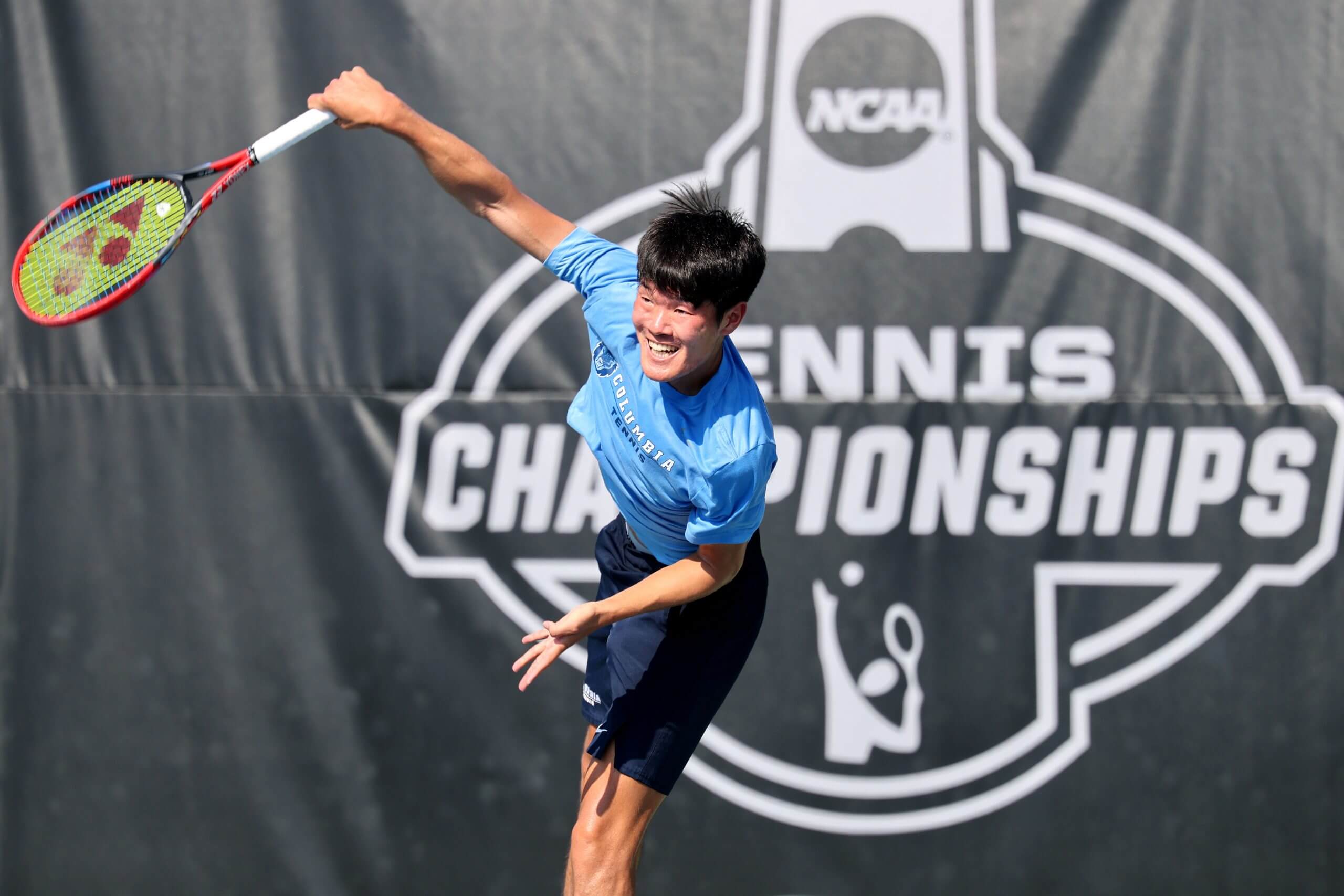
Michael Zheng defended his NCAA title late last year before stunning compatriot Sebastian Korda at the Australian Open. (Jamie Schwaberow / NCAA Photos via Getty Images)
“I tell everyone, if I were to do it again, I would have gone to school, would have gone to Georgia,” said Tommy Paul, who decided to skip college after winning the French Open boys’ title in 2015. Paul, now 28, wasn’t ready, mentally or physically, to compete with men. “Especially the way that it is now, people getting paid to go play in school, I would tell a lot of people that are 17, 18 to go to school.”
The pay for college athletes, on top of scholarships that cover education, room and board, is just the start.
It wasn’t long ago that tennis programs at all but a handful of colleges were athletic department afterthoughts that had to scrounge for funding that football and basketball teams — the so-called revenue sports — gobbled up.
Over the past two decades, athletic departments and coaches have gotten more aggressive about increasing private donations to fund non-revenue sports, building out coaching staffs with assistants, strength and conditioning experts, nutritionists and tutors to help players stay afloat academically if they need it.
That funding has helped allow coaches to recruit more internationally. About 60 percent of Division 1 college tennis players are foreign-born. Coaches lure them with the same perks that attract top American athletes — lots of good coaching and personal attention, as well as high-quality facilities on same level as, or above, national tennis federation training centers in their respective countries.
“The resources are unbelievable,” Spizzirri said after his second-round win over Wu Yibing earned him the showdown with Sinner, where he displayed the ruggedness that has long characterized college players. “When I went to college I told myself, ‘Listen I’m getting top-10, 20 in the world resources for four years as a 17-, 18-year-old.’ So you really do have the chance to, I guess, maximize your potential.”
The growth of international enrolment essentially released college tennis from its age-old criticism — that players who who played NCAAs faced a far more shallow pool of talent. Good players could rack up wins without training hard or missing out on the social pleasures of American college life.
That’s not the world that the former college players who are making it on tour experienced, and they’ve gotten plenty of reinforcement this week, starting with Michael Zheng’s opening day win over Korda. Zheng, the two-time NCAA champion from Columbia, used his solidity to defuse Korda’s explosive power and all-court fluidity.
Vacherot, the surprise star of last fall, who came out of nowhere to win the Shanghai Masters as a qualifier, wasn’t surprised. He said he still follows college tennis closely, and he kept seeing Zheng’s name and reading about him
“If you’re a national champion in NCAA, your level is in the top 100,” Vacherot, who now the No. 30 seed at a major after winning that title in China as world No. 204, said after his first-round win over Martin Damm Jr., an American who opted to skip college and has struggled with injuries the past two years.
“I’m really not surprised to see him beat a top-50 guy.”
The big tradeoff of going to college has long been the inability to collect substantial prize money, above $10,000 per year. Pre-enrolment, any prize money above $10,000 must be used as expenses on the tournament in which it was earned; post-enrolment, prize money is attributed to annual expenses.
Zheng is the rare college athlete who can collect a windfall and remain eligible for the spring season since he is graduating. Also, new sponsorship rules allow college tennis players to get extra money while playing for their schools. Reese Brantmeier, the lead plaintiff in a lawsuit against the NCAA designed to overturn the prize money rules, won this year’s women’s singles championship.
The deficit between college money and professional money is not the only substantial chasm players have to navigate: The move from college to the ATP or WTA Tours involves a pretty serious adjustment, of tennis and also physicality. Steve Denton, the former pro and longtime coach at Texas A&M, said during a recent interview that players who go straight to the upper levels of tennis without the rigor of college sometimes find that their bodies cannot cope.
Football and basketball players talk about how much the games sped up when they jumped to NFL, the NBA, and the WNBA. Spizzirri said he experienced the same thing when he left Texas and became a full-time professional in 2024.
“It’s definitely a different tempo,” Spizzirri said Thursday after his win over Wu.
He can even feel it when he’s practicing with a guy who is ranked between 150 and 300, compared with someone who is ranked between 50-100. But if they can get used to the tempo, he and the rest of the college players have some intangible benefits gleaned from experiencing the rowdy atmospheres of college matches.
Some Croatian fans were getting on Stearns Thursday, during her tight second set with Petra Marčinko. At one point they used an obscenity, and Stearns went after them, like she was back at Texas and playing an archrival like Oklahoma.
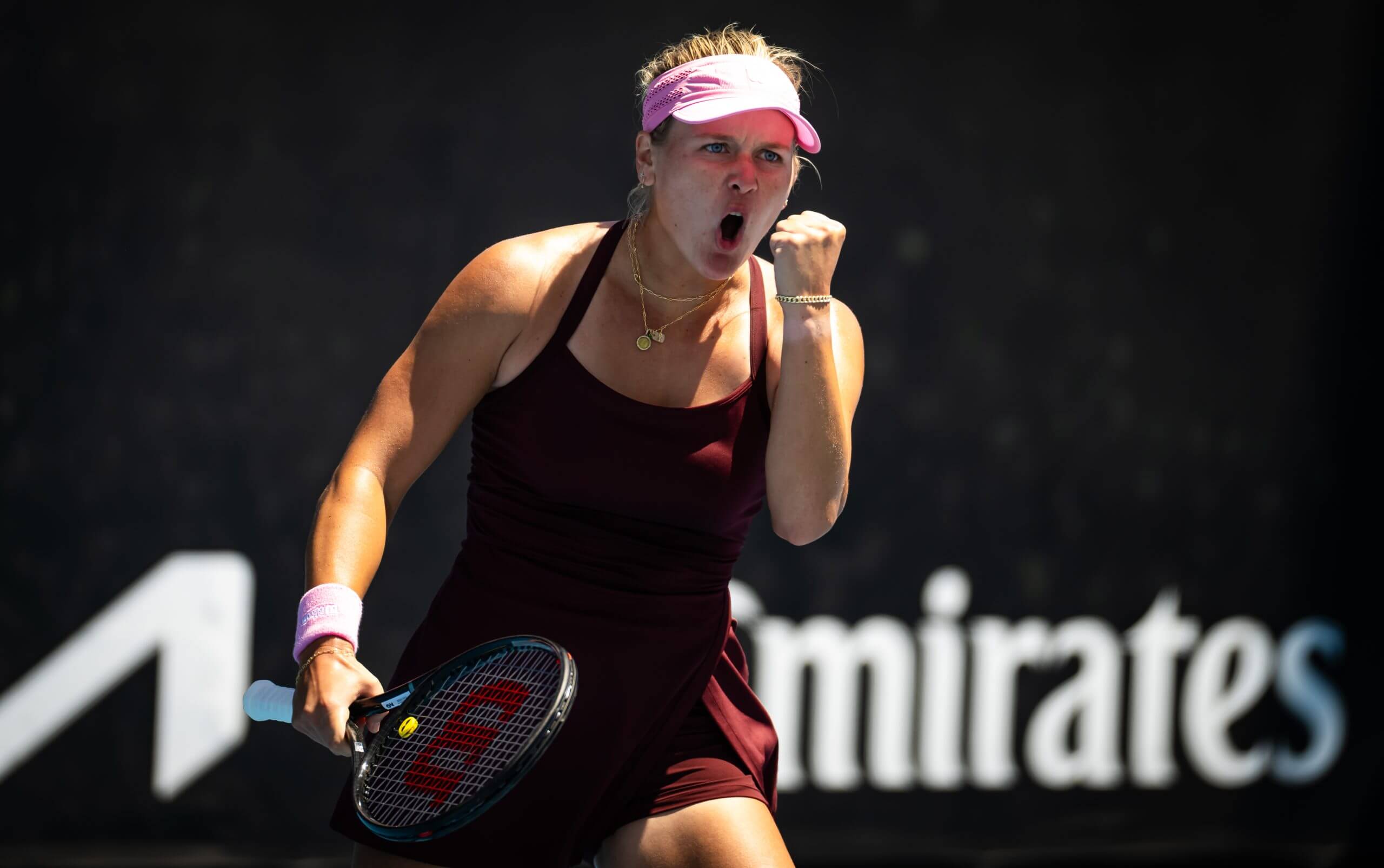
Peyton Stearns won the 2022 NCAA title while representing the Texas Longhorns. (Robert Prange / Getty Images)
She glared at them when she hit winners. She won a crucial point when her ball ticked the net. She skipped the apology to Marčinko and pumped her fist at the fans.
“I started, you know, feeding the monkeys bananas is the best way to put it, and that backfired miserably, so you should not do that,” she said.
But she’d been in this sort of situation before, and knew how to shut out the noise and settle down, reeling off the last five games of the match to prevail 6-2, 7-5.
“When that energy towards my opponent goes, I almost use it as like a deflector of, like, let’s win this next point so you don’t hear that,” she said. “The best way to silence the crowd is to win, and that’s what you got to do if you want them to be quiet.”
When the match was over, she wagged her finger at the harassing bunch, and that was that. It couldn’t get her past Amanda Anisimova in the third round Saturday, but Stearns hadn’t won a match in Australia’s main draw in two previous tries. The week felt like a win even before she took the court Saturday.
Quinn had a similar experience against Hubert Hurkacz Thursday, when a crew of Polish fans went after him and were cheering after he missed first serves. Quinn has missed college since he left after just one year. Then on a stadium court in Melbourne, he felt like he was back in school, battling for the Georgia Bulldogs against a hated rival.
“That was really, really special,” he said during a news conference after a three-set win. “I love it. It doesn’t matter where I’m at. If they’re cheering against me, for me, everything, I just love being in that atmosphere.”
Quinn’s locker in Melbourne is next to Shelton’s. He’s pretty sure they are two of the louder players in the room.
He heard what Shelton had to say about college players being “dogs” and didn’t disagree.
During his time in Athens, Ga. he quickly learned that students and student athletes can get lost if they aren’t careful. The ones who thrive are the ones who figure out how to do things for themselves — finding a hitting partner for extra practice, going to see the strength and conditioning coach for an extra lifting session.
“That’s certainly a trait that NCAA champs probably would have,” he said. “They’re willing to go out and get it, and they’re going to be loud about when they get it.”