
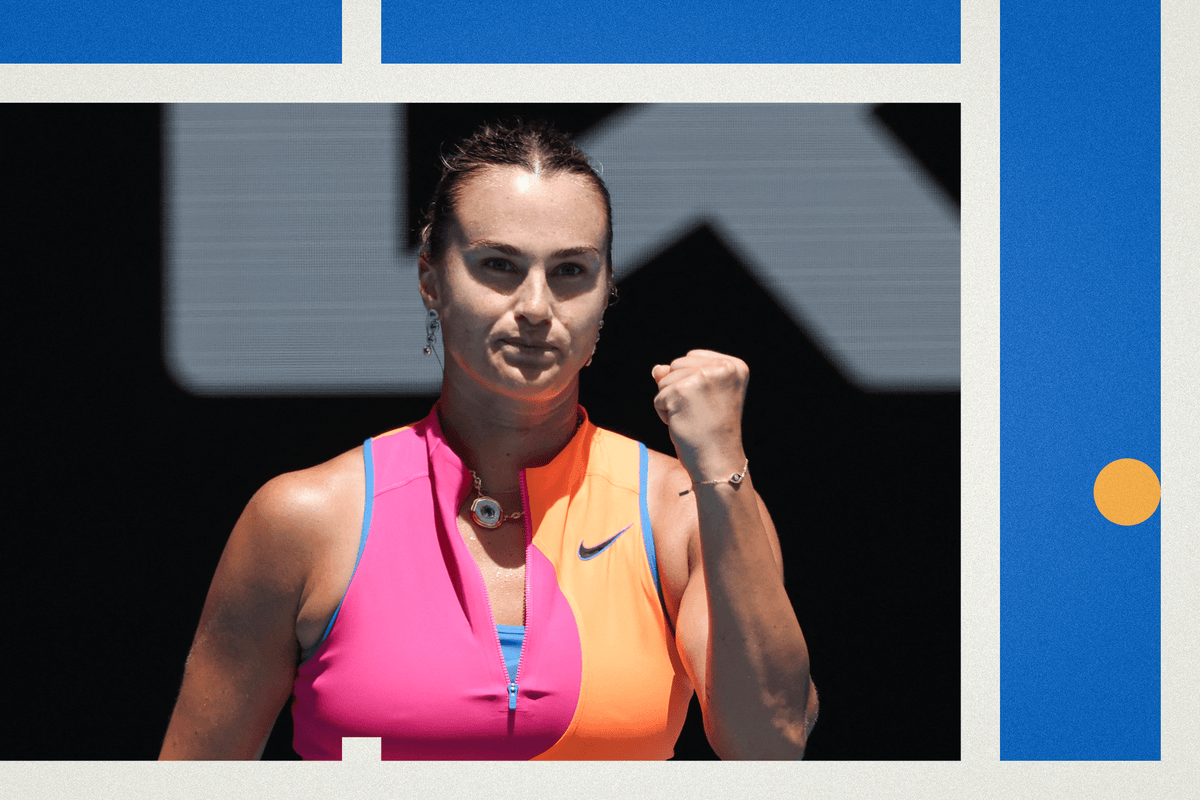
Follow The Athletic’s Australian Open coverage
Welcome to the Australian Open briefing, where The Athletic will explain the stories behind the stories on each day of the tournament.
On Day 8, a world No. 1 broke a Grand Slam record, two matchups went as usual and a new climate hazard arrived.
How does Aryna Sabalenka reset to break records?
There are many ways to illustrate Aryna Sabalenka’s brilliance, but few tell as much of a story as her astonishing tiebreak record.
By winning one against Victoria Mboko Sunday to secure a 6-1, 7-6(1) victory, Sabalenka set a new record for most consecutive Grand Slam tiebreaks won, with 20. She last lost one at the 2023 French Open, and broke the record held by Novak Djokovic, perhaps tennis’ ultimate clutch player.
In one way, winning so many tiebreaks illustrates an ability to play under pressure. But so many of her tiebreak wins come after she has failed to serve out a match and / or given up a lead, also illustrating both the ability to raise her game when it matters and some difficulty with being a favorite or front-runner.
This was the case Friday against Anastasia Potapova when she won two tiebreaks, the second of which came after she had been up by a double break and served for the match. It was the same story Sunday, when Sabalenka gave up a double break lead and then failed to serve out the match, missing three match points on her own serve when up 5-4, largely thanks to some prodigious returning from Mboko.
Sabalenka was furious at herself, at times disbelieving of the sensational level her opponent was reaching. But she steadied herself for the tiebreak, won the first point of it with some superb defense (and some hesitancy from Mboko in coming forward) before racing to an unassailable 6-0 lead.
Something similar happened during last year’s U.S. Open final, when Sabalenka missed a smash at 30-30 when serving for the match at 5-4 against Amanda Anisimova, before being promptly broken. Sabalenka looked rattled on that occasion, as she did against Mboko, especially as she had lost her previous two Grand Slam finals. Again, she reset, and raced through the subsequent tiebreak comfortably.
Sabalenka has tended to explain away her tiebreak record by saying that the format forces her to lock in and focus in a way that she doesn’t always do in the middle of a set. But that doesn’t really account for how she can fail to convert in tight moments towards the end of a set, but become basically unbeatable once into a tiebreak.
And by this point, she and her opponents are well aware of the record, which has become increasingly self-perpetuating. What an asset for the world No. 1 to have as the Australian Open enters its closing stages.
— Charlie Eccleshare
How did two exciting matchups become business as usual?
For Coco Gauff, the fun begins now, at the business end of the tournament, when only eight singles players are left in the locker room.
Maybe that’s what makes the people who win Grand Slams different than the ones who don’t: The ones who let the pressure grow and smother them as stakes rise.
“I definitely think it’s more fun just because you’re in great battles,” Gauff, the No. 3 seed, said after beating No. 19 seed Karolína Muchová 6-1, 3-6, 6-3 in what was a tight battle against a tough opponent.
“You expect to play the peak version of every player. I think it’s just a fun challenge.”
Muchova has been a fun challenge for Gauff. She is 5-0 against the Czech standout who has one of the more elegant arsenals in the sport. And every time she has beaten Muchová, she has ended up winning the tournament.
Gauff was about as good as she can be in the first set, as Muchová came out unsure of how to play her opponent, the sport’s best defender but somehow a player who can get off kilter in a hurry if rushed.
Muchová, with a game built around finesse, a lethal slice backhand, and stellar net play, couldn’t seem to decide which part of her arsenal to use. When she was able to cage Gauff on her forehand and press into the court, she hesitated to commit to the net, and Gauff punished her.
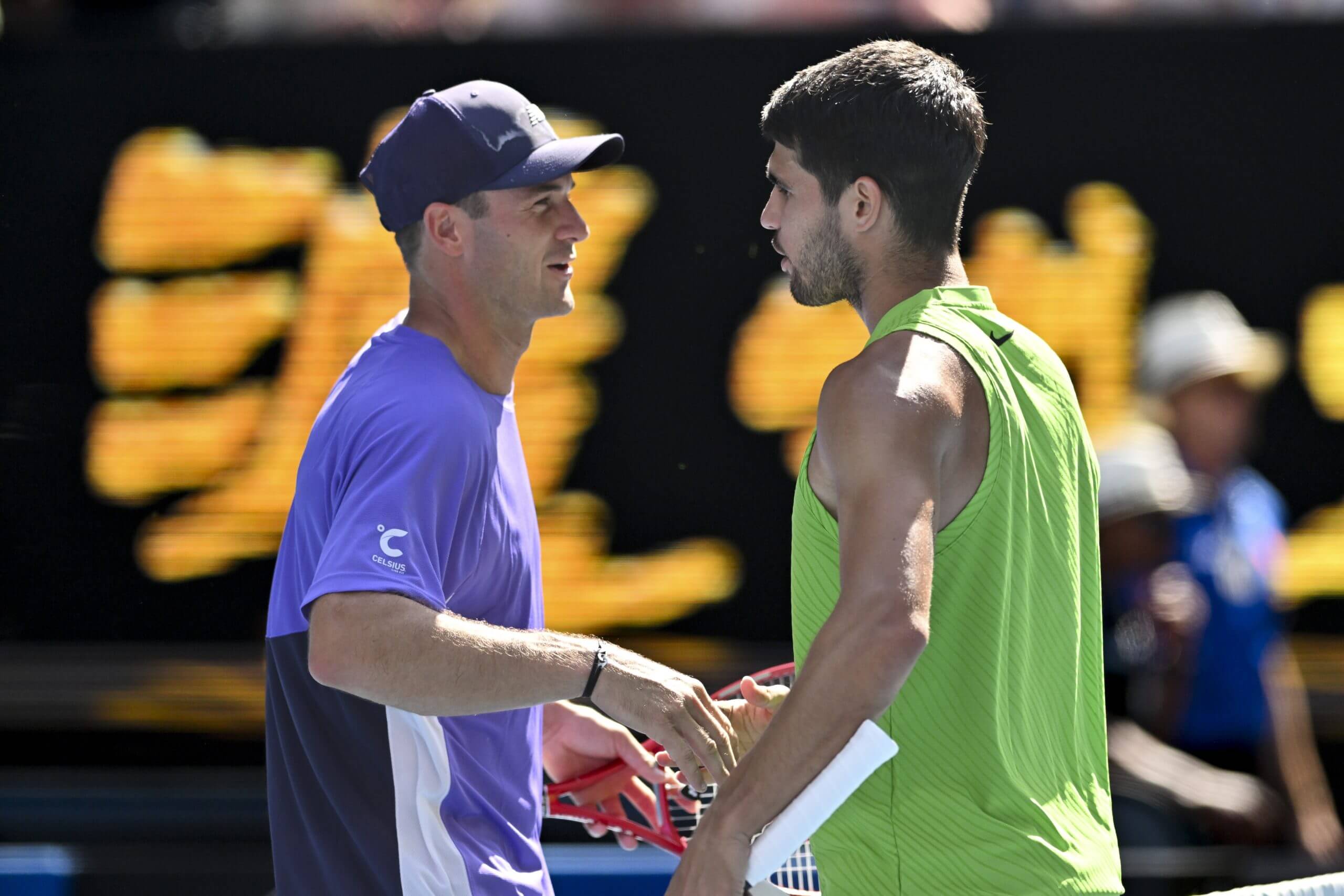
Tommy Paul and Carlos Alcaraz meet at the net after Alcaraz’s win. (Mark Avellino / Getty Images)
Watch them separately, especially on a day when Gauff’s serve and forehand are shaky at best, and Muchová appears to be the far superior player. But she lacks kill-shot from the back of the court that would put Gauff on the back of her back foot. Her finesse plays to Gauff’s biggest strengths — her legs and her defense. More often than not, Gauff has time to make a play. Now she’s in the quarters and able to have some fun in an emptying locker room.
“It’s nice, because you can actually move around,” she said. “You’re not saying, sorry, every two seconds, because you’re not bumping into someone.”
On the men’s side, point-to-point, game-to-game, Tommy Paul vs. Carlos Alcaraz is one of the more aesthetically pleasing match-ups in the sport.
Two immensely gifted athletes who could likely succeed at a multitude of sports, Alcaraz and Paul play similar all-court games. They can play high-octane tennis. They can cut slices. They can come in and finish at the net, or try to, and hustle back to the baseline to catch up with lobs if needed.
The problem for Paul is that Alcaraz does everything just a little bit better, and he doesn’t miss important serves and big spots. In each of their three sets, Paul went toe-to-toe with Alcaraz. He even had two serves at 5-4 in the first-set tiebreak, only to have Alcaraz win four of the next five points, the last on a Paul double-fault.
“He kind of suffocates you in a way,” Paul said of Alcaraz, who won 7-6(6), 6-4, 7-5. “He makes you feel like you have no time. He rushes you. I hit my forehand terribly today, and he saw that early. He was trying to get in that forehand-to-forehand rally, and he did it much better than I did.”
— Matt Futterman
And how did another fall flat — in a fascinating way?
Learner Tien and Daniil Medvedev’s rivalry to date has been a thrilling, messy, tentacular, attritional, often very sweaty mess. Tien haunts Medvedev’s dreams, but Medvedev can — or could — serve him out of sets and, at least once, out of matches. It began at last year’s Australian Open, when Tien won a five-setter just before 3 a.m. and catapulted a captivating, but hardly superstar, matchup into the brains of tennis nerds forever more.
Their meeting at this year’s Australian Open had all the ingredients of a classic. It was not: it was a defenestration.
Tien, the No. 25 seed from the U.S., toyed with Medvedev, the Russian No. 11 seed. When he wasn’t serving him off the court, Tien was ragdolling him from rally to rally, humiliatingly so by using exactly the same pattern. A crosscourt rally would break out. Tien would open up his lefty forehand inside-out, spearing Medvedev into his backhand corner. Medvedev would hook the ball crosscourt and Tien would be there to meet it, waiting to send it down the line and make Medvedev run across the court.
This would continue like a sadistic game of Pong, until Medvedev either expired from the effort of the rally or Tien finished it with another cracking forehand, or a drop shot, or a lob, or just about whatever he wanted.
When it was over, Tien was a 6-4, 6-0, 6-3 winner and into his first Grand Slam quarterfinal. Medvedev, who so often rages at his box, himself, or the gods when losing, was respectfully calm, even after losing his first bagel set in 451 played at Grand Slams.
Tien will face No. 3 seed Alexander Zverev, who he has beaten once on a hard court, at the Mexican Open in Acapulco, though Zverev described the loss as the worst match of his career. The American, 20, is the youngest U.S. man to reach his first Grand Slam singles quarterfinal since Andy Roddick at the 2001 U.S. Open. The question for him now is to what extent this level against Medvedev was matchup-specific — and Medvedev will be asking the same in reverse, but from a very different perspective.
— James Hansen
After scorching heat, another hazard fell over the Australian Open
For a good part of the morning Sunday, it appeared that the biggest climate threat to the Australian Open was no longer heat, but smoke.
After 100-degree (38 Celsius) weather suspended play and changed the course of matches at Melbourne Park Saturday, a bushfire burned through the night in the Otways region of Victoria near the town of Gellibrand. It broke containment lines around 6 p.m. Saturday, spreading rapidly.
Melbourne is 150 miles away from Gellibrand, which is in the southwest of the state, but starting Saturday evening winds carried the smoke toward the city.
By the time darkness had fallen on the night session of the Australian Open, a haze blanketed Melbourne, leading tournament officials to close the roof on Rod Laver Arena during the third set of Casper Ruud’s four-set win over Marin Čilić.
By 8 p.m. local time, the Air Quality Index for the city was classified as “unhealthy for sensitive groups,” and by Sunday morning, it had worsened to “unhealthy,” as a thicker layer of smoke blanketed the city in much cooler temperatures than the previous day. Overnight and into the morning, the city air took on the smell of a wood fire, bringing back memories of the 2020 Australian Open.
Then, fires burned some 3.7 million acres of land north and east of the city, with five officially recorded fatalities in the state. The fires destroyed hundreds of properties, and smoke shrouded Melbourne Park during qualifying, suspending play as players reported coughing fits and other health concerns.
Fortunately for the city and the tournament, the winds shifted in the late morning and began blowing directly from the south, off Port Phillip Bay. That quickly cleared the air, and with cooler temperatures staying through Sunday, there should be a reprieve. But they are expected to rise substantially Monday and Tuesday, hitting 109 degrees on Tuesday. That will increase the fire risk in the region and could cause more smoke to blow towards the city.
— Matt Futterman
Other notable results on Day 8:
American teenager Iva Jović (29) continued her run through the draw, dispatching Yulia Putintseva 6-0, 6-1 to become the youngest women’s player to reach the Australian Open quarterfinals without dropping a set since Venus Williams in 1998.
Alexander Zverev (3) came through 6-2, 6-4, 6-4 in a straightforward match against Francisco Cerúndolo (18), an opponent who usually causes him problems.
Alex de Minaur (6) cruised past the resurgent Alexander Bublik (10) 6-4, 6-1, 6-1 to set up a quarterfinal against Carlos Alcaraz (1).
Elina Svitolina (12) stunned Mirra Andreeva (8) 6-2, 6-4 to knock out one of the tournament favorites.
Shot of the day
Coco Gauff and Karolína Muchová’s head to head is lopsided, but the points they play are anything but. Still, Gauff came out on top again here:
 Drop Shots
🤕Jakub Menšík withdrew from his fourth-round match against Novak Djokovic with a muscle injury, sending the 10-time Australian Open champion into the quarterfinals.
😧 How Novak Djokovic narrowly escaped disqualification from the Australian Open — and whether tennis’ rules around balls struck in anger need to change.
📈 At last year’s Australian Open, there was one teenager in the WTA top 100. Now, a group of rising stars are making a mark on the sport’s biggest stage.
👋 Grand Slam farewells for elite players can often be sad, or even a little tragic. At 40 in Melbourne, Stan Wawrinka showed that there is a better way.
🌀 Carlos Alcaraz once again showed that perceptions of his tennis inconsistency don’t match up with reality.
Up next: Fourth round continues
🎾 Women’s singles: Jessica Pegula (6) vs. Madison Keys (9)
7:30 p.m. ET on ESPN Unlimited
Two compatriots, friends, partners in seeking tennis change, and podcast hosts meet in a fourth-round tie that could easily be a final. Keys, the defending champion, has faced far more jeopardy than Pegula so far. She has also played her best tennis at the tightest moments, just as she did to win the title in 2024. So many factors make this match compelling — may it deliver on the court.
🎾 Women’s singles: Wang Xinyu vs. Amanda Anisimova (4)
Not before 9:30 p.m. ET on ESPN Unlimited
Anisimova, who last year reached her first two Grand Slam finals, has thus far recorded straight-set victories that have been a little more complicated than they appear. Anisimova has at times appeared frustrated with her own game but, by the same token, she has not let that frustration translate into dropped sets or danger. Wang, who has reached several Grand Slam fourth rounds but not since 2024, will be able to test the American’s patience with her shotmaking and ability to extend rallies.
🎾 Men’s singles: Lorenzo Musetti (5) vs. Taylor Fritz (9)
Not before 10 p.m. ET on ESPN Unlimited
Lorenzo Musetti loves to disrupt Taylor Fritz’s game. He loves to chip returns low and short off the American’s monstrous serve, dragging him to parts of the tennis court that he does not want to visit. He loves to slice Fritz’s backhand into submission, forcing him to get low and hit up over and over until he misses. But Fritz loves hard courts, and Musetti finds them hard to manage, because they neutralize a lot of these tactics, or at least soften them. A compelling encounter.
Australian Open men’s draw 2026Australian Open women’s draw 2026
Tell us what you noticed on the eighth day…