
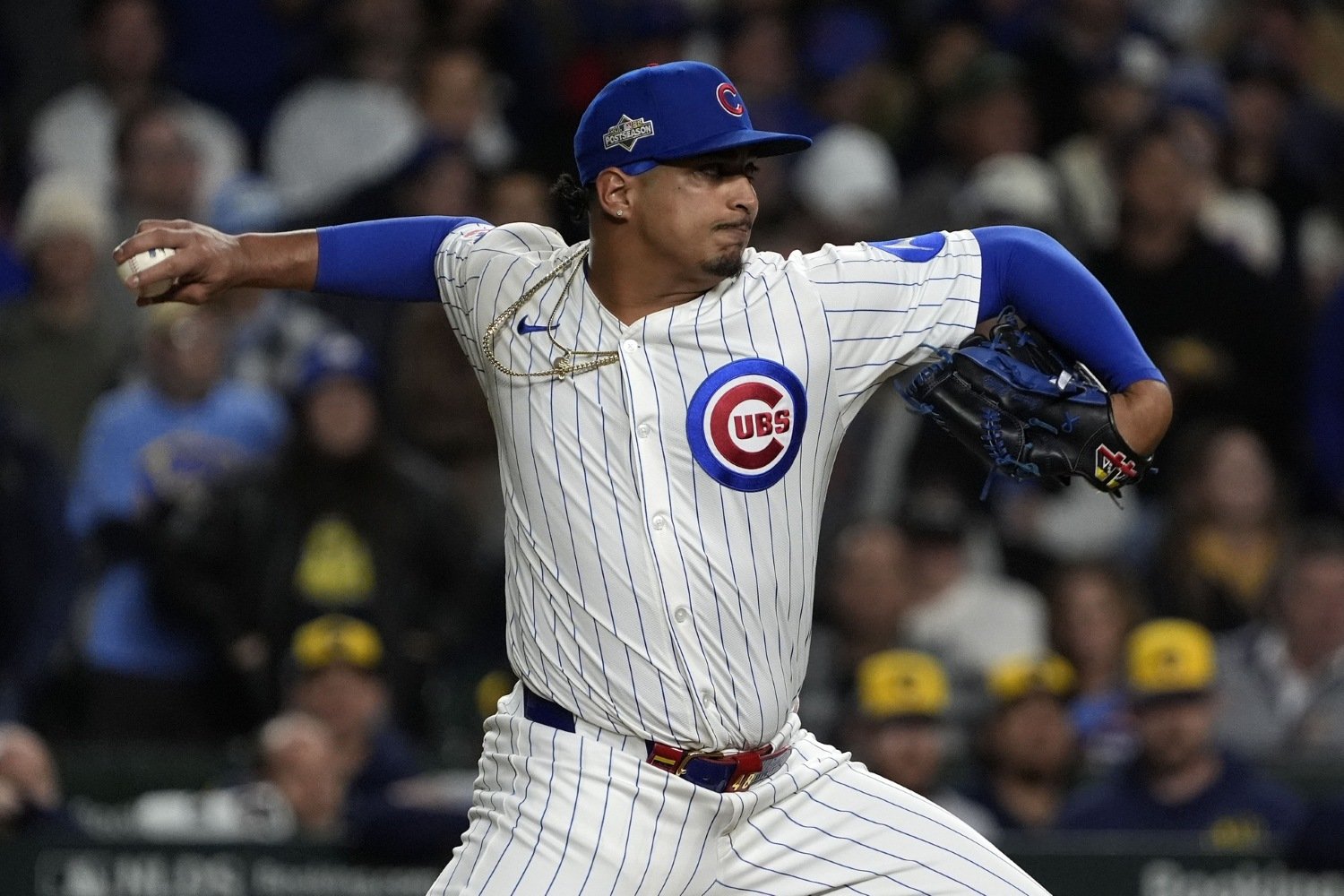
After an active winter that saw several departures and just as many arrivals, the Cubs enter 2026 with good bullpen depth. However, there are a handful of unclaimed spots on their pitching staff, and spring training should yield a lively competition for them. To better understand that free-for-all, let’s examine each of the candidates and the ways they might best mesh. We’ll consider the right- and left-handed relievers separately, to make the project a bit more manageable.
It would be hard to properly evaluate the candidacies of each player hoping to win a job in the bullpen without first mapping out what the end result of those evaluations should be, so let’s start there. Most modern bullpens include eight pitchers, and for simplicity’s sake, we’ll assume that the 2026 Cubs will hew to that norm. They might well use a six-man rotation for some stretch of the season, which would shorten the pen to seven, but that variable can be saved for later.
Of the eight in the pen, five or six are usually right-handed. It’s great to have lefties who can neutralize dangerous pockets of opposing lineups that include multiple dangerous lefty sluggers, but with the three-batter minimum in place since 2020, it’s hard to carry more than a couple of lefties without eventually being compelled to expose them to bad matchups. An especially split-neutral lefty can ameliorate that problem, but the Cubs don’t have such a pitcher on their staff at the moment. Let’s again use a simplifying assumption to clarify our discussion, and say that Caleb Thielbar and Hoby Milner will be the only lefties in the eight-man pen on Opening Day. That leaves six spots to fill with northpaws.
Deciding who those six should be starts, of course, with considerations of quality. Before getting to the nuances and the nitty-gritty of roster-building, you can get a long way by focusing on the fact that good pitching staffs are made up of good pitchers. The Cubs’ relief ace is Daniel Palencia, and they’ll lean heavily on the two setup-quality righties they brought in this winter: Phil Maton and Hunter Harvey. When all three are healthy, those will probably be the top three righties on the relief depth chart.
In fact, there are basically five righties who belong in this conversation and will absolutely be on the roster on Opening Day, unless they’re hurt. In one case (Colin Rea), that doesn’t necessarily mean the bullpen, but all five will be around when they’re available. That group is Palencia, Maton, Harvey, Rea and Jacob Webb. Of the set, only Palencia has the ability to be optioned to the minors, and the Cubs won’t want to do that, unless he has an unforeseeably disastrous spring.
There are two key considerations, beyond pitcher quality, that constrain every discussion about the makeup of a bullpen: minor-league options and 40-man roster status. Teams adore players who can be optioned to the minors, because in theory, they give the roster greater fluidity and flexibility. They like to sign credible big-league pitchers to minor-league deals during the offseason, because by doing so, they save space on the 40-man roster. Once those guys are added to that reserve list, though, they have to be in the majors, and many of them come with opt-out clauses in their contracts that allow them to elect free agency if they’re not added to the roster.
Here are the 15 right-handed pitchers the Cubs will bring to camp with a shot to make their bullpen. I’ve highlighted in gold the ones who have options, and I’ve cast the ones not currently on the 40-man roster in gray.
.png.dd9963105f0ef29536f3f5299219f7f8.png)
A lot of the information you need to project their Opening Day pen is right here. I put a blue fence around the five names we’ve already discussed, because they’re not really part of the competition for space on the roster. For that matter, we don’t know whether Rea will end up as part of this mix, even though we know he’ll be on the team. If one of the team’s incumbent starters gets hurt during camp, Rea would be first in line to step into the back end of the rotation.
Let’s assume that there are two more spots to assign to members of the cohort outside that blue box. Injuries could create a second slot fairly easily. That means that Javier Assad, Ben Brown, Porter Hodge, Gavin Hollowell, Jack Neely and Ethan Roberts are in the mix for spots, but the team can theoretically keep any of them by simply optioning them to the minors. Jeff Brigham, Corbin Martin, Collin Snider and Trent Thornton aren’t on the 40-man roster, and if added, they wouldn’t be eligible to be sent back to the minors. The flip side is that if they aren’t added, they might not be long for the organization.
From a roster-juggling perspective, those considerations can almost come out in the wash. Brown and Assad feel pretty safe, because they both have some big-league success under their belts; the ability to stretch out and work multiple innings at a time; and a bit of upside left in their profiles. They won’t be traded (unless as part of a fairly significant deal) or designated for assignment. However, Hodge, Hollowell, Neely and Roberts need to have strong camps to hold onto their roster spots. It’s nice that they can be sent to the minors, but if the team needs to open a roster spot for one of the four guys on minor-league deals, losing one of those four isn’t going to keep the front office up at night.
This is why, even in the era of big data and extremely refined player evaluation, spring training battles are very real. If you’re Brigham, Martin, Snider or Thornton, you have to come to camp and be better than one of Hodge, Hollowell, Neely or Roberts—and not just better, but better by a wide enough margin that the team feels reasonably confident you’ll stick on the roster for a couple of months, to make up for the roster flexibility lost by swapping out an optionable hurler for a roster-locked one.
Finally, there’s the more fun, on-field set of questions about building a bullpen. In the array above, I used snapshots from Baseball Savant to give a sense of both the arm slot and the pitch shapes of each hurler, so we can see how the team has accumulated diversity (and where redundancy exists). We’ve come full-circle, here, in that I need to stress that a team shouldn’t cultivate diversity in shapes at the expense of quality; some pitch shapes are better than others. Where possible, though, it’s good to have guys who throw from varying arm slots and have varying pitch mixes, so that the manager can manipulate matchups as well as possible.
Referring back to that image, then, we can see one more reason why Assad is secure in his place on the roster: that high arm slot. He offers hitters a different look than just about any other Cubs righty, so he’ll be a change of pace no matter when he pitches. One reason why Webb appealed to the Cubs and merited a big-league deal is the unique interplay of his fastball and changeup, with the latter running arm-side quite a bit but not having much depth. A wrinkle like that helps a pitcher stand out, and makes them more important to a team that doesn’t have much of that particular trait. Palencia’s velocity is another, related outlier trait, in what is otherwise a relatively soft-tossing pen.
Hollowell, Roberts and Snider each offer some lesser variation on what Maton does, with low arm slots and a wide horizontal movement spread. However, the team probably doesn’t need all four of those guys. Hollowell and Roberts combined to spend about 75% of their season in Iowa last year. If Snider comes to camp and shows as well as the Cubs expect, he’s a good candidate to snare a roster spot, at the expense of one of those two pitchers.
Martin’s profile is similar to Harvey’s, and because Harvey is often injured, the Cubs would probably prefer to keep both pitchers—but ideally, that would be either because Martin is willing to stick around in the minors or because Harvey is on the injured list when the campaign begins, leaving another spot open on the 26-man roster. If Martin has a great spring and the team wants to keep him, but Harvey is healthy, they’ll have a bit of redundancy in profiles in middle relief. However, it wouldn’t hurt them terribly to add him to the 40-man, because his profile is also somewhat similar to those of Neely and Hodge. Those, again, are pitchers the Cubs didn’t trust for most of 2025, and Martin would give them much of what they’d lose by waiving either.
If the Cubs landed Thornton without granting him an opt-out or upward mobility clause (which is plausible, because he’s still recovering a bit from an Achilles injury last summer), he could be the most valuable pitcher in this set. As we discussed last week, he looks like a terrific candidate to add a kick-change to his arsenal, and if he develops one, he’ll have a pitch mix much like those of Rea or Assad. He doesn’t have quite as much capacity to pitch multiple innings as they do, but he’s a nice piece to have as backup for either one. If he can leave at the end of spring, though, he’s a much tougher fit, and might be destined to land elsewhere in a March trade.
Finally, there’s Brigham. His cutter is a unique pitch, but not an especially good one. It sits halfway between his rising four-seamer and a solid sweeper, but doesn’t engender the confusion one might hope for. That makes him the wrong kind of redundancy; he doesn’t really protect the team from injury. With a tweak or two, he could be similar to Hodge, but Hodge can be optioned to the minors. Brigham would have to embrace some significant changes in camp to merit a place on the 40-man roster, knowing he’d likely be last in the bullpen pecking order and would soon have to be replaced.
This isn’t even the exhaustive list of guys who could theoretically pitch for the team early in 2026. They’ll also get looks at non-roster righty Zac Leigh, and they’ve signed Yacksel Rios as another non-roster invitee. These 15 will be the most interesting names to watch, though, and the way they fit together—who could replace whom, and who makes a nice complement to the rest of the group—will be the final determinant of the team’s choices two months from now.