
Whether it is a beloved childhood recollection or the simple knowledge of what you had for breakfast, our memories often seem like the only things we can be certain of.
But, according to a group of leading physicists, all of your memories could merely be an illusion.
According to this bold theory, all of your recollections are more likely to arise from random fluctuations in space than from real past events.
That would mean everything you currently remember about your life and the world has no more bearing on reality than your wildest dreams and fantasies.
Scientists and philosophers call this idea the Boltzmann Brain hypothesis, after the Austrian mathematician Ludwig Boltzmann.
It is the idea that the most likely situation is that your brain, complete with all its memories, sprang into existence at this very moment out of random chaos.
That might seem crazy; however, these scientists argue that it is an unfortunately unavoidable consequence of our most important laws of physics.
In their paper, published in the journal Entropy, the scientists say: ‘At present, there is no fully rigorous argument that relies only on established physics to dispel the possibility of the BB [Boltzmann Brain] hypothesis.’
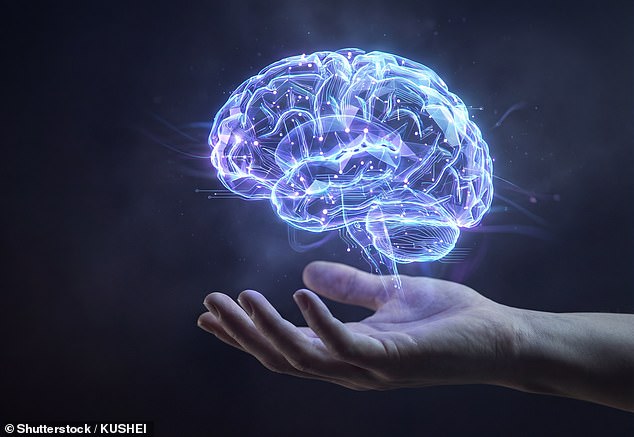
Our memories may be an illusion arising from random fluctuations in the universe, according to scientists (stock image)
To put it very simply, the idea behind the Boltzmann Brain hypothesis is that a random collection of particles can give rise to any possible structure given enough time.
Those possible structures include the exact current state of your brain at this very moment, including all your memories, beliefs, thoughts and desires.
Co-author Dr Carlo Rovelli, a theoretical physicist from the Santa Fe Institute, told the Daily Mail: ‘Imagine in the distant future the universe has evolved into a homogeneous hot soup where things randomly fluctuate.
‘Imagine that a fluctuation builds up, just by random chance, a brain like yours, with your present memories and your present perceptions, which nevertheless a moment later dissipates again in the soup.’
In the infinite time of the distant future, its is quite likely that such a brain will occur so the question is whether you currently are such a brain.
Intuitively, it seems that the odds of such a brain occurring are impossibly small compared to the chances of our brains and memories being real.
However, a bizarre consequence of the laws of physics means that it is almost infinitely more likely that you are, in fact, a Boltzmann Brain.
The problem is that this Boltzmann Brain hypothesis appears to come directly from something that almost all scientists agree is true.

A terrifying theory called the ‘Boltzmann Brain hypothesis’ suggests it is more likely that our brain popped into being from a random fluctuation in an otherwise empty universe than that our memories reflect reality (stock image)
The second law of thermodynamics states that the total disorder, or ‘entropy’, of a system always increases over time – like a room that’s always getting messier over time.
But, in order for our modern physics to work properly, this rule has to be ‘symmetrical’ with respect to time.
That means, at any particular moment, the world was likely more disordered both in the future and the past.
Lead author Professor David Wolpert, of the Santa Fe Institute, and his co–authors explain: ‘In other words, the most probable situation, given the current observations, is that we happen to be precisely at a special point in the dynamics of the universe’s entropy.
‘In other words, the most probable situation is that we are just an entropy fluctuation, which is to say that we are a BB [Boltzmann Brain].’
This has the strange implication that it is far more likely that our memories are false than genuine recollections of things that happened.
However, the scientists argue that we shouldn’t be worried about such a hypothesis.
Co-author Dr Jordan Scharnhorst told the Daily Mail: ‘Although we cannot prove that we are not Boltzmann Brains, we have no reason to believe that we are.’

Scientists say that the fact that our lives are an illusion, like in the sci–fi classic The Matrix, arises from the laws of physics
In this sense, Dr Scharnhorst says that the Bolzmann Brain hypothesis is ‘unscientific’, meaning that it can’t be proved or disproved with any amount of evidence.
‘At that point, it becomes like the simulation hypothesis – totally inconsequential speculation and not worth any anxiety,’ he adds.
In their paper, the researchers analyse the component parts of the Boltzmann Brain hypothesis with tools from the study of probability and randomness.
What these results show is that the only confidence we could have that we are not Boltzmann Brains comes from the confidence we have in the Big Bang theory.
Dr Rovelli says: ‘Dr Roveli says: ‘Generally we tend to assume that our memories are reliable: they are not random fluctuations in our brain. To ground this assumption, we have to assume something about the entropy in the past.
If the Universe has a definitive start point with a fixed level of disorder, we can orient ourselves in time and show that we aren’t just a random fluctuation in chaos.
Prior to the discovery of the Big Bang through the Cosmic Microwave Background in the 20th Century, the idea that our memories were false was just as certain as the second law of thermodynamics.
However, thanks to what we now know about the Big Bang, Dr Rovelli says ‘it is clear we are not Boltzmann brains.’
TRAINING YOUR BRAIN TO BANISH BAD MEMORIES
A 2020 study led by researchers from Dartmouth and Princeton has shown that people can intentionally forget past experiences by changing how they think about the context of those memories.
The researchers showed participants images of outdoor scenes, such as forests, mountains and beaches, as they studied two lists of random words.
The volunteers deliberately manipulated whether the participants were told to forget or remember the first list prior to studying the second list.
Right after they were told to forget, the scans showed they ‘flushed out’ the scene-related activity from their brains.
But when the participants were told to remember the studied list rather than forget it, this flushing out of scene-related thoughts didn’t occur.
The amount people flushed out scene-related thoughts predicted how many of the studied words they would later remember, which shows the process is effective at facilitating forgetting.
To forget those negative thoughts coming back to haunt you, researchers suggest trying to push out the context of the memory.
For example, if you associate a song with a break-up, listen to the song in a new environment.
Try listening to it as you exercise at the gym, or add to a playlist you listen to before a night out.
This way, your brain will associate with a positive feeling.
If a memory of a scene from a horror film haunts you, watch the same scene during the daytime.
Or watch it without sound but play a comedy clip over the top.