
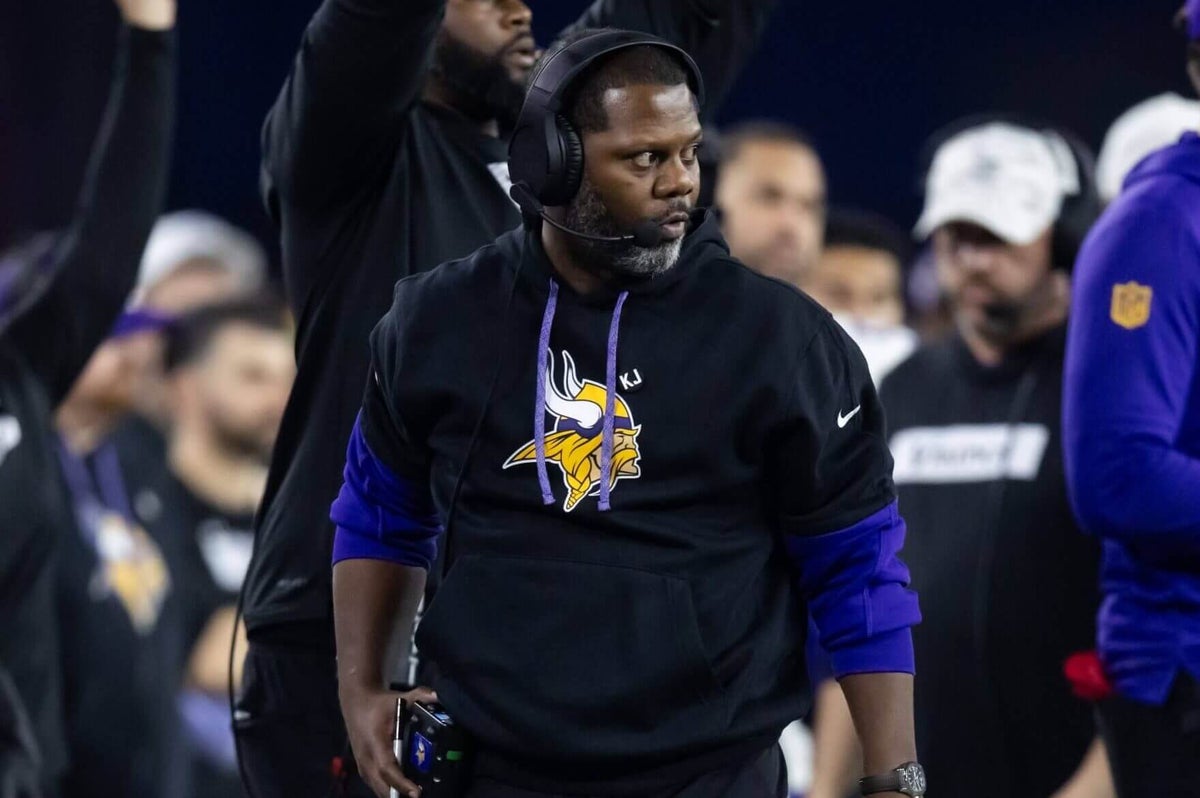
The Washington Commanders are finalizing a deal to make Daronte Jones, the Minnesota Vikings’ defensive backs coach and pass game coordinator, their new defensive coordinator, a league source with knowledge of the move confirmed.
A Maryland native who played at Bishop McNamara High (in the Washington suburbs) and at Morgan State University, Jones will be a first-time NFL play caller as he attempts to transform a Washington defense that has been a liability for much of the last two seasons. He takes over for Joe Whitt Jr., who was fired after two seasons of leading the Commanders’ defense, and inherits a group with numerous roster holes. Washington has more than 30 free agents across the roster and many positions that need upgrades in talent.
Jones, 47, began coaching as a graduate assistant at Lenoir-Rhyne University in 2001 and has spent the majority of his 25-year career working with defensive backs, rising from the high school and college ranks, where he spent his first 15 years of coaching. He broke into the NFL with the Miami Dolphins in 2016 as an assistant defensive backs coach on Adam Gase’s staff.
After two seasons in Miami, he went on to coach the Cincinnati Bengals’ defensive backs (in 2018 and 2019) and then spent a year coaching the Vikings’ secondary before jumping to LSU as its defensive coordinator. He returned to Minnesota in 2022 and has coached the defensive backs since, while taking on the added title of pass game coordinator for the last three seasons.
As Brian Flores’ No. 2 on defense, Jones helped coach a Vikings unit that ranked among the league’s top three in both total yards and passing yards allowed, as well as opponent red-zone efficiency, last season. Minnesota also gave up an average of only 19.6 points per game and allowed the fewest plays of 20 yards or more, at 38.
The Vikings’ secondary also played a significant role in their 14-3 run in 2024, when they led the league with 24 interceptions (at least one in every game) and 95 passes defended, and had the fourth-best total defensive EPA per game (5.76). Minnesota’s defensive backs accounted for 18 interceptions.
Jones was one of nine candidates to interview for the Commanders’ job, along with Vikings defensive coordinator Flores, Chiefs defensive line coach Joe Cullen, new Packers defensive coordinator and former Cardinals head coach Jonathan Gannon, Raiders defensive coordinator Patrick Graham, Bears defensive backs coach and pass game coordinator Al Harris, Seahawks DBs coach Karl Scott, new Giants defensive coordinator Dennard Wilson and Steelers defensive coordinator Teryl Austin.
Jones spoke to the Commanders on Sunday as part of the team’s final wave of interviews. By then, Flores had already agreed to stay in Minnesota if he couldn’t land a head coaching job, and Gannon had agreed to join the Packers.
Jones has worked with All-Pros, including safety Harrison Smith and cornerback Patrick Peterson, while also developing younger talent, such as corner Byron Murphy, a 2024 Pro Bowl selection. He’s also worked with several other top play callers and coordinators from varying systems, including Broncos defensive coordinator Vance Joseph, Colts defensive coordinator Lou Anarumo and former Vikings coach Mike Zimmer.
Producing turnovers, limiting explosive plays and developing talent have been priorities for Commanders coach Dan Quinn since he arrived in 2024. He appointed Whitt as his defensive coordinator and play caller that season after the two helped Dallas lead the league in takeaways in consecutive seasons.
But Washington’s defense failed to develop over the last two years. Worse: The group regressed last season, finishing with a league-high 384 yards allowed per game and the league’s second-fewest number of takeaways, at 10. Washington’s minus-13 turnover margin, the metric Quinn stresses the most as a gauge of team efficiency, ranked 31st in the NFL.
“The things that I’m not pleased with are our turnover margin and not creating enough takeaways, not doing a good enough job with the ball,” Quinn said earlier this month in his end-of-season news conference. “Those are the things that come to mind first. We want to play bold. We want to play aggressively. But that … would be one that comes to mind first.”
In Week 11, during the team’s trip to Madrid, Quinn took over play calling from Whitt and finished out the season as the Commanders’ de facto defensive coordinator, a role he intentionally tried to avoid when he became head coach. He wanted his focus to be on the full team and not simply one group.
The change seemed to improve Washington’s defense initially, but it wasn’t long before the same struggles resurfaced: missed tackles, explosive plays allowed, poor communications and blown coverages.
That the Commanders would move on from Whitt at season’s end was hardly a surprise. That they’d also move on from offensive coordinator Kliff Kingsbury was notable — and risky.
Quinn appointed David Blough, the team’s assistant quarterbacks coach the last two seasons, to be its offensive coordinator and play caller, a massive jump for someone with only two years of coaching, neither of which was as the leader of a positional group or as a play caller.
But Quinn has long thought highly of Blough, and if the team could pair him with a strong defensive coordinator who could reshape the defense, the Commanders could provide him with a safety net. Or so the thinking went.
That job is now up to Jones, who faces a risk of his own; should the Commanders’ season go poorly, Washington may ponder a full staff change after this year to try to reverse course.
The hope instead, of course, is that Jones can remake the Commanders’ defense into the “aggressive” and “bold” unit Quinn envisioned.