

MELBOURNE, Australia — Aryna Sabalenka, the world No. 1, has urged the Grand Slams to reverse a ban on wearable technology after a series of controversies at the Australian Open.
Sabalenka, along with the top men’s player, Carlos Alcaraz, has been forbidden from wearing a band produced by American company Whoop. The band tracks metrics such as heart rate variability, sleep stages, skin temperature and blood oxygenation; World No. 2 and two-time defending champion Jannik Sinner was also asked to remove his ahead of his straight-sets, fourth-round win against Luciano Darderi on Monday.
The devices are allowed at WTA and ATP level, and the Whoop device worn by Sabalenka and Alcaraz was permitted by the International Tennis Federation, the organization whose rulebook the majors follow, according to a report filed Dec. 19, but the four tournaments do not individually permit them.
A Tennis Australia spokesperson confirmed via email that “wearables are currently not permitted at Grand Slams,” and said “the Australian Open is involved in ongoing discussions on how this situation could change.” An ITF spokesperson referred to Tennis Australia’s statement when approached for comment.
A representative from the French Tennis Federation, which players are hoping will be open to reversing the ban before the French Open begins in May, did not immediately respond to a request for comment.
A representative from Whoop, which counts Cristiano Ronaldo, LeBron James and Rory McIlroy among its users, said via email: “Whoop believes athletes have a fundamental right to understand their own performance and health — including during competition at events like the Australian Open.
“Whoop is approved by the International Tennis Federation for in-match wear and poses no safety, fairness, or competitive risk. Blocking access to personal health data does not protect sport,” the representative said.
“The reason why I was wearing that on court (is) because we received the email that we got approval from the ITF to wear this device,” Sabalenka, who is an ambassador for Whoop, said in a news conference Tuesday after beating Iva Jović to reach the semifinals. “I didn’t know that Grand Slams didn’t come to (this) conclusion.
“All the tournaments I play, we wear Whoop. It’s just for tracking my health. I don’t understand why Grand Slams are not allowing us to wear it, and I really hope that they will reconsider the decision and let their players track their health.”
Sinner said he was fine with the ban but added in a news conference Monday that: “There is certain data that we would like to track a little bit on court. It’s not for the live thing. It’s more about what you can see after the match. These are data that we would like to use also in practice sessions.”
The majors’ stance has also been criticized by former players. “We’ve got coaching; why can’t you have your own data?” 16-time Grand Slam men’s doubles champion Todd Woodbridge asked on Australian broadcaster Channel 9.
“I don’t understand those rules. So this provides blood readings, pulse rates. This (tracks) your rest, your heart rate, how your body is, sleeping patterns, how much working recovery, all of that type of stuff.
“So why isn’t a player allowed to have their own data and know how they’re feeling? It doesn’t make sense. Sometimes our rules in tennis, one rule is over here, and then the other one says ‘no’. Can we get our rules the same, please?”
The Professional Tennis Players’ Association medical director, Dr. Robby Sikka, who is also a team physician for the New York Yankees, drew an unfavourable comparison with other sports.
“Other major sports leagues have already built thoughtful, evidence-based frameworks for wearable technology,” he wrote via text message.
“The NFL allows approved wearables and RFID tracking, the NBA operates a formal wearables committee with full player access to their data, MLB rigorously vets devices, and global soccer leagues have multiple approved systems in place. Tennis should meet that same standard.”
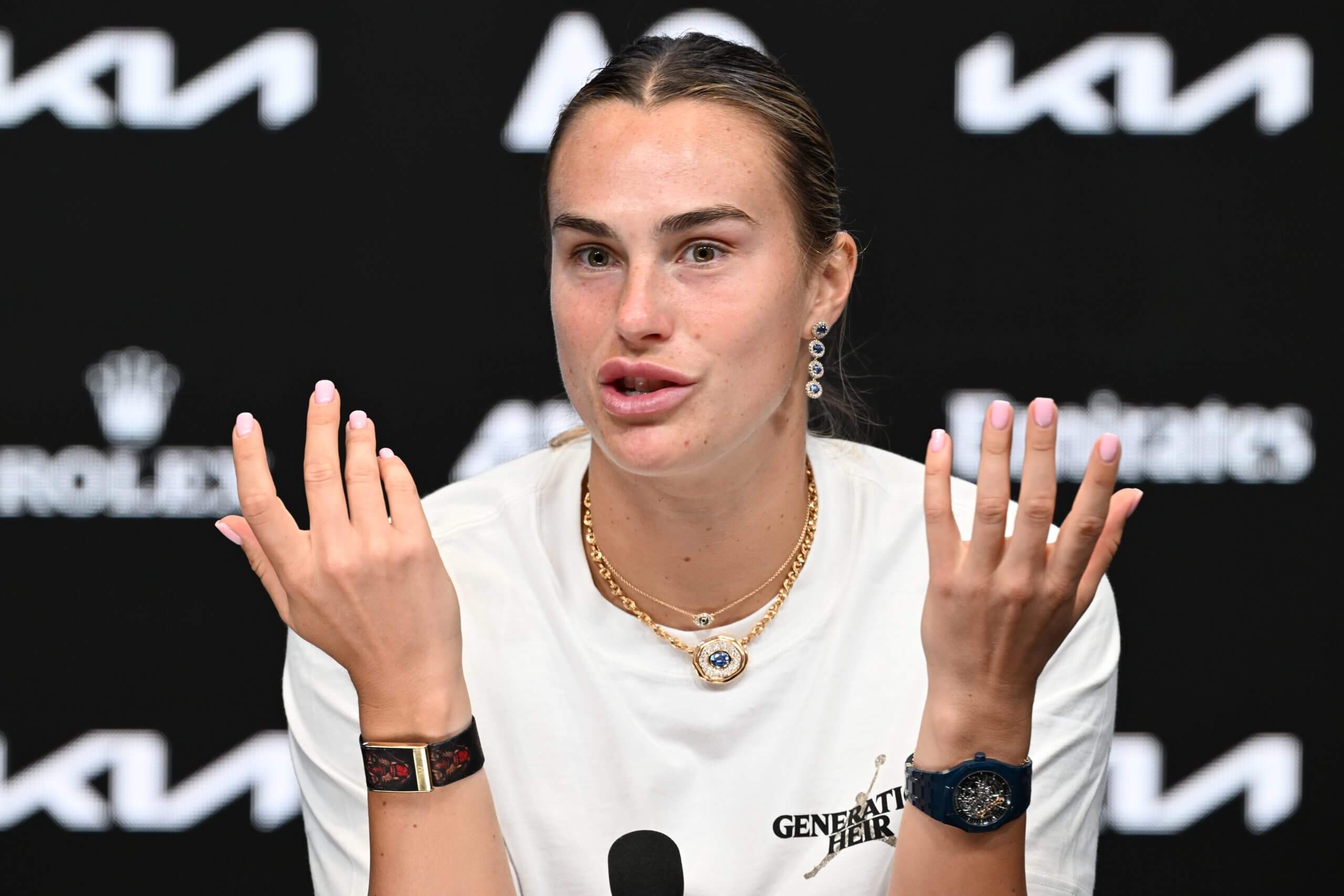
World No. 1 Aryna Sabalenka wears a Whoop wearable on her right hand during a news conference. (James D. Morgan / Getty Images)
When the ATP Tour announced the approval of in-match wearable devices in 2024 (three years after the WTA), then-chief sporting officer Ross Hutchins said the technology was a “big step forward in our push to optimise player performance and prevent injury.”
Part of the reason the ban has provoked such consternation is the wider dissatisfaction some players have with not having access to their own data and information. Players such as Daria Kasatkina have expressed frustration previously at being extremely limited in what footage can be broadcast of themselves because of copyright limitations attached to the Grand Slams’ media rights deals.
For now, top players will have to make do without the bands at the majors.