
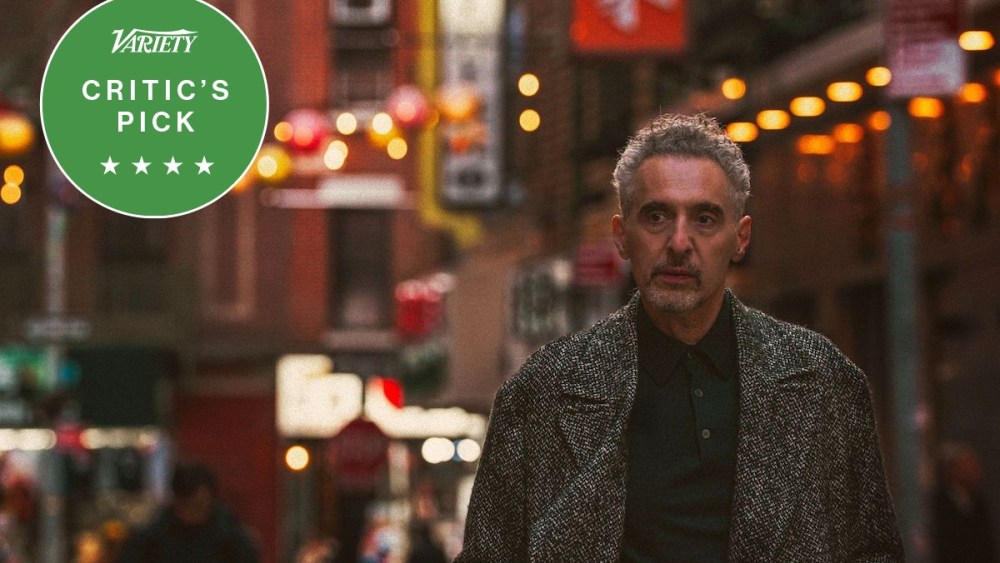
A melancholic affection for New York City permeates writer-director Noah Segan’s nostalgia-powered “The Only Living Pickpocket in New York,” a minor-key character study that quietly mourns a bygone era, when life was analog, and so were its criminals. Bookended by two pitch-perfect needle drops that signify every New Yorker’s complex emotions about their city (LCD Soundsystem’s “New York, I Love You but You’re Bringing Me Down” and the Bobby Short version of “I Happen to Like New York”), longtime actor Segan’s sophomore feature feels like a warm embrace in defiance of an increasingly cold world that has lost its manners, along with the tactile elements worth holding onto.
Often accompanied by a groovy, ’70s-style score of the Lalo Schifrin jazz-funk variety, the 60-something Bronx man Harry is certainly trying his darndest to maintain some semblance of that past. Played by John Turturro in a mesmerizingly tender performance, Harry lovingly cares for his disabled, nonverbal wife Rosie (Karina Arroyave) and wrestles his way through the stuffed subway cars of the Big Apple in search of cash and valuables to lift as a pickpocket with old-school skills, while being increasingly confronted by harsh contemporary realities where an average person no longer carries cash or wears heirloom timepieces.
The most Harry can swipe these days is a slim wallet here or an iPhone there — a traceable nuisance that isn’t all that lucrative to sell to his longtime partner-in-crime and good friend Ben (Steve Buscemi, in his wonderfully acerbic mode), a pawn shop owner as perplexed by the techy gluten-free kids of today as his pal. He makes an exception for his savvy daughter Eve (Victoria Moroles), one of the good ones, who helps out her dad and treats Harry like family.
In an ingenious prologue, “Pickpocket” starts with the daily grind of New York, following a white-collar man through his morning routine and workday, until he can’t locate his wallet to pay for a business meal. That’s because he’s just been one of the countless New Yorkers who had the misfortune of standing right next to Harry in a subway car earlier, an instance we only briefly witness with Harry being just another face amid the rush hour.
Except, it’s hard not to notice Harry if we’re being honest, not when he’s wrapped in an instantly iconic cashmere overcoat that matches his salt-and-pepper hair and feels as essential and character-based a choice of outerwear as Alain Delon’s “Le Samouraï” trench. The coat looks expensive (and is expensive, having been made by Ermenegildo Zegna as eagle-eyed viewers will notice), but far from unrealistic an item for the otherwise modest Harry, who doesn’t even have a mobile device to own.
That’s because Harry believes in things that last — as such, the coat invites us to imagine that he’s owned and cared for it for some time. Plus, investing in good clothes isn’t a bad idea for a street thief like Harry, who should want to evade suspicion. He hasn’t always been successful at dodging trouble — that much we pick up from his close relationship with Detective Allan Warren (Giancarlo Esposito, in a gently pensive register).
Soon enough, Harry messes with the wrong sort, stealing from a wealthy and well-connected Gen-Z kid from a shady crime family — not that he realizes it at the time. He is the flashy Dylan (an impressive Will Price), comically dressed in an overpriced and oversized tracksuit, versus Harry’s old-world elegance. It doesn’t take long for him to figure out Harry’s whereabouts, once Harry and Ben naively plug in the USB card Harry finds in Dylan’s wallet. (Harry is so clueless about these technological advancements that he can’t even spell USB properly, the kind of comedic flourish Segan’s script leans into.) Once cornered, Harry has no choice but to retrieve the card — he might not be able to save his own life, but he can save his wife’s.
Harry’s trek across all five boroughs of New York City gives us a unique taste of the sprawling town that’s been a playground for many legendary films and filmmakers. In that, the New York of “Pickpocket” isn’t the picturesque Central Park, charming brownstone blocks or imposing highrises. Not unlike Sean Baker’s “Anora,” this film navigates and caresses the overlooked corners of arguably the most popular movie town in cinema history, while lamenting an old way of being in urban spaces.
That means asking for directions instead of using GPS, relying on the generosity of strangers and looking up and around instead of touchscreen scrolling. Along the way, Harry’s race against the clock gradually shifts into a journey of reconciliation, even self-discovery, especially when he takes a detour to visit his estranged daughter Kelly (a scene-stealing Tatiana Maslany) in Queens. The scene plays like a thoughtful aside, giving us just enough (but not too much) backstory, like the rest of the well-calibrated script that leaves some room for audience imagination.
There are some frisky reveals throughout the last act of “Pickpocket,” bouncily assembled by editor Hilda Rasula, as well as a quietly playful cameo by an A-lister as the formidable matriarch of Dylan’s family. But across all of its humor-filled touches, “Pickpocket” mostly preserves its bittersweet, gloomy tone across its economic runtime, a temperament matched by Sam Levy’s beautifully elegiac cinematography. It’s the kind of unapologetically local love letter to the Big Apple and its less-illustrious denizens that New York deserves.