
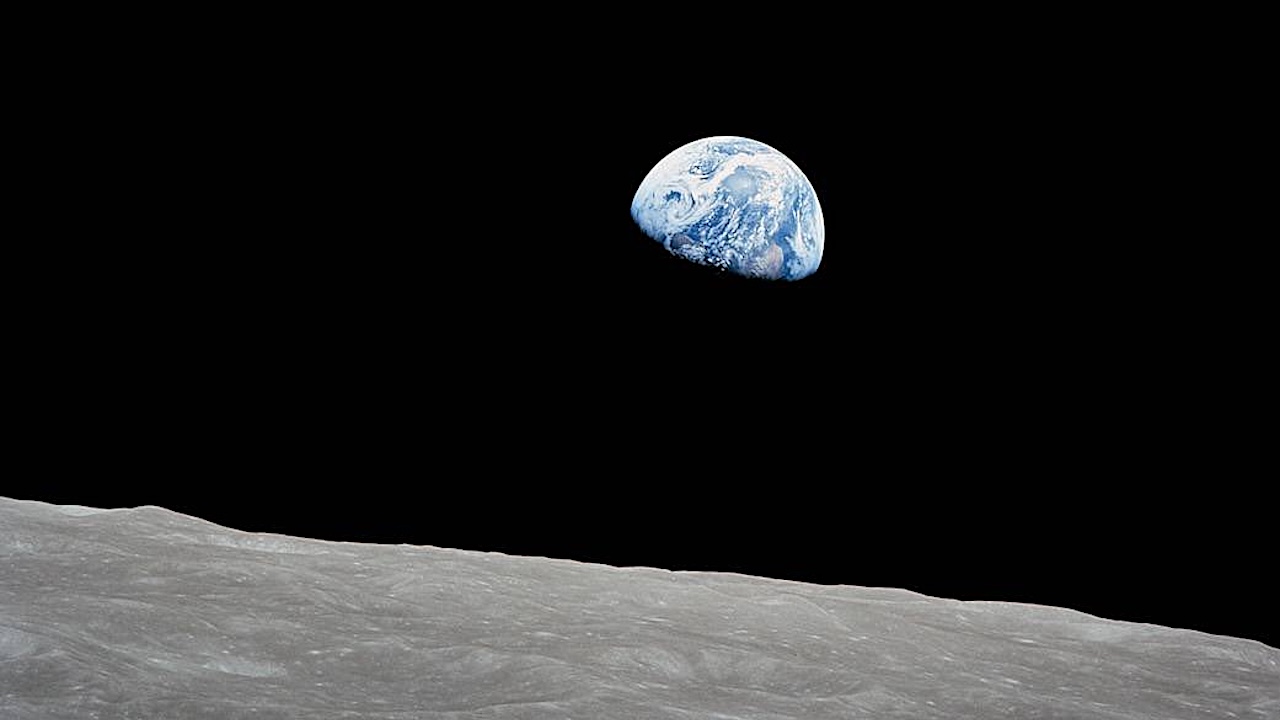
Earth as seen during Apollo 8 in 1968 — NASA
Keith’s note: this short essay, “A Plea to NASA Administrator Jared Isaacman, from Planet Earth”, was posted on LinkedIn byJon Mikel Walton, Former Earth Public Engagement Lead, at NASA JPL: “Jared, I used to manage NASA’s Global Climate Change website. As we stand on the edge of humanity’s return to the Moon, I’m asking you to restore NASA’s full leadership on Earth science-and its right to speak plainly about the state of our planet. Nearly sixty years ago, Apollo 8 captured Earthrise: a thin crescent of home suspended in darkness. That single image helped ignite the modern environmental movement, and helped make possible missions like Landsat, which still provides the world’s longest continuous space-based record of Earth’s land surface. (more below)
Today, NASA’s Earth Science fleet is one of America’s most valuable strategic assets: a planetary-scale measurement system tracking Earth’s vital signs across heat, water, ice, ecosystems, and atmospheric gases. This global coverage and continuity is an achievement no private or academic effort can sustain on its own.
It translates observation into public value, like better storm and flood forecasting, stronger disaster readiness, safer water and food planning, and clearer visibility into climate risk. This critical public infrastructure saves lives, protects the economy, and keeps the United States ahead.
And yet over the past year, budget uncertainty and political pressure have weakened one of the country’s most trusted sources of Earth intelligence. Teams were cut, expertise was lost, and NASA’s ability to communicate clearly about climate and environmental risk was silenced-exactly when those risks are accelerating.
Congress has reaffirmed NASA’s science mission by restoring its funding. The question now is whether the agency will lead where it matters most: helping the nation-and the world-understand what’s happening to Earth in real time. NASA is uniquely positioned to provide this shared reality: what’s changing, why it’s changing, and what it means for lives, livelihoods, and national resilience.
You are one of the few hundred humans who have seen our planet from space. Astronauts often describe the Overview Effect: awe at Earth’s beauty, clarity about its fragility, and instant understanding that one thin atmosphere protects everything we love. Space agencies have a profound responsibility to steward this perspective and share it back with the world.
The scientists and engineers at JPL, Goddard, and across NASA are still doing extraordinary work under impossible conditions. They have the data. They have the expertise. What they need is institutional backing-and the permission-to tell the truth, plainly and consistently.
So here is the mandate: rebuild NASA’s Earth science leadership, safeguard its workforce, and restore its public voice on Earth.
Fund the fleet. Protect the teams. Tell the truth.
It’s time to lead.
Jon Mikel Walton
Former Earth Public Engagement Lead, NASA Jet Propulsion Laboratory