
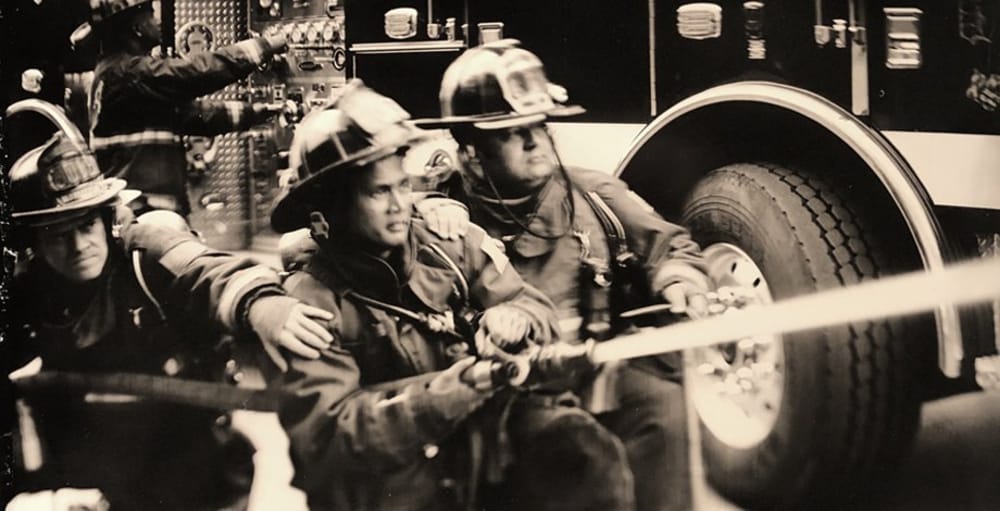
A photography style associated primarily with the Civil War is receiving a contemporary update from Arlington’s Mac Cosgrove-Davies.
For “Essential Arlington” — now on display at the Museum of Contemporary Art Arlington — Cosgrove-Davies uses the wet-plate collodion technique to create tintype images of those workers whose efforts keep the community running smoothly.
Subjects range from road-construction crews and a supermarket-checkout employee to a barber and funeral-home director.
“These are folks doing essential services for us that we take for granted if we even think of them at all,” said Cosgrove-Davies, who retired after a quarter-century working on rural-energy issues for the World Bank.
“They are important people, doing important stuff,” he said during an ARLnow interview.
The technique he used for the images on display was a dominant, in some case the dominant, photographic technology of the mid-19th century.
If you are viewing a Civil War photograph, “you almost certainly are looking at an image made by wet-plate collodion,” Cosgrove-Davies said.
It was the first process that took photography out of the studio and “out into the country,” he said.
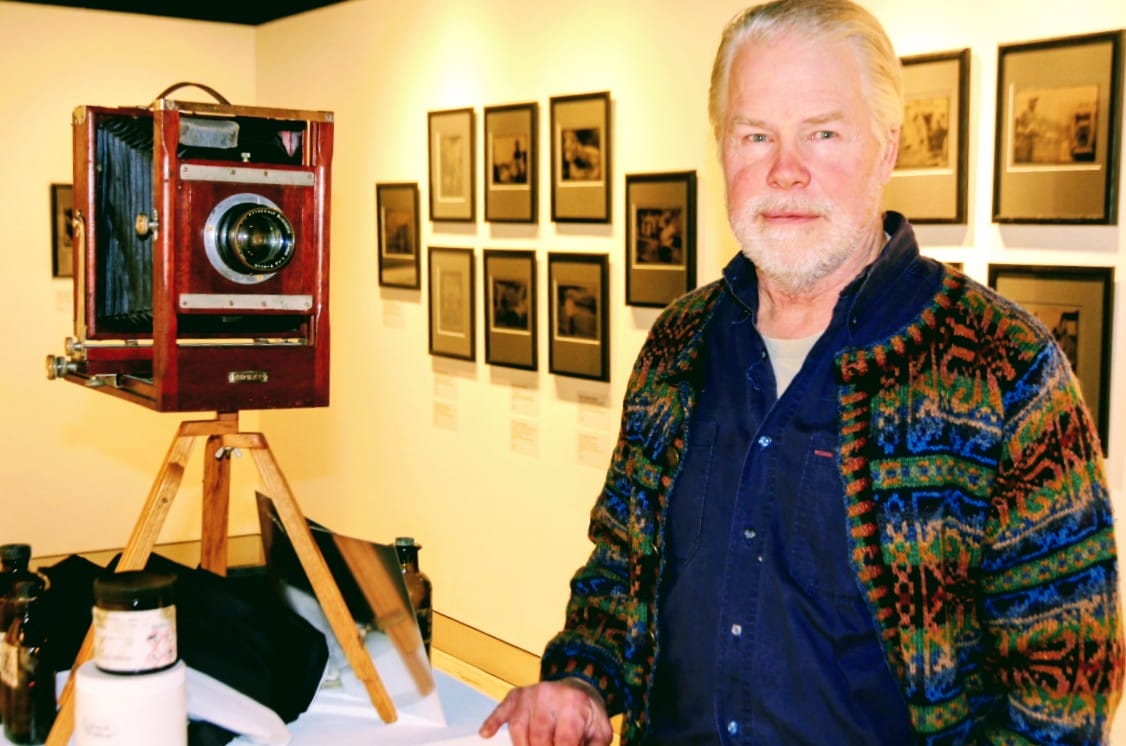 Photographer Mac Cosgrove-Davies with one of his classic cameras (staff photo by Scott McCaffrey)
The resulting tintypes on display in “Essential Arlington” are, in effect, underexposed negatives. The sepia-toned images are comprised of grains of silver, with the final product varnished to preserve its longevity.
“Tintype” is the name commonly used for the end result but is a bit of a misnomer, Cosgrove-Davies said. Instead, images are developed on photographic plates made of sheet aluminum, the kind used to make trophies.
The exhibition delivers on a number of levels, said Catherine Anchin, executive director of the Museum of Contemporary Art Arlington.
“Mac’s historic lens gives an engaging look at Arlington today, while also helping visitors see how photography has evolved since the 19th century,” she said.
Among those photographed in 2024-25 and included in the exhibition:
Tony Watts, Geoffrey Knollys and other members of a Dominion Energy power-pole replacement team
Daniel Mariam, an Arlington Public Schools’ substitute teacher
The cafeteria staff at Arlington Career Center
Deputy Sheriff Angelica Zelaya
Road flagger Jerry Wright
Police Officer Julia Hammer
Arlington police crossing guard Richard Starr
El Phounsavath, an auto mechanic for the Department of Environmental Services
Fatima Mohameden, a pharmacist at Preston’s Pharmacy
Mary Rochette, a cashier at Giant Food
Shawn Baker, funeral director at Chinn-Baker Funeral Home
Ronald Marshall, proprietor of Star Barber Shop
To create the images, Cosgrove-Davies sets up his 8-inch-by-10-inch cameras — one more than 80 years old, the other even older — on tripods, puts a dark cloth over his head and composes the shot.
“It is just me and the image,” he said.
Portraits can be shot indoors or outdoors, although doing it outside in an overcast environment typically produces the best results. Too much lighting, as on a sunny day, or too little, as in a dark room, is less ideal.
The timing of photographic exposures can range from a few seconds to as many as 20. “It’s not easy to do,” Cosgrove-Davies said of subjects needing to stand still for the duration. Often, they will be posed against something so they can brace and remain motionless for the length of time needed.
“I develop, I hope, some rapport with the subjects,” he said. “It is a very deliberate process, one that requires the subject to be part of that process.”
The final steps are completed on location; Cosgrove-Davies has a mobile darkroom in the back of his car.
“I love working with my hands,” he said of the process, which he learned while taking a class in 2022 at the Maine Media Workshops.
The exhibition and those it features has brought positive responses, Anchin said.
“We’re so pleased to show Mac’s work in our Jenkins Community Gallery and to hear visitors’ reactions when they recognize familiar faces from around Arlington,” she said.
The current exhibition is a follow-up to Cosgrove-Davies’ 2022 effort chronicling volunteerism in Arlington during Covid.
A self-taught photographer, Cosgrove-Davies has been working with classic techniques since the late 1970s. His repertoire has included works using processes including gum bichromate, cyanotype, VanDyke, palladium, oil printing and carbon printing.
He also is an instructor at Glen Echo Photoworks in Maryland.
While he enjoys working with photographic techniques of the past, Cosgrove-Davies said he’s not antagonistic toward modern technology.
“I take pictures of my grandkids with cellphones,” he said.
As for the photos taken for the exhibitions, they are being donated to the Charlie Clark Center for Local History so they can be kept together as a set.
Next up for Cosgrove-Davies? He is working on a project called “The Turbulence,” using classic photographic techniques to chronicle recent protests in Arlington and around the region.
“Essential Arlington” continues through March 1. Works by Cosgrove-Davies also are part of a group show — “Time Less” — running through Jan. 31 at River Road Unitarian Universalist Congregation in Bethesda.