
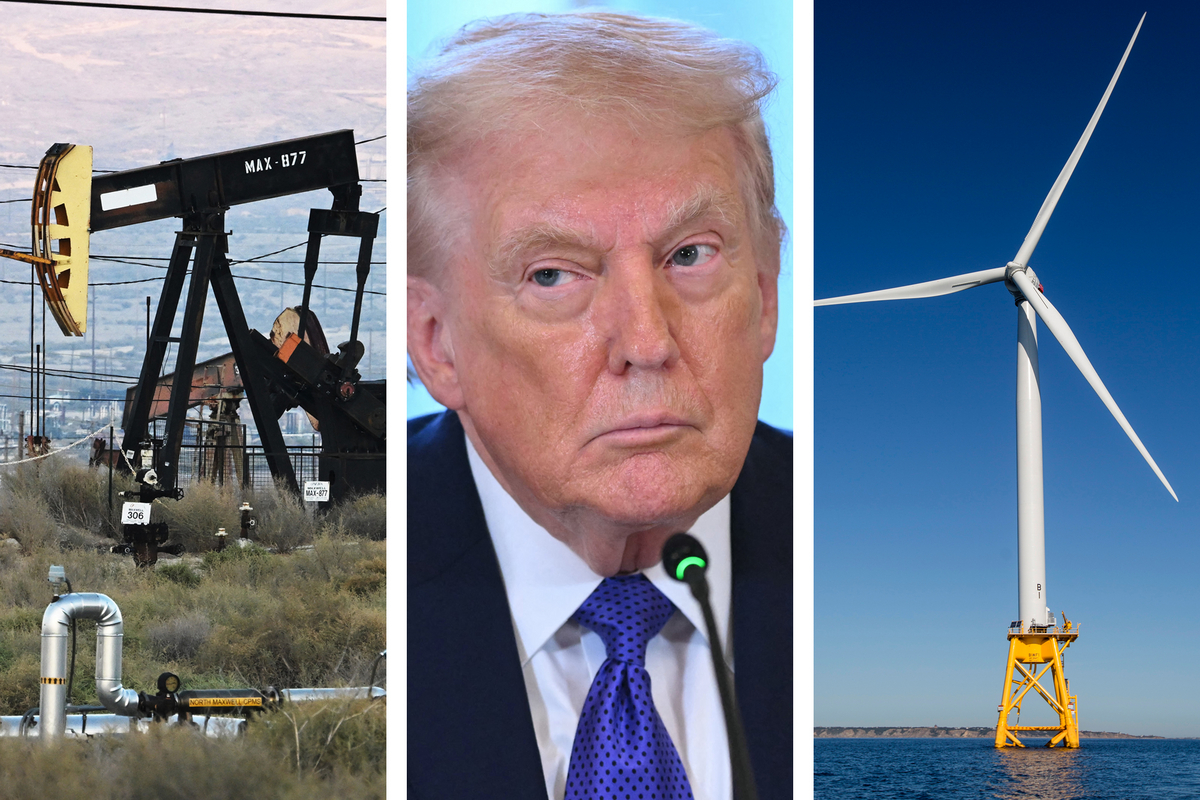
Some environmentalists would like to see Democrats act more like President Donald Trump, even though they despise his policies.
With headlong assaults on offshore wind and other renewable energy projects, the president has opened a door to more aggressive action by a future Democratic president on climate and energy.
“Trump kicked down the door and removed the frame,” said Mitch Jones, deputy director of the environmental group Food & Water Action. Now, he said, “there is now so much more room for an executive with the right policies.”
A future Democratic administration adopting the Trump-pioneered tactics to use against oil and gas presents a risk for oil and gas companies, according to experts, some environmentalists and even some in the industry. Most industry leaders, though, aren’t talking about such prospects and aren’t publicly worried.
But, veteran Oklahoma oilman Mike Cantrell said, “They should be.”
A potential Democratic president such as California Gov. Gavin Newsom, Cantrell said, “would use the executive power much like Trump uses it on the right.”
Representatives for Newsom did not provide comment Tuesday.
The idea of trouble for fossil fuels was also expressed last year in an anonymous survey of oil and gas executives from the Federal Reserve Bank of Dallas.
“Life is long,” said one unnamed executive, “and the sword being wielded against the renewables industry right now will likely boomerang back in 3.5 years against traditional energy.”
The industry will face “harsher methane penalties, permitting restrictions, crazy environmental reviews and other lawfare tactics,” the executive predicted.
Trump has long complained about renewable energy infrastructure, even making an unfounded claim at one point that wind turbines cause cancer. And he laid out his plans to stop the U.S. from participating in a transition to renewable energy as soon as he returned to office last year.
But he’s strayed into territory where other presidents fear to tread by canceling wind energy projects that already had permits and clawing back money for solar projects that had already gone out the door. Many of the moves were legally dubious and judges have rejected them, but they’ve still left the industry badly damaged as investors flee.
Still, bad news for renewables isn’t necessarily good news for oil production.
Imagine what could happen in future years to an offshore oil drilling project approved late in a Republican administration, said Severin Borenstein, director of the Energy Institute at the University of California, Berkeley.
“There’s going to be real hesitancy,” Borenstein said, “if the next president can just say, yeah, you sunk billions of dollars, but we don’t really care — we’re canceling that.”
Trump’s no-holds-barred strikes on wind and solar are fundamentally different from the way previous Republican administrations have used their power to advance the interests of fossil fuels, said Erik Schlenker-Goodrich, executive director of the Western Environmental Law Center.
“It was at least within the bounds of normal policy discourse,” he said. “It didn’t feel like they were just completely ignoring a century of norms and legal frameworks that had been built up over time, which is what this administration has been doing.”
For example, Schlenker-Goodrich said, the temporary moratorium Biden placed on new leasing of public lands for oil and gas still allowed new drilling by companies that had existing leases and permits. What’s different, he said, is that Trump is blocking development for companies that have active leases and permits.
But the White House and some fossil fuel industry leaders say Trump’s attempts to shut down wind and solar projects reflect how the pendulum swings in Washington when a new administration takes over.
“It was the Democrat Party that frivolously launched an ideological crusade on the coal, oil, and gas industries to advance their radical Green New Scam,” White House spokesperson Taylor Rogers said in an emailed statement, misnaming the Democratic Party in a manner many members find annoying or offensive.
‘Shock to the system’
The head of the American Petroleum Institute, the oil and gas industry’s main trade group, offered a similar — if less combative — explanation earlier this month.
“Barack Obama had a war on coal. Joe Biden had a war on oil and gas. This is not the first administration that has halted energy projects,” API CEO Mike Sommers said in his “State of American Energy” speech.
Thomas Pyle, president of the Institute for Energy Research, described the current situation as a comeuppance for wind and solar. His nonprofit is closely aligned with the fossil fuel industry,
“I don’t think this is ‘Boy, he’s showing us all these great tools that we can use to go after oil and gas,’” Pyle said. “I think that it’s a shock to the system for renewables because they have had the gravy train for so long.”
Oil and gas and other fossil fuels also receive subsidies, although advocates for the various sources differ on how much. A U.S. Energy Information Administration report from 2023 found that renewables got about 46 percent of federal energy subsidies while fossil fuels and nuclear got about 15 percent combined from 2016 to 2022.
In Oklahoma, Cantrell said Trump’s moves highlight the political peril the oil industry faces in having friends in only one party on Capitol Hill. Cantrell, a board member of the National Stripper Well Association, said he’s been encouraging oil leaders to cultivate relationships with Democratic elected officials. One way to start, he said, is to avoid attacks on wind and solar.
“As small-business producers, we have to take a position that America needs all of America’s energy,” Cantrell said in an interview. “We don’t denigrate wind and solar and other forms of energy.”
Trump set a “bad precedent” with his unconstrained strikes on wind and solar, said Frank Maisano, a senior principal at Bracewell who represents clients in the oil and gas industry as well as renewables.
But he said Biden set his own anti-energy precedent with his temporary halt on approvals for new natural gas export terminals, although it didn’t directly lead to the cancellation of any projects.
What it really shows, Maisano said, is that Congress needs to step in and overhaul the way that the federal government approves and permits energy projects of all types.
“It’s a hard example, a hard political example, of why you need to have Congress step in with a permit reform approach that addresses this issue,” Maisano said.
API’s Sommers made a similar point in his speech, likening a permitting overhaul to a truce in the partisan energy wars.
On Capitol Hill, Democrats and Republicans have been trying for several years to package their differing complaints about permitting into legislation that can draw bipartisan support. But Trump’s unbridled strikes on wind and solar prompted Democrats to put the effort on ice for now.
The idea that a future Democratic president should take cues from Trump builds from the view that Biden and many Democrats before him have been too timid on the environment and many other issues, paralyzed by fear of criticism.
Others have defended Biden’s strategy, pointing to legislative accomplishments like the “Inflation Reduction Act,” which contained myriad climate provisions. Some of Biden’s supporters say that such criticism left many voters unaware of what Biden did accomplish in his single term.
But many environmentalists still think Biden had more power to act, and “just refused to use it,” Jones said.
“Obviously, Trump isn’t afraid to use it,” he added.
Schlenker-Goodrich said Democrats shouldn’t copy Trump, and he doesn’t think they will. He described a fundamental difference, saying Democrats are “more institutionalist in nature.”
But that doesn’t mean they can’t take a more muscular, bold approach while continuing to work with the confines of norms and laws, he said.
“I think it’s a danger to say that Democrats should somehow emulate what Trump has done as some kind of model for boldness,” he said.