
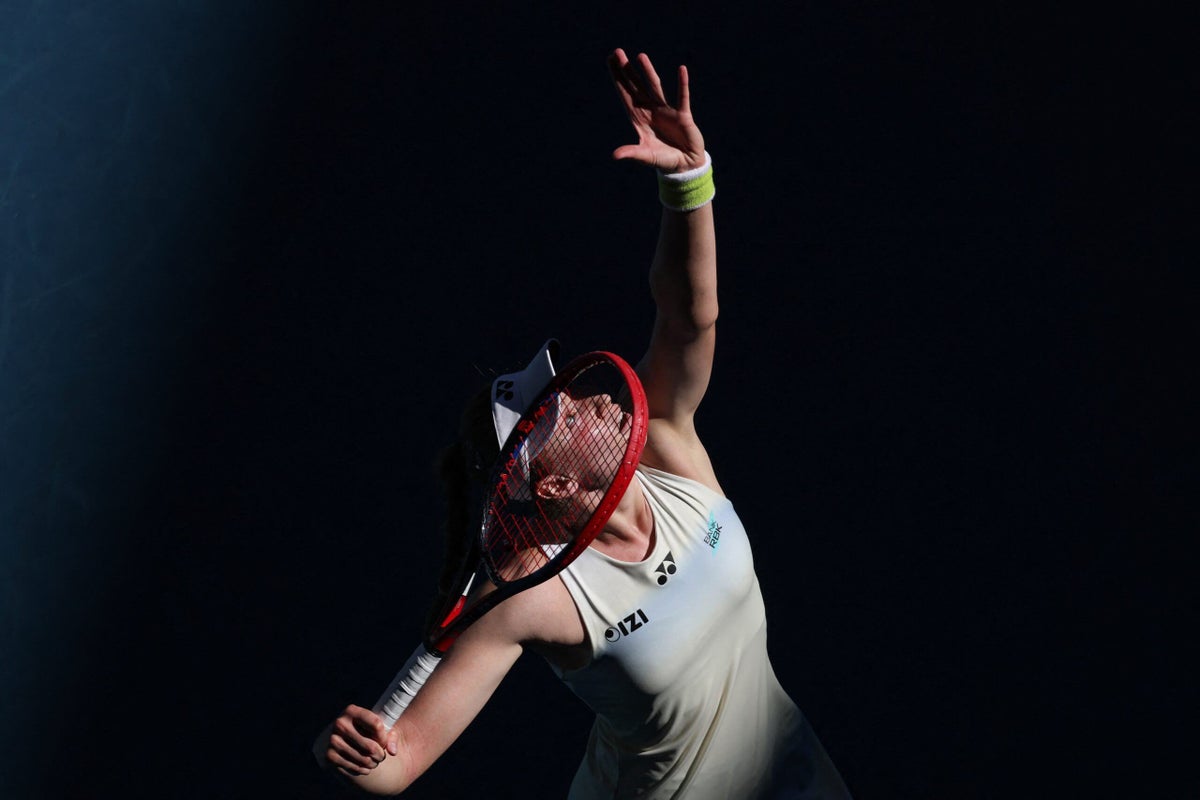
MELBOURNE, Australia — After all the attention on Iga Świątek’s bid to remake her balance between baseline patience and going for too much when under stress, her Australian Open elimination actually came down to something far more simple: the serve.
Up against one of the game’s best servers, the 2022 Wimbledon champion Elena Rybakina, Świątek’s lack of a release valve in tight moments and access to free points in more neutral ones led to a 7-5, 6-1 quarterfinal defeat. Rybakina, seeded No. 5 and a finalist here three years ago, carved her path to victory with a devastating serving display.
Świątek was always facing an uphill battle because of how much more she was having to do to hold serve, essentially playing every game if not on return, then with a huge reduction in advantage from the start of points. Rybakina’s serve, by contrast, released pressure almost every time that she faced it.
Rybakina won 93 percent of her first-serve points in the first set, but only made 41 percent of her first-serve attempts. That meant she was largely in charge of her service games even when hitting more second serves than first ones. When down 0-40 in the third game of the match after an exchange of breaks, Rybakina was able to serve her way out of trouble, helped by a first of 11 aces. She went down 0-15 five times, compared to just twice for Świątek, but held serve on all five occasions where Świątek was broken once out of her two 0-15 games.
Compared to Rybakina’s serving dominance, Świątek won just 64 percent of her first-serve points in the opening set, off a first-serve percentage of 54. After having to work so much harder to win points on her serve, the pressure eventually told in the 12th game. Serving down 6-5, Świątek went up 30-0 but got dragged back to 30-30. After missing a forehand wide, she saved a set point, but Rybakina picked up the second from a game in which Świątek had to hit six second serves from eight points played.
Freed up by winning the opener, the second set was even more of a serving clinic from Rybakina. Down 15-30 when up 2-0, Rybakina responded with an ace and two +1 (tennis speak for the first shot after the serve) winners to hold. When down 0-30 in her next service game, Rybakina hit a quartet of aces to hold via deuce, the second two of which came after Świątek had battled to win a point to keep herself in the game. Rybakina’s response to hold for 4-1 felt like a crushing blow.
An ace, fittingly, sealed the win.
Rybakina said in a news conference afterward that practising indoors Tuesday because of the heat might have upset her serving rhythm in the first set and led to that low first-serve percentage. “In the second set I tried to toss from a different position and move a bit the toss, so I’m glad it worked out,” she said.
“You need to be able to adjust.”
For Świątek, a day when her serve felt under constant pressure brought back memories of her defeat to Aryna Sabalenka at last year’s French Open. And it was in stark contrast to how well she served on her way to winning Wimbledon a month later, when she could play with so much more freedom knowing she was largely taking care of her service games.
It was a similar story when Świątek beat Rybakina at the Cincinnati Open last August where she made 69 percent of her first serves, winning 78 percent of those, and 67 percent on her second serves. Those figures were 55, 65 and 40 on Wednesday, when it was Rybakina who said in her on-court interview that “she could play more free” in the second set knowing she was serving so well.
Świątek referenced that Cincinnati Open match in her news conference as one in which she’d served at a much higher level.
She said that she will continue to make tweaks to her serve, and will take the extreme measure of skipping WTA 1000 events (the rung below the Slams) to work at her game: “There’s some stuff on the serve that I want to change, and I already changed that in the pre-season, but then matches come and you don’t have that much time to think about this. You don’t want to think about these kind of details when you play.
“So then it comes back to the old patterns. So yeah, I’ll focus on that.”
That push-pull between the counterpunching playstyle from her early successful years and the more aggressive one introduced later by Tomasz Wiktorowski has been a defining feature of her tennis the past year.
On “for sure” missing some 1000 events, which leads to financial and prize money penalties, she added: “I think it’s necessary, because if you want to improve your game, unless I want to stay the same and just prepare for every tournament, then I can do that as well. I’ll play well, but if I want to improve something, it will be nice to have some time.”
The shift in scoreline from tight to one-sided also crystallized the reality of a few recent Świątek performances in which a similar pattern has emerged. Having to earn almost every point on her serve via a rally flips her from being in an advantageous position to a near 50-50 situation. Constantly winning games from such a position, especially against a player as good as Rybakina, is hard; only a small shift in points won can take a set from tight to one-sided.
Świątek was only on court for one hour and 35 minutes, but it seemed longer after a match in which it felt like she was playing defense every game, irrespective of who was serving.
Looking ahead to Thursday’s semifinal against No. 6 seed Jessica Pegula, who beat No. 4 seed Amanda Anisimova 6-2, 7-6(1), Rybakina said: “Most important for me is to be focused on my serve, since it’s a big advantage if it works, and stay aggressive in the rallies.”
If Rybakina can keep playing with the same rhythm on serve and general serenity, even Sabalenka, the world No. 1 and a favorite to reach a fourth straight final, could be reduced to the role of bystander come Saturday.