

Herbert Smith Freehills Kramer LLP’s articles from Herbert Smith Freehills Kramer LLP are most popular:
within Finance and Banking topic(s)
in United States
with readers working within the Property and Law Firm industries
Herbert Smith Freehills Kramer LLP are most popular:
within Transport, Antitrust/Competition Law and Employment and HR topic(s)
with Inhouse Counsel
The uptake of AI use cases in the financial services sector has
been faster than regulators had initially envisaged. In financial
services, AI is being used to: optimise internal processes;
transform customer relationships; target marketing and offer
services; assist in credit assessments; automate trading systems;
detect patterns and make future value predictions; support
know-your-customer (KYC) and due diligence processes; monitor
risks, regulatory compliance and employees; shed light on dark data
for underwriting and collection purposes; report data to
regulators; and more. Some firms are also already investing in
quantum computing projects, in anticipation of quantum
viability.
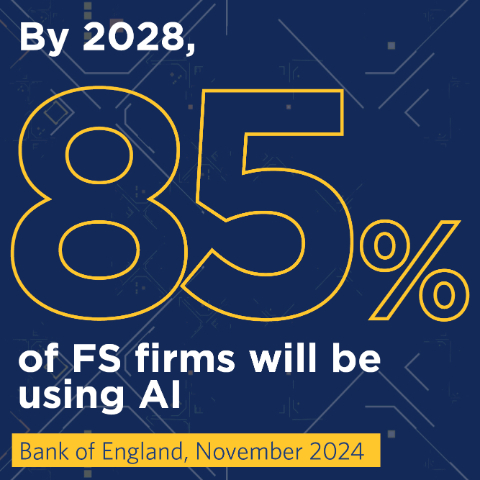
In November 2024, the Bank of England reported that more than 75% of
financial services firms were using AI systems. Over 50% of all
financial services AI use cases have some degree of automated
decision-making: around 24% are semi-autonomous (designed to
involve human oversight for critical or ambiguous decisions) and as
of November 2024, only 2% were fully autonomous.
Research from Russell Reynolds suggested that
in the first half of 2025 around 91% had taken steps towards
implementing generative AI in their workflow.
Against this background of increasing take-up, a third of
financial services use cases are third-party implementations
– this poses challenges in terms of transparency, governance
and control, in addition to a degree of concentration risk at the
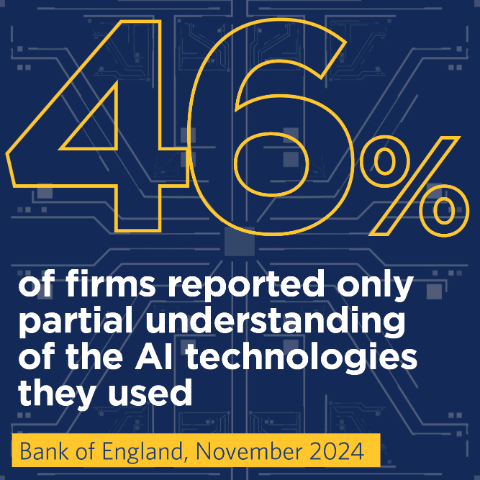
level of cloud, model and data providers. More concerningly, only
34% of firms using AI felt they had a complete understanding of the
technologies they used; 46% reported only partial understanding.
Nonetheless, 40% of firms are using AI to optimise their own
internal processes.
Regulatory approaches
The regulators, often with strong encouragement from
governments, are taking steps to ensure firms are empowered to
embrace automation and capitalise on the many opportunities it
creates. The vision is that AI will help to enhance growth, market
integrity and consumer outcomes.1 Most regulators seek
to foster the development of these systems through the provision of
testing environments for AI that simulate conditions close to the
real world, as well as other forms of private/public collaboration.
Unsurprisingly, however, the regulators also expect firms to ensure
appropriate management of the risks that the use of this technology
may introduce or amplify.
Markets remain complex, nuanced and deeply human. The value of
skilled, well-trained analysts – those who understand market
behaviour, context and intent – is not diminished by
technology. If anything, it’s amplified.
Dominic Holland
FCA Director of Market Oversight, November 2025
While a few jurisdictions have sought to adopt
technology-specific legislation and rules, many jurisdictions and
regulators (for example, the UK and Hong Kong) aim to take a
technology neutral or agnostic stance, welcoming the use of
‘good technology’ to support and enhance decision-making
but only as long as firms maintain robust governance, oversight and
testing and comply with existing regulatory requirements. The
result is that existing regulatory requirements – many of
which were originally developed in a more analogue context –
now apply in an increasingly digitalised operating environment.
That said, regulators are also beginning to develop guidance and
best practices on the basis of their growing experience of the
range of AI use cases being deployed by the firms they
regulate.
Nonetheless, as Dominic Holland, Director of Market Oversight
at the UK Financial Conduct Authority (FCA), recently said, AI
cannot replace human judgement. Interestingly, he noted that
regulations are written with individuals in mind and stressed that
the regulators’ experience is in interrogating, issuing
directions to, and taking action against individuals, including
individuals within a body corporate.
Some regulators, like the Hong Kong Monetary Authority (HKMA),
require firms to allow customers to opt out or request human
intervention in customer facing applications using GenAI, and the
Hong Kong Securities and Futures Commission (SFC) imposes stricter
requirements on high-risk activities like the provision of
investment recommendations, investment advice and investment
research using GenAI models.
The Republic of Korea and Vietnam are progressing detailed and
comprehensive requirements specifically governing the use of AI
rather than focusing on financial services specifically; Indonesia,
Thailand and the Philippines are also considering a comprehensive
legislative approach, and the UK too is contemplating possible
cross-sector legislation. The Australian government has, for now at
least, rejected a proposal for stand-alone legislation.
On the other hand, having finalised AI-specific legislation, the
EU is now delaying implementation of requirements for ‘high
risk’ applications until harmonised standards and support tools
are in place and is considering targeted measures to simplify the
EU AI Act to help foster growth and innovation. In common with
approaches elsewhere, EU AI regulation stresses the need for
appropriate human oversight measures in addition to adequate risk
assessment and mitigation systems, quality of datasets,
transparency, monitorability, security and robustness.
Fundamentally, AI will continue to be a focus for regulatory,
supervisory and use case development through 2026 and beyond.
Footnote
1 The HKMA, for example, notes potential uses such as the
identification of vulnerable customers, and those who may need more
information or clarifications to better understand product
features, risks, and terms and conditions, and the issuance of
fraud alerts to customers engaging in transactions with potentially
higher risks: See HKMA Circular on customer protection in
respect of the use of Generative Artificial Intelligence, 19 August
2024 (HKMA GenAI Circular).
The content of this article is intended to provide a general
guide to the subject matter. Specialist advice should be sought
about your specific circumstances.