
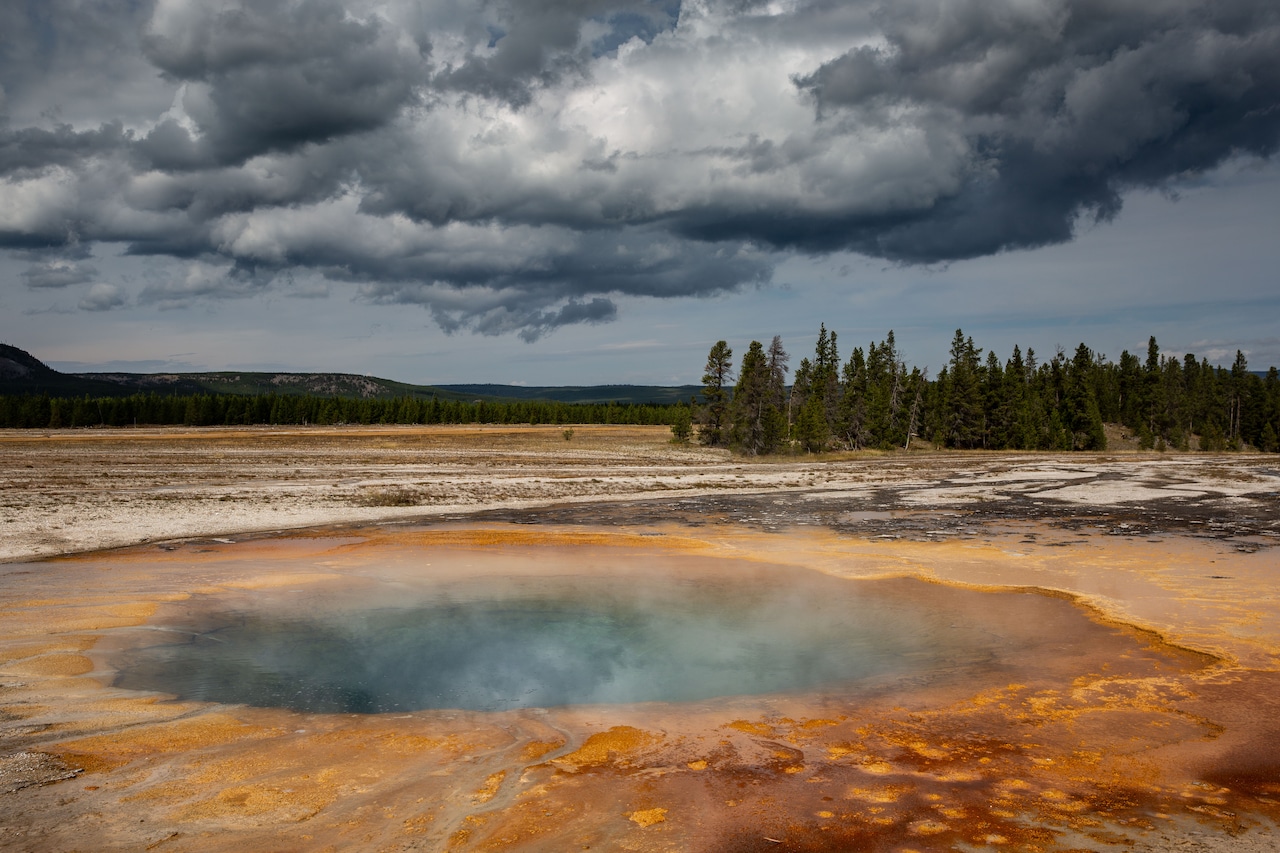
A gigantic bulge in the north rim of the Yellowstone caldera is the latest sign of volcanic activity in the national park.
Geologists call this type of bulge “volcanic uplift.” It’s often caused by the movement of magma or gas underground.
Dubbed the Norris Uplift Anomaly when it first appeared near the Norris Geyser Basin in 1996, the uplift disappeared after 2004.
In July 2025, the Norris Uplift returned – and is now the size of a major American city.
Measuring roughly 19 miles across, it “is the size of Chicago,” Michael Poland, Scientist-in-Charge at the Yellowstone Volcano Observatory told Cowboy State Daily.
In the observatory’s monthly update, posted to the US Geological Survey website on Jan. 2, scientists wrote that the “measurements indicate subtle uplift along the north caldera rim that appears to have started in July.”
Calling a city-sized deformation “subtle” might seem like an understatement, but according to Poland, the phenomenon is hard to see from above ground.
“Between July and the time the stations were collected in September,” Poland wrote in Yellowstone Caldera Chronicles, a weekly blog produced by the observatory, “the ground rose by almost 2 centimeters (less than an inch).”
A shift that small is hard to see with the human eye, but was captured by GPS monitoring sites and interferometric synthetic aperture radar.
What does this mean for the Yellowstone supervolcano?
Nothing.
“Is this a sign of an impending eruption, or some other hazard? No,” Poland wrote in the blog post. “Rather, it is another example of Yellowstone’s dynamic nature, and what we can learn about the characteristics of the subsurface using a new generation of sensitive monitoring tools.”
In the event of any future activity, we would have plenty of notice. Yellowstone is closely monitored and signs of significant seismic disturbances would show up decades in advance.
According to Poland, “the current deformation is also minor in magnitude (it pales in comparison to deformation seen at other caldera systems), and before any hazardous activity the deformation rates would accelerate dramatically — something that can obviously be tracked by the continuous GPS network.”
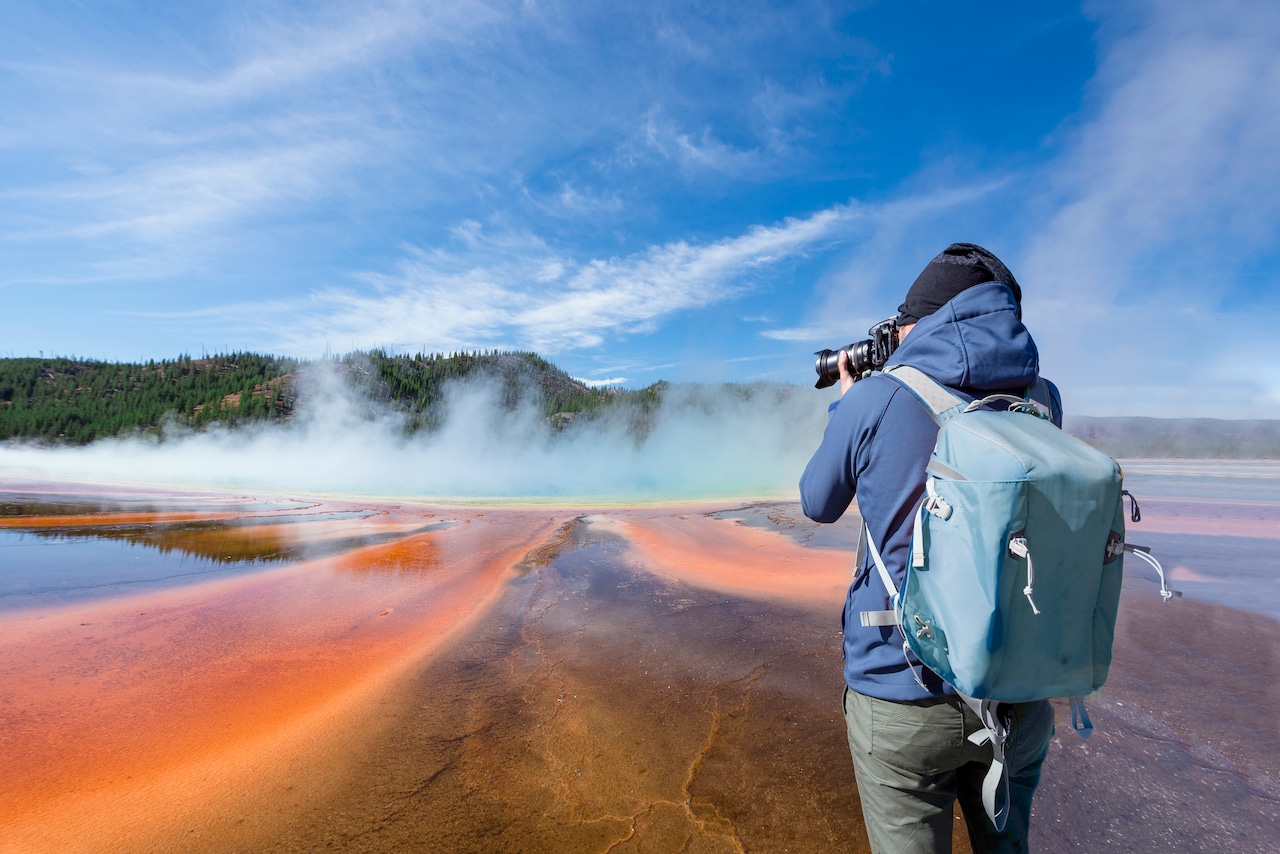 Tourist taking photos on Grand Prismatic Spring in Yellowstone National Park, Wyoming.Getty ImagesIs Yellowstone dangerous?
Yes, like most areas with a lot of volcanic activity, it can be hazardous. But not because of any immediate danger of a supereruption of the Yellowstone caldera.
Fears about an impending eruption of the supervolcano that created Yellowstone have circulated online for years.
Last summer, videos of animals appearing to flee Yellowstone went viral, leading to speculation that the park’s infamous “supervolcano” was set to erupt. What the videos actually showed, though, were simply the natural migrations of animals in the park.
Social media posts and misleading online videos often claim that the Yellowstone supervolcano is “overdue” for another catastrophic eruption, like the one that initially created its caldera about 0.63 million years ago.
However, according to the USGS, that’s simply not how most supervolcanoes work.
“Most volcanic systems that have a supereruption do not have them multiple times,” the agency says in an online FAQ.
That means that, while it’s possible Yellowstone may see more volcanic activity in the future, it probably won’t be on that scale again — and it’s certainly not “overdue.”
What is a supervolcano, anyway?
The U.S. Geological Survey defines a supervolcano as “a volcanic center that has had an eruption of magnitude 8 on the Volcano Explosivity Index (VEI), meaning that at one point in time it erupted more than 1,000 cubic kilometers (240 cubic miles) of material.”
So, yes, the Yellowstone caldera was created by volcanic activity from a so-called supervolcano.
But, according to the USGS, it’s a little complicated:
“The largest eruption at Yellowstone was 2.1 million years ago and had a volume of 2,450 cubic kilometers. Like many other caldera-forming volcanoes, most of Yellowstone’s many eruptions have been smaller than VEI 8 supereruptions, so it is confusing to categorize Yellowstone as a ‘supervolcano.’”