
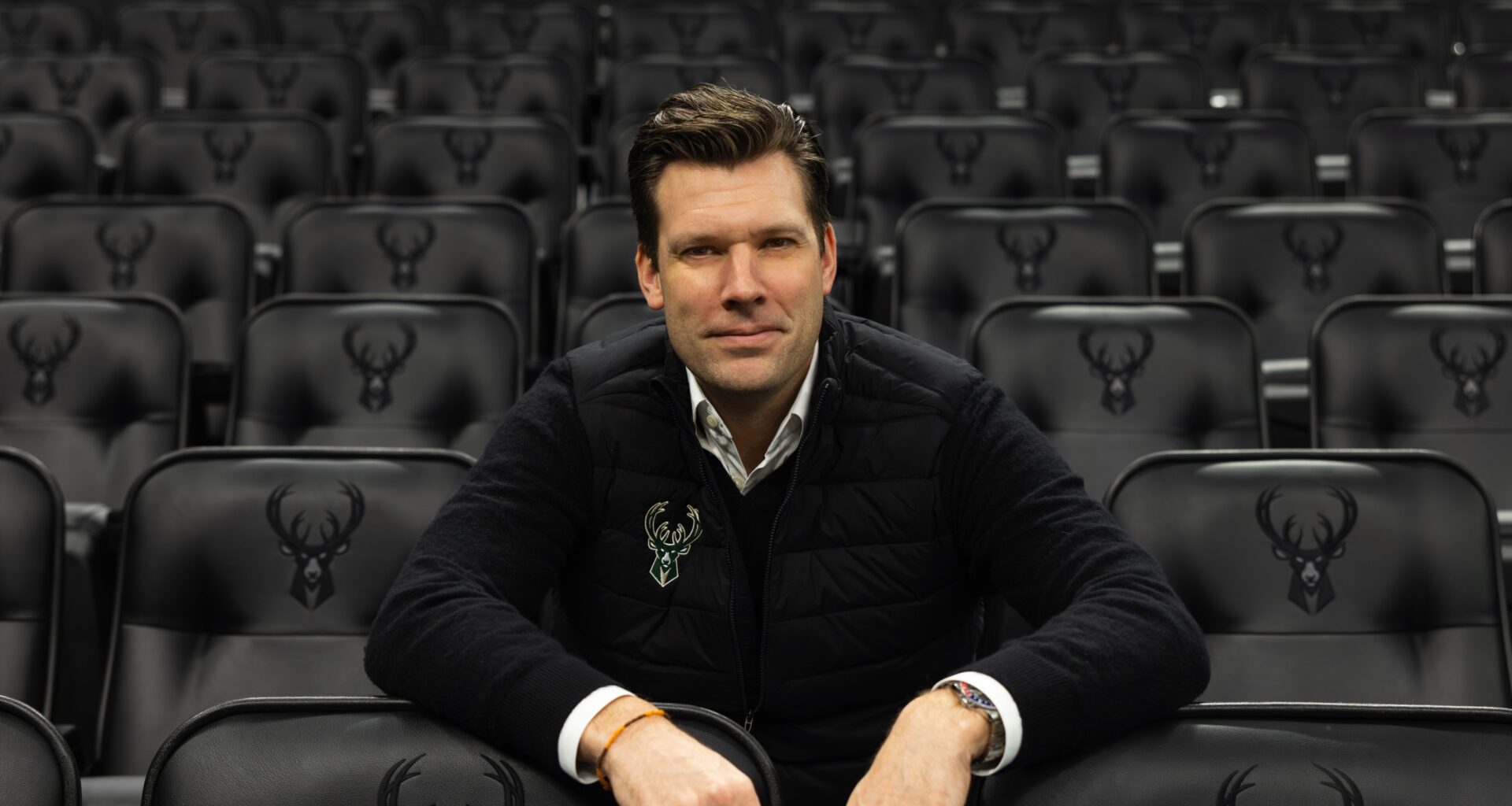
It’s big news with the Milwaukee Bucks as of late – welcoming a new president after 12 years of business leadership under Peter Feigin and NBA buzz over the potential trade of star forward Giannis Antetokounmpo.
But new president Josh Glessing has his sights set on carrying forward Feigin’s legacy and evolving rather than reinventing the organization.
Glessing, a Wisconsin native who was named president of the Bucks in early January, recently sat down with BizTimes to discuss his transition and vision for the future of Milwaukee’s NBA franchise.
The interview has been edited for length and clarity.
What are your first initiatives as president?
“The first couple of weeks are ensuring stability, meeting internal and external stakeholders, and ensuring that everyone understands that this transition with (Feigin) is how it’s supposed to be done. So that’s been the focus – listen, learn, ask questions. I have no intention in these first 30 days to do anything drastic as it relates to the Milwaukee Bucks. I say that obviously as there’s some noise in the background, but my partner, (Bucks general manager) Jon Horst, is focused on that and on ensuring that the Bucks continue to compete on the court.”
Given the trade deadline is next week, where do you stand now on the topic of Giannis and a potential trade?
“We have a transcendent superstar on our roster right now. We’re looking at ‘How do you take advantage of that? How do you build on what we have in place?’ What I know is, we have a deep commitment from the front office and basketball operations, and from our ownership, to ensure that we’re trying to sustain success in the short term and long term. These things can be complicated, but we’re working to ensure that we can compete. As we stand today, we’ve got a transcendent superstar on the roster.”
What are your plans for Deer District?
“This is a huge focus of mine. Our hope is that over the course of the next three to six months, we can be in the ground on a number of projects. We’re not developers, but we partner with developers. The developer of The Trade Hotel is developing the Moxy Hotel, we’ve got the new Live Nation venue, we’re working with (J. Jeffers & Co.) on a multifamily residential project, and there’s also an attempt to get a commercial (office) building built on the site. So it’s drive density, drive density, drive density, drive density, and all that builds on itself.”
How are ticket sales (season and individual game) and how are sponsorships?
“I can’t really speak definitively on what we’re going to do different, but the reality is we’ve got 41 Milwaukee Bucks regular season home games next year. The goal is to sell those games out. Selling in any B to C business (centers on) the relationship between expectations and reality. For a very long time, people were comparing the experience between the Bradley Center and Fiserv Forum. Seven years later, people have gotten really used to the Fiserv Forum experience. The best thing for us would be if our fans were able to go to 20 of the 29 other arenas in the NBA and then come back. Then the appreciation would be real. Their expectations have met their reality and they’ve gotten used to it. How do we evolve with the game day experience to reset the expectations versus reality paradigm? In my second week on the job at the NBA sales market meeting, we won, for the second straight year, ‘Best Game Day Entertainment Experience.’ The rest of the (NBA) acknowledges what we give to our fans and we have to continue to push the bounds.”
In a previous role with Goldman Sachs, you helped finance Fiserv Forum. What was your involvement in the project?
“Ironically, I was engaged before (Feigin) started. In the summer of 2014, when Marc (Lasry) and Wes (Edens) were acquiring the team, they needed to figure out a way to finance, build and design a new arena in Milwaukee. They engaged (Goldman Sachs), and we came in and worked with them on all of the efforts with the city, county and state to figure out the public and private partnership. We ultimately financed the private portion of the arena. It’s all coming full circle here. I thought it was really special to be able to do this with other teams at the time, but I was in the room when we were selecting architects in Kansas City, and I was in the room the first time anyone saw the designs for what is now Fiserv Forum. It was cool doing that stuff in general, being a Bucks fan made it extra special.”
Did that experience serve as a catalyst to further your involvement with the team?
“When I say that I was a fan of the Bucks, my interest has always been here. It’s not hyperbole to say the Milwaukee Bucks were my first favorite sports team and the one consistent in my personal and professional life.”
The Milwaukee Brewers just ended their contract with FanDuel Sports Network Wisconsin. Will that affect Bucks’ network coverage?
“Right now, we’re working with FanDuel to ensure that we can continue to deliver Bucks games to our fans. What I can say definitively is, there will always be an option for our fans. We hope it’s FanDuel, our goal is FanDuel and we will work with FanDuel, but we will ensure that our games are reaching our fans.”
What should Bucks fans know about the team under your leadership?
“The Bucks organization is in such a different place. As someone who’s advised and worked with the Bucks in multiple capacities, this is not a revolution. In 2014, when Feigin took over, it was a revolution. There needed to be change. What we’re talking about now is an evolution – growing, building on the solid foundation, continuing to do what we’ve always done. But this is not a full reset like it was when Feigin came here. It’s very different than that. There are a lot of people who should be really proud of that because it was revolutionary, and it needed to be. Now, we have this platform in the NBA and we have to take advantage of that. It’s our job to use the platform we are given to shine a light on Milwaukee.”
What is your gametime ritual?
“The team has me working on game days. My ritual is to get in early, make the rounds through the building, and make sure that we’re doing everything we need to do operationally. The reality is, we have some people that show up on game days that don’t show up every other day. That’s my time to interact with them as much as anything else. It’s incumbent to me to ensure that I am interacting with our fans and with our people. I like to watch the fourth quarter and then I try to watch the replay of the game the next day with my kids.”