
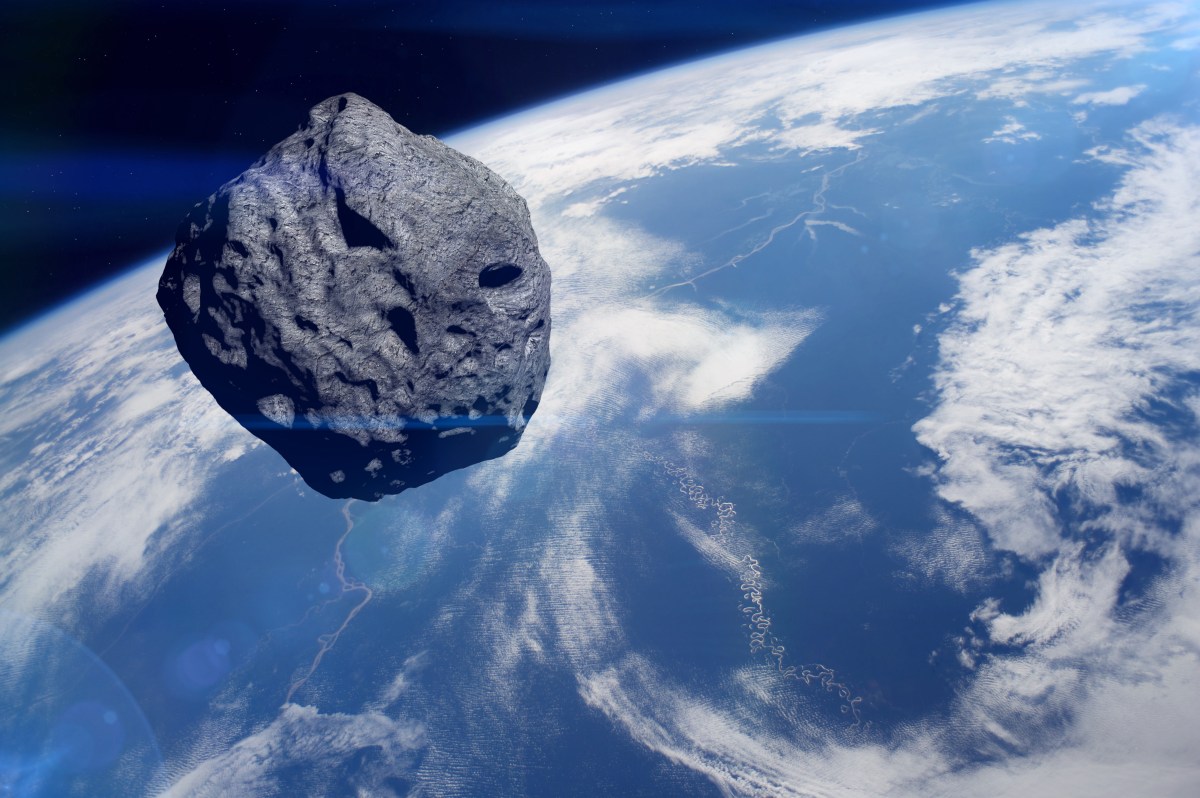
NASA is currently tracking a bus-sized asteroid set to zip past the Earth on January 31 at a whopping 8,478 miles per hour.
Known as 2022 OC3, the space rock is estimated to be about 24 feet across and will make its closest approach on Saturday, at a distance of 311,000 miles, according to NASA’s Jet Propulsion Laboratory (JPL).
More asteroids are expected to zoom past the Earth in the coming days. Also, today, a house-sized asteroid known as 2026 BK, will make its closest approach at a much larger distance of 2,310,000 miles.
Three more asteroids will follow on Saturday. A car-sized space rock known as 2023 RX1 will pass within 2,090,000 miles, followed by bus-sized 2026 BF1, which will come as close as 2,630,000 miles distant; and plane-sized 2025 YQ12, 95 feet across, which will get up to 2,860,000 from our planet.
Asteroids are small, rocky objects that are remnants from the formation of the solar system around 4.6 billion years ago. They are mostly located in the main asteroid belt, orbiting the Sun between Mars and Jupiter.
Small asteroids measuring up to 30 feet across impact the Earth roughly once every ten years. These collisions usually result in a bright fireball and a powerful sonic boom and may occasionally break a window, but they generally do not cause any significant damage.
In February 2025, an asteroid estimated to be between 174 and 220 feet in size—”2024 YR4″—was calculated to have a 3.1 percent chance of striking Earth in 2032, which was described as “the highest impact probability NASA has ever recorded for an object of this size or larger.”
An asteroid of this size could destroy an entire city if it impacted Earth. However, updated calculations indicate that an Earth impact is very unlikely, and some scientists now suggest that 2024 YR4 may instead be on its path to possibly collide with the Moon in December 2032.
“Asteroid 2024 YR4 is now too far away to observe with either space or ground-based telescopes. NASA expects to make further observations when the asteroid’s orbit around the Sun brings it back into the vicinity of Earth in 2028,” NASA said on their website.
More recently, scientists from South Korea’s Pusan National University examined another large asteroid known as Bennu. This space rock some 1,640 feet wide is predicted to have a one-in-2,700 chance of colliding with Earth in September 2182.
Although an impact is highly unlikely, the potential consequences of it would be severe. Shock waves produced by the collision would trigger earthquakes, wildfires and thermal radiation. The impact would also create a large crater, sending debris into the atmosphere.
Atmospheric chemistry and global photosynthesis would also be disrupted for three to four years due to the release of 100–400 million tons of dust into the atmosphere from the impact.
Average surface temperatures would drop by about 7 degrees Fahrenheit, rainfall would decrease by 15 percent and the ozone layer would be reduced by 32 percent. Plant photosynthesis would also decline by 20 to 30 percent.
Do you have a tip on a science story that Newsweek should be covering? Do you have a question about asteroids? Let us know via science@newsweek.com.