
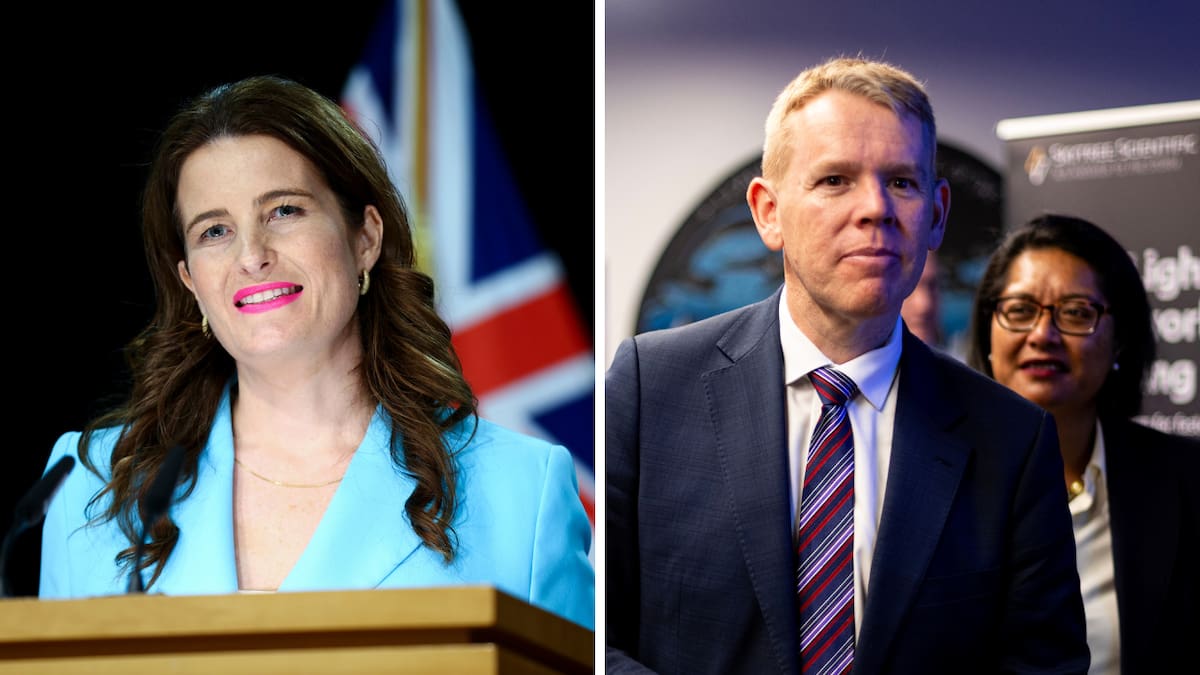
The annual debate on the Prime Minister’s statement is one of the few parliamentary fixtures that live up (or down, depending on your preference) to the slur “political theatre”.
Every year, the Prime Minister opens proceedings with a lecture on the unassailable greatness of their Government, and each year the Opposition leader motions, in vain, to topple them.
So dripping with venom was Hipkins’ effort this year – “no confidence in this Government, who have failed to deliver on their promises … are out of touch … have continued to promise a recovery that never arrives … choked off economic growth … forced thousands of Kiwis out of their jobs, forced up the cost of living for New Zealand families … seen record numbers of New Zealanders lose hope and leave the country for good” – that, like all good plays, the audience might have convinced itself that perhaps the ending, this time, will be different – that Juliet would wake up, or Scarpia would keep his word.
But of course, the ending is always the same. The parliamentary arithmetic that writes the script of this debate stays the same. The speeches get progressively worse as lower and lower ranked MPs rise to take their calls – each anguished self-aggrandising soliloquy becoming less Romeo and Juliet and more Pyramus and Thisbe – until eventually the debate ends, Hipkins’ motion fails.
It was the content, as much as the delivery, of Hipkins’ speech that should concern the Government. He’d dusted off the September 2023 edition of Treasury’s Pre-Election Economic and Fiscal Update (Prefu).
Back then, Treasury thought we’d be enjoying gross domestic product (GDP) growth of more than 3% a year (having not had a single year of negative growth over the Parliament), unemployment would be 4.8%, Consumers Price Index (CPI) inflation would be just 2.1%, and house prices would have grown slightly each year of the parliamentary term, suffering just a minor 9.6% blip in 2023.
The Government’s books would bask in the reflective glow of the economy.
This year would be the last of the Covid deficits, with the books returning to surplus next year. The debt ratio, having peaked at 43% of GDP in 2024 would be at about 40% now, and tracking lower.
It’s a devastating document, sketching out, in the clinical impartial language that could only come from No 1 The Terrace, just how much better life would be now if the last three years hadn’t panned out like they did – and, in Hipkins’ telling, what the economy would look like had it been under the administration of a third-term Labour Government.
Labour was hitting that message hard this week. On her way into caucus, finance spokeswoman Barbara Edmonds noted real GDP was lower now than it was prior to the election.
Council of Trade Unions economist Craig Renney took to social media with an unflattering chart showing how much each one of Treasury’s half-yearly forecasts had revised downwards the assumptions of the one prior. The cumulative effect of these revisions means the economy is several billions of dollars smaller than it was expected to be.
Finance Minister Nicola Willis clearly couldn’t hold back her response until her scheduled appearance before the Finance and Expenditure Committee the next morning. Taking National’s first call after Hipkins, she tried to paint the Prefu fairy tale, as just that, a fairy tale.
“[Hipkins] discovered numbers over the break and he went and he read a few Budget documents and here’s what he said: ‘Turns out we’ve got to do something about the debt’. Welcome to my world, Chris Hipkins!
“This is the same leader who spent the past two years opposing every single savings initiative put forward by this side of the House!” she thundered.
It was a strong performance, so strong that when the National Party came to posting excerpts of the debate to its social media accounts, it was Willis’ speech they were sharing.
She went further the next morning to demolish the idea that the Prefu represented a reliable artefact of the economy run by a third-term Labour Government.
It’s a hard case to make; Prefu, like all the other Efus, is a non-partisan document drawn-up by Treasury. With a couple of exceptions (Treasury buried the unflattering “net core Crown debt” in the back of the document, opting to put Labour’s preferred metric, the smaller “net debt” number at the front, much like the current Government’s Obegalx malarkey), its 100 or so pages are unmolested by political interference.
Willis did a strong job fighting back. Her case boils down to this: that those Prefu forecasts were wrong and unreliably rosy.
She’s on strong ground. As the Herald has reported, Treasury began revising its economic outlook downward at the end of 2022.
The drums were beating loudly at the beginning of 2023, forcing some last-minute re-evaluating of the Budget that year.
In August of 2023, things got bad enough that Finance Minister Grant Robertson announced across the board spending cuts, shaving off 2% of public service baselines, booking $2 billion in savings over four years.
But still things deteriorated. The post-election Half-Year Update (Hyefu), showed a further major downwards revision. Willis can confidently claim that one’s nothing to do with her either, as those forecasts were signed off when Labour was still in Government.
These attacks on Treasury’s forecast began last December.
In an appendix to the Budget Policy Statement, a political document from the Finance Minister’s office, usually published alongside Treasury’s half-year forecasts, Wills included a rather unflattering graph, showing the Prefu’s comparatively vertiginous economic growth forecasts alongside the rather more earthbound recent revisions.
The commentary laid out her defence, giving two succinct reasons for the multiple backslides.
The first, was Treasury now has a better understanding of the downturn, “which started earlier, was deeper and has persisted for longer, than was previously understood or expected”.
The other is the Treasury’s evolving assessment of productivity trends. With the benefit of hindsight, earlier economic forecasts attributed too much weight to an apparent pick-up in productivity during the Covid-19 pandemic that did not persist.
Put even more succinctly, Treasury, in 2023, was wrong.
Edmonds was keen not to let Willis off the hook.
When Willis came to Edmonds’ committee on Wednesday to defend the Budget Policy Statement, Edmonds’ first question was on the comparisons with the Prefu, and how much of the economy’s subsequent decline was due to forecasters being wrong, and how much was the fault of the Government?
“I have not been advised that the Government through any of its specific policy choices has contributed to that decline, in fact the Treasury’s advice is that a number of actions we have taken have supported GDP to be stronger than it would otherwise be,” was Willis’ response.
“There was a presumption that the bounce-back from the Covid period would be stronger than it was,” she said, adding the latter for emphasis, “it wouldn’t matter if it was me sitting at the desk, Grant Robertson sitting at the desk, or Chlöe Swarbrick sitting at the desk, those forecasts would have occurred on anyone’s watch”.
Finance Minister Nicola Willis defends the forthcoming Budget at the Finance and Expenditure Committee. Photo / Mark Mitchell
Edmonds asked Willis whether the committee could have a squiz at the advice she had received from Treasury on why the forecasts were wrong and needed to be revised.
Willis was “very happy” to oblige, answering with an enthusiasm that left you wondering whether, when Willis dialled up the advice, she did so with herself or a curious electorate in mind as the primary audience.
Willis said she had “extensive” advice on why Treasury “revised their forecast assumptions and what they think they got wrong prior to the election”.
“You can imagine coming in as a minister, having been presented a set of forecasts prior to the election with a fair expectation that that is what would happen, to immediately have significant downward revisions, is something I have interrogated quite closely,” Willis grinned.
The coalition finds itself at the whim of a history not written by the victors. This is unusual. The last two Governments had far greater success in tarring their predecessors with the slur of “nine years of neglect” or a “decade of deficits”.
This Government, by contrast, hasn’t quite managed to get the public to see things its way. It’s belatedly accepted that the mood around the economy is dreadful, but it’s waited too long to make a sophisticated case for why things aren’t totally its fault.
That’s a challenge because it can’t completely exonerate itself from the state of the economy either. Public spending retrenchment and pausing construction products would tend to have a negative impact on the economy.
The obvious riposte to Labour, however, is that continuing to deficit-spend would, all things being equal, lead to higher more unsustainable debt, and higher interest rates, which, on balance, would be negative for the economy.
Labour’s been clear it wouldn’t have cut taxes in 2024, but Willis’ spending cuts have gone beyond what was needed to fund the tax cuts – Labour’s got a question to answer here about whether, had it won the election, it too would have tightened its belt a bit.
It’s a messy waterbed of an argument: you jump down on one issue, only to see an equal and opposite question pop up somewhere else – and one which is so kaleidoscopic in its dizzying, ever-shifting complexity that only the most skilled politician can wade in.
Yet wade in Willis must.
The coalition MPs discovered this week that if it doesn’t write its own history, Labour will be quite happy to write it for them.