
Looking to play the lottery? Your odds of catching a glimpse of a flamingo in Florida can feel almost as slim. The bright pink bird is one of the state’s most recognizable symbols, yet in the wild it has long been a rare sight.That rarity, however, could be starting to change.On a windy morning in Estero Bay, temperatures were cool enough to keep most people indoors, but not Vince McGrath. The longtime birder walked the shoreline scanning the mudflats through binoculars.“If you want to see something that is rare, you are going to have to work for it,” he said.McGrath is the longest tenured member of the Caloosa Bird Club, a group devoted to birdwatching across Southwest Florida. On this day, he pointed out lesser yellowlegs and short-billed dowitchers, but the real hope was to spot something far less common: flamingos.Estero Bay Preserve Park, with its shallow mudflats and mix of fresh and saltwater, offers suitable habitat for shorebirds. It is also one of the most recent places where flamingos have been reported in Lee County. During a spike in sightings in 2023, birders counted dozens in the area.Those sightings revived a long-running question. If flamingos are so closely tied to Florida’s identity, why have they been so hard to find in the wild?The answer goes back more than a century. According to FGCU ornithologist Oscar Johnson, flamingos were once fairly common in extreme South Florida, especially around the Everglades, Florida Bay, and Cape Sable. That changed by the early 1900s.”Humans hunted the last flamingos out of Florida around 1901,” Johnson said. “Their feathers were a major reason why. Decorative plumes were fashionable in women’s hats at the time, especially in cities like New York and Boston, where feathers were seen as a sign of status. Heavy hunting pressure in Florida wiped out the state’s birds.”Flamingos survived in other places, including Cuba and the Yucatán Peninsula, where healthy populations remain today. Scientists believe some of those birds were blown into Florida during Hurricane Idalia in 2023. As the storm moved north, reports of flamingos followed, with sightings from Southwest Florida into the Big Bend region.Storms alone may not explain why some birds have lingered. Researchers with the South Florida Water Management District have documented a flock of more than 100 flamingos staying in the southern Everglades. Mark Cook with the district said improved habitat may be a key factor.”Many of those birds have stayed in Florida because conditions are now more suitable,” Cook said. “They have found areas they had not used for more than 100 years and are feeding there again.”Everglades restoration has increased the flow of freshwater moving south from Lake Okeechobee into Florida Bay. That balance of fresh and saltwater helps maintain a productive estuary, creating the kind of environment flamingos prefer.So far, there is no confirmed evidence that flamingos are breeding in the wild in Florida. Still, scientists say a healthier habitat raises the possibility.“When you restore a habitat, its productivity returns,” Cook said. “We can make a good case that they are coming back because the habitat has improved, but we still have more to learn.”For birders like McGrath, that potential is reason enough to keep looking. Each trip along the shoreline carries a small but growing chance that Florida’s most iconic bird may truly be making a comeback.DOWNLOAD the free Gulf Coast News app for your latest news and alerts on breaking news, weather, sports, entertainment, and more on your phone or tablet. And check out the Very Local Gulf Coast app to stream news, entertainment and original programming on your TV.
LEE COUNTY, Fla. —
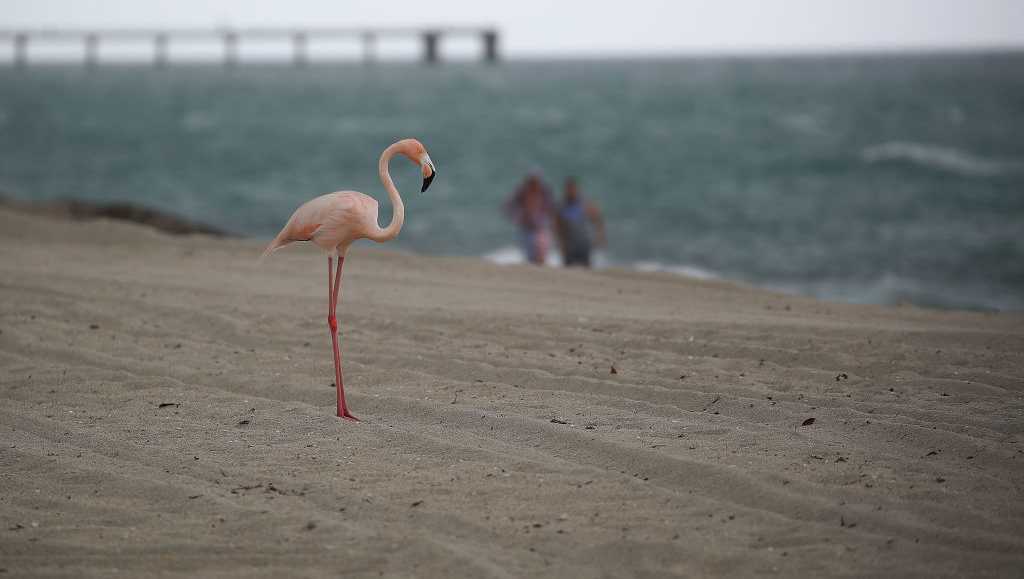
Looking to play the lottery? Your odds of catching a glimpse of a flamingo in Florida can feel almost as slim. The bright pink bird is one of the state’s most recognizable symbols, yet in the wild it has long been a rare sight.
That rarity, however, could be starting to change.
On a windy morning in Estero Bay, temperatures were cool enough to keep most people indoors, but not Vince McGrath. The longtime birder walked the shoreline scanning the mudflats through binoculars.
“If you want to see something that is rare, you are going to have to work for it,” he said.
McGrath is the longest tenured member of the Caloosa Bird Club, a group devoted to birdwatching across Southwest Florida. On this day, he pointed out lesser yellowlegs and short-billed dowitchers, but the real hope was to spot something far less common: flamingos.
Estero Bay Preserve Park, with its shallow mudflats and mix of fresh and saltwater, offers suitable habitat for shorebirds. It is also one of the most recent places where flamingos have been reported in Lee County. During a spike in sightings in 2023, birders counted dozens in the area.
Those sightings revived a long-running question. If flamingos are so closely tied to Florida’s identity, why have they been so hard to find in the wild?
The answer goes back more than a century. According to FGCU ornithologist Oscar Johnson, flamingos were once fairly common in extreme South Florida, especially around the Everglades, Florida Bay, and Cape Sable. That changed by the early 1900s.
“Humans hunted the last flamingos out of Florida around 1901,” Johnson said. “Their feathers were a major reason why. Decorative plumes were fashionable in women’s hats at the time, especially in cities like New York and Boston, where feathers were seen as a sign of status. Heavy hunting pressure in Florida wiped out the state’s birds.”
Flamingos survived in other places, including Cuba and the Yucatán Peninsula, where healthy populations remain today. Scientists believe some of those birds were blown into Florida during Hurricane Idalia in 2023. As the storm moved north, reports of flamingos followed, with sightings from Southwest Florida into the Big Bend region.
Storms alone may not explain why some birds have lingered. Researchers with the South Florida Water Management District have documented a flock of more than 100 flamingos staying in the southern Everglades. Mark Cook with the district said improved habitat may be a key factor.
“Many of those birds have stayed in Florida because conditions are now more suitable,” Cook said. “They have found areas they had not used for more than 100 years and are feeding there again.”
Everglades restoration has increased the flow of freshwater moving south from Lake Okeechobee into Florida Bay. That balance of fresh and saltwater helps maintain a productive estuary, creating the kind of environment flamingos prefer.
So far, there is no confirmed evidence that flamingos are breeding in the wild in Florida. Still, scientists say a healthier habitat raises the possibility.
“When you restore a habitat, its productivity returns,” Cook said. “We can make a good case that they are coming back because the habitat has improved, but we still have more to learn.”
For birders like McGrath, that potential is reason enough to keep looking. Each trip along the shoreline carries a small but growing chance that Florida’s most iconic bird may truly be making a comeback.
DOWNLOAD the free Gulf Coast News app for your latest news and alerts on breaking news, weather, sports, entertainment, and more on your phone or tablet. And check out the Very Local Gulf Coast app to stream news, entertainment and original programming on your TV.