
Lylee Aguilar was a few years shy of her 40th birthday when she realized she needed to get serious about fertility planning. “I had been so wrapped up in living my life and my professional pursuits,” the Bay Area-based consultant said. “Age just creeps up on you.”
When her initial lab tests did not indicate strong fertility levels, her doctor recommended that she consider donor eggs.
“I was like, wait, what?” Aguilar recalled. “Already?”
That’s when she turned to the “egg whisperer.”
San Ramon-based fertility doctor Aimee Eyvazzadeh has built a reputation over the past decade-plus for helping women get pregnant. What sets her apart, according to patients, is her willingness to take on tricky cases like Aguilar’s. Her methods include offering extremely hands-on care, whether Facetiming during hormone injections or answering texts at 10 p.m, and embracing emerging technologies like platelet-rich plasma therapy (opens in new tab) (PRP) as well as more woo-woo approaches, like “kissing your ovaries” — though not without criticism.
 Eyvazzadeh’s desk is surrounded by cards and gifts from patients.
 She’s gained a reputation for helping women realize their fertility dreams.
She’s rabidly recommended in group chats, fertility forums, and on social media for being a savior for women who had nearly given up the hope of bearing children.
“Patients tend to see me when other doctors have told them, ‘There’s nothing else I can do for you,’” Eyvazzadeh said.
Her services are expensive — an IVF cycle costs $35,000 on average — and she doesn’t take insurance. (The average price of an IVF cycle nationwide is around $20,000.) She regularly works with reality stars, professional athletes, and tech bigwigs.
Her services are particularly alluring in the Bay Area, which is home to the oldest first-time mothers in the country, thanks to a combination of factors that include lofty career ambitions, companies that foot the bill for egg freezing, and a sky-high cost of living that incentivizes waiting to have kids. Eyvazzadeh’s clients are, on average, 41 years old.
In a region where untold resources are being harnessed to stave off basic biological realities like death, it’s little surprise that there are also people zealously looking to create life.
It helps that Eyvazzadeh looks and acts the part of the baby-making wellness guru. She lifts weights, dances at EDM raves and music festivals, and balances a seemingly around-the-clock work schedule with four kids of her own.
“I don’t know how she does it, really,” Aguilar said. ”Like, does she sleep?”
Aguilar, now in her mid-40s, credits Eyvazzadeh for her toddler son: “It’s not a job for her. It’s a calling.”
Giving people hope, without being a ‘hope dealer’
A plush uterus, thank-you cards, and dozens of eggs — glass, wood, and even Faberge — decorate Eyvazzadeh’s office at her San Ramon clinic. They’re all gifts from patients. “Every piece is a success story,” she said.
The desk itself holds special meaning: It’s the same one her father used during his career as an OB-GYN. Her grandfather delivered babies too, and Eyvazzadeh knew she wanted to go into the family business when she was just 3.
 On a recent afternoon, previous clients pinged Eyvazzadeh’s phone with cute photos or videos of their children.
“I was born intense, full-throttle, 100%,” she said. “I would say that I’m one level above obsessed.”
After watching her mother struggle with miscarriages, Eyvazzadeh decided to specialize in reproductive endocrinology, graduating from UCLA (opens in new tab) with a residency at Harvard Medical School and earning a Master’s in Public Health from the University of Michigan. She first gained national media attention (opens in new tab) in the early 2010s, when she started throwing “egg freezing parties” to educate women about fertility screening and the freezing process over cocktails and canapes. Around the same time, she helped a 48-year-old get pregnant, and the patient gifted (opens in new tab) her the Eggwhisperer.com (opens in new tab) website domain — and, thus, an enduring nickname.
In the years since, Eyvazzadeh has gained a following thanks to a bedside manner and approach that patients say is unlike anything they’ve experienced with a doctor. “You feel like you’re her only patient,” as one put it.
For publicist Madison Ginnett, working with Eyvazzadeh to freeze her eggs contrasted dramatically with a demoralizing experience she had at a large fertility center in San Francisco.
“From the beginning, it was very impersonal: You were just a number,” she said. When she received the news that her expensive retrieval had resulted in very few eggs, she wondered why her provider hadn’t made recommendations on how to improve her outcome.
Her experience with Eyvazzadeh felt like a 180. “Every body is different, and she’s trying to figure out what is going to work for you,” Ginnett said. “She is in your corner and makes you feel so comfortable and seen.”
Ginnett mixes her medications. | Source: Courtesy Madison Ginnett
 Her experience with Eyvazzadeh felt like a 180 from her time at another clinic. | Source: Courtesy Madison Ginnett
To help patients prepare for egg retrieval, Eyvazzadeh may suggest a broad range of supplements, treatments, or interventions, like NAD+ (opens in new tab), PRP, GLP-1s, (opens in new tab) and red-light (opens in new tab) or hyperbaric oxygen therapy (opens in new tab). “I’m an early on-boarder,” she said. “I pay attention to research articles.”
She also her patients’ biggest cheerleader and preaches the power of visualization and optimism, suggesting exercises like kissing one’s fingertips, then placing them on the lower abdomen, over the ovaries.
While Eyvazzadeh prides herself on such treatments, other experts warn that patients should be wary of fertility interventions that lack significant evidence of their efficacy.
Stanford law professor Hank Greely (opens in new tab), who specializes in reproductive technologies, said he’s skeptical about clinics that recommend alternative medicine methods that aren’t backed by widespread, long-term studies. “Using unproven techniques in a medical field where there are desperate people is a red flag,” he said. The “world of conventional medicine” doesn’t think highly of interventions like PRP and NAD+, he added, because there’s not enough research behind them. “There can be physical, emotional, and financial costs.”
But Eyvazzadeh’s embrace of these practices is exactly why her patients trust her. Kristen Cropper, a former patient who works in the wine industry, credits Eyvazzadeh’s suggestions — like doing two rounds of PRP therapy — for thickening her uterine lining and helped her get pregnant. “She is by your side the entire way, but she won’t sugarcoat things,” Cropper said. She has two young boys and no regrets about the procedure.
“I practice being positive and practical at the same time,” Eyvazzadeh said. “I’m not a hope dealer.”
 Cropper poses with Eyvazzadeh, who she describes as a ”unicorn” and ”an angel on earth.” | Source: Courtesy Kristen Cropper
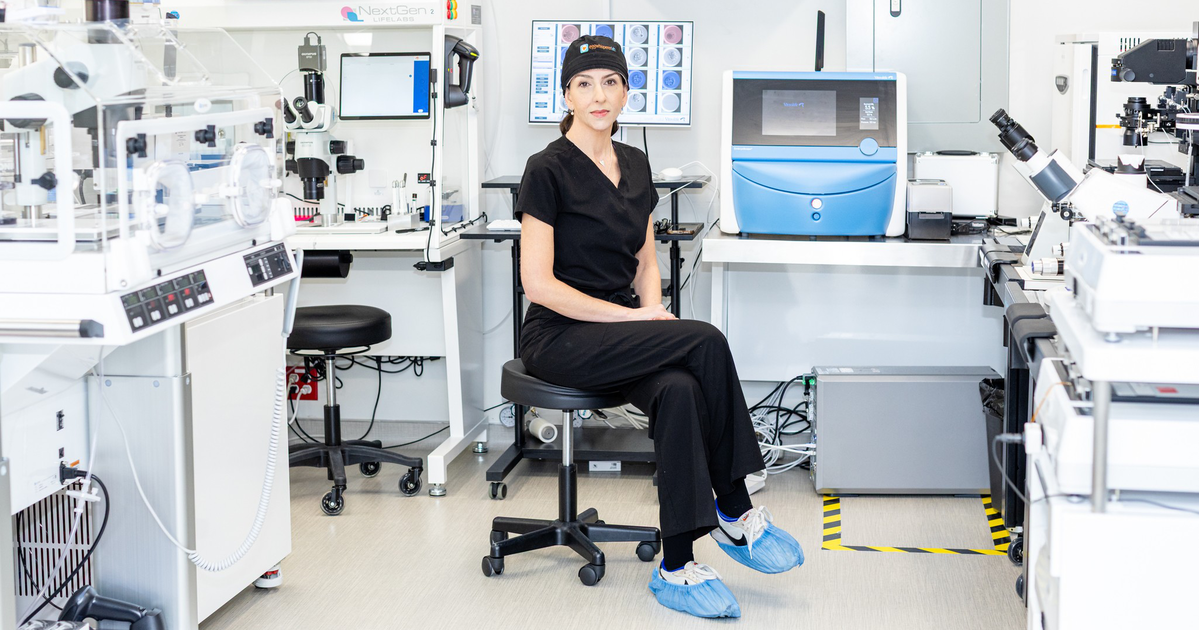
 Eyvazzadeh works in the lab at her clinic. | Source: Constanza Hevia H. for The Standard‘50 will be the new 40’
In the past decade, the conversation around fertility treatments has changed dramatically, with egg freezing and IVF becoming standard aspects of family planning. Still, the procedures remain expensive — one egg-freezing cycle in the U.S. costs $11,000 (opens in new tab) on average, and IVF can be double that (opens in new tab) — and techniques for increasing egg counts are understudied.
More companies now offer fertility benefits (and a new state law requires them for large-group insurance plans (opens in new tab)), but Eyvazzadeh’s office doesn’t work with insurance providers, raising the costs for patients who can afford her services.
“It’s been concierge since the very beginning, and if I were to take insurance, I wouldn’t be able to see the number of patients that I see,” she said, adding that she treats about 30 people daily, in person and virtually.
Knowing that cost will be prohibitive for many, she has a YouTube channel where she discusses techniques and protocols. For those who do become patients, she takes a high-touch approach. “I don’t care if you’re a billionaire or if you work at the grocery store — everyone’s VIP,” she said.
“You feel like you’re her only patient.”
Tech industry employee Anne Živojnović started working with Eyvazzadeh because after having several miscarriages, she felt she was getting passed around between specialists and having to fight to get follow-up testing. It seemed no one was willing to take a holistic view of her situation, she said.
In contrast, Eyvazzadeh took the time to “figure out the puzzle pieces.” Živojnović had her first child after working with the doctor and enlisted her services again for the second, despite having gained insurance benefits that would have paid for treatment elsewhere.
“It was worth every penny for us,” she said.
The effectiveness of Eyvazzadeh’s treatments is a trade secret. She doesn’t report her data to the Centers for Disease Control and Prevention as is federally mandated (but not enforced (opens in new tab)) or the Society for Assisted Reproductive Technology, which tracks IVF success rates. She thinks SART’s stats don’t offer enough specificity. Instead, she offers data directly to prospective patients: “Tell me your age, tell me your [Anti-Mullerian Hormone (opens in new tab) level], tell me what you’ve been through, and I’ll give you a personalized likelihood of success,” she said. “I’m not trying to hide anything.”
Her clinic has several vats with liquid nitrogen where embryos are stored.
Eyvazzadeh bubbles with excitement when she notices a particularly “beautiful” embryo.
UC Davis professor Lisa Ikemoto (opens in new tab), who studies bioethics and reproductive technology, said it’s not uncommon for fertility clinics to withhold data. The SART reporting system has flaws, she said; among them, clinics can be discouraged from taking on complex or high-risk cases to avoid lowering their scores.
“As the data is reported, it’s hard to catch nuances or points of comparison,” Ikemoto said. “So if a doctor takes older patients, or those with other health concerns, you might decide that the better strategy for you is simply not to report.”
Eun-Joo Chang, a consultant in her mid-50s who is pregnant, said she was rejected by other IVF clinics before finding Eyvazzadeh. She credits the doctor with taking a full measure of her health and fitness instead of refusing to work with her solely because of her age.
And Chang isn’t the only patient in her 50s who is expecting. As Eyvazzadeh has watched fertility technology improve since she started her practice in 2008, the average age of her patients has crept up.
“I have more patients now than ever trying to conceive, not necessarily with their own eggs, in their early 50s,” she said. “I predict that in a generation, 50 will be the new 40, and 30 will be like a teen pregnancy.”