
NASA has scheduled the launch for the Artemis II moon rocket for no earlier than Feb. 8. WTOP will have details on the mission as they become available.
“Eyes to the Skies” is a recurring feature and publishes on the first of every month. You can find it on WTOP’s The Space Place. Email Greg your space questions and he might answer them in the next edition.
Welcome to WTOP’s space feature “Eyes to the Skies.” Each month it features the best the sky has to offer stargazers regarding the moon, planets and stars. Space-related events that might interest you taking place in the D.C. region are included too.
Let’s get to the very busy sky for February 2026!
Must-see sky sights for February
NASA has scheduled the launch for the Artemis II moon rocket for no earlier than Feb. 8. WTOP will have details on the mission as they become available.
The winter constellations are our home in the Milky Way galaxy. When looking at them, you are seeing our galactic neighborhood.
The almost full moon covers up the bright star Regulus.
Venus and Mercury dance with each other and the moon.
The appearance of the moon and Mercury almost touching will be a must-see event.
The Zodiacal Light returns.
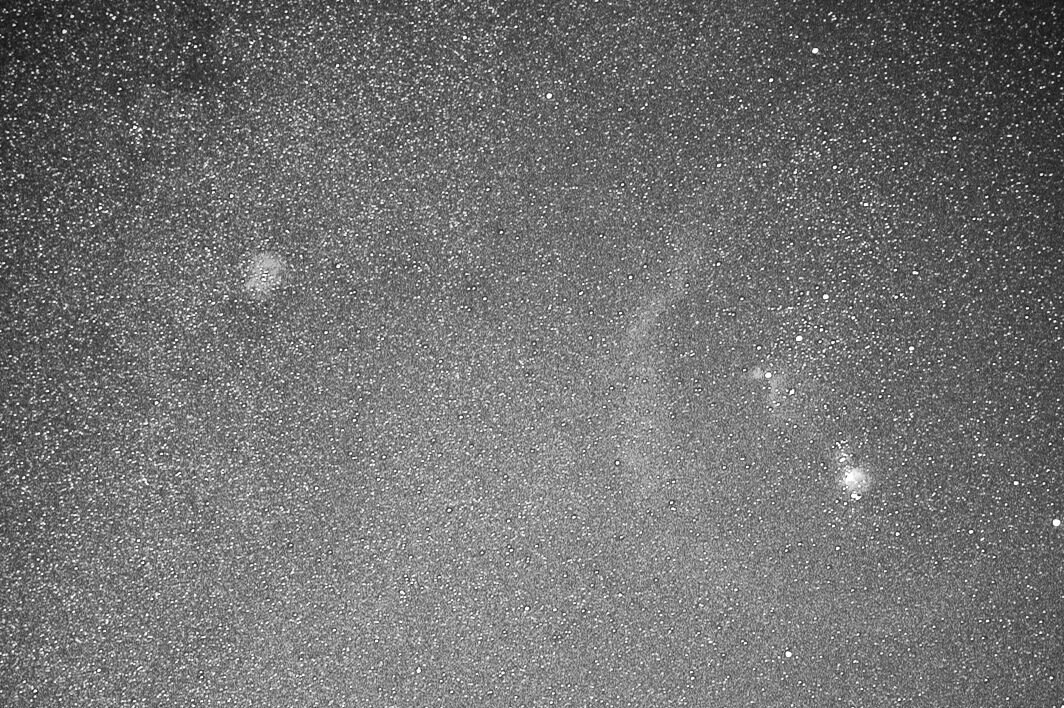 Countless stars, wisps of dark dust, and Orion can be seen in this photo of the Orion Spur or Arm. (Courtesy Greg Redfern)
Star of the month
In February, be on the lookout for Sirius — the brightest star in the night sky.
Look for it right after the sky becomes dark in the Southeast. It is easy to spot using the three “belt” stars of the very bright and distinctive Orion the Hunter constellation.
Orion can also be used to find and recognize the winter constellations. Orion is one of the most recognizable and well-known constellations of the 88 that comprise the sky. Orion, or parts of it, are visible anywhere on the planet. It can be seen upside-down below the equator if you go far enough south.
If you binoculars and/or a telescope, be sure to check out the Orion Nebula for an amazing view of a stellar nursery. Consider using your smartphone or camera to shoot a picture of Orion, you may even capture an image of the nebula.
Seeing the bright stars of Orion and the winter constellations marks the gateway to our solar system’s home in the Milky Way galaxy, known as the Orion Arm or Spur.
Highlights of the month
As February begins, the bright constellations and stars of Winter make their appearances as soon as skies become dark. As the night progresses, the ‘best and brightest’ are high in the South at 11 p.m. Eastern. Bright Jupiter adds to their splendor. By month’s end, you can still see them easily high in the southern sky.
Feb. 1 — The Full Snow Moon occurs at 5:09 p.m. Eastern, lighting up the sky and ground which can make for a very beautiful picture if there’s snow present.
Feb. 1 — Remember our star of the month in October, Algol? It is worth looking at it as it descends to minimum brightness for two hours, centered at 7:36 p.m. Eastern, and then getting brighter. See the other dates this month below. Consider using your smartphone or camera to shoot a picture or video.
Feb. 2 — If you have a clear view of the Southwest to western horizon at dusk, use binoculars to scan for Venus and Mercury just above the horizon. Venus will be the brighter and lower of the two inner planets. It is worth looking each day in February, to see them grow farther apart as Mercury rises higher and faster than Venus.
Feb. 2 — In the Eastern sky, the almost full and very bright moon will cover the bright star Regulus. in the D.C. area, this will begin around 8:51 p.m. Eastern, and last almost an hour before the star reappears from behind the moon on the other side. A telescope will provide the best view with binoculars being the runner-up. It will be difficult to view through the naked eye, as Regulus disappears and reappears. Get the full rundown here. You can get precise timing by entering your location in the website.
Feb. 3 — If you happen to be under a dark sky site in the next two weeks, make sure to look for the Zodiacal Light in the western sky as it gets dark. Consider using your smartphone or camera to shoot a picture. For best results, your device should be mounted on a tripod or held very steady for a time exposure of several seconds.
Feb. 6 — In the East before 12 a.m., you can see a close pairing of the moon and the bright star Spica. They will get closer as dawn approaches. Consider using your smartphone or camera to shoot a picture.
Feb. 16 — Consider using your smartphone or camera to shoot a picture or video of Algol at 3:43 a.m. Eastern.
Feb. 18 — If you have a clear view of the western horizon at dusk, use binoculars to scan for the very young crescent moon close to Mercury above the horizon. The pair will be several finger widths held horizontally at arms length above the horizon. Earthshine may be present, and you should definitely consider using your smartphone or camera to shoot a picture.
Feb. 19 — Consider using your smartphone or camera to shoot a picture or video of Algol at 12:33 a.m. Eastern.
Feb. 21 — Consider using your smartphone or camera to shoot a picture or video of Algol at 9:22 p.m. Eastern.
Feb. 26-27 — The moon and bright Jupiter keep each other company as they travel the night to the pre-dawn sky.
The moon
Feb. 1 — Full Snow Moon
Feb. 9 — Last quarter
Feb. 17 — New Moon, and an annular solar eclipse visible from Antarctica. A partial eclipse will be visible in Antarctica, Africa, South America and parts of the Pacific, Atlantic and Indian oceans.
Feb. 24 — First quarter
Planets
Mercury is in the West, above Venus at dusk.
Venus is visible in the West at dusk, below Mercury.
Mars is in the glare of the sun.
Jupiter is visible all night and very bright.
Saturn is in the Southwest after dark, offering a great view of the rings via telescope.
Uranus is in the western sky after dark. You will need a telescope to best observe the planet, although it is visible in binoculars.
Neptune is in the western sky after dark. You need a telescope to observe it.
Pluto is way out there in the solar system. It requires taking images through a telescope, spaced days apart, to locate it.
DC-area events
Bonus section
Use this useful tool to create a custom star chart for your location to help you find your way around the stars.
You can also send in any space-related questions to my email address. Suggestions about this feature are also welcome.
Follow my daily blog to keep up with the latest news in astronomy and space exploration. You can email me at skyguyinva@gmail.com.
Get breaking news and daily headlines delivered to your email inbox by signing up here.
© 2026 WTOP. All Rights Reserved. This website is not intended for users located within the European Economic Area.