
 Photo via Oregon State University
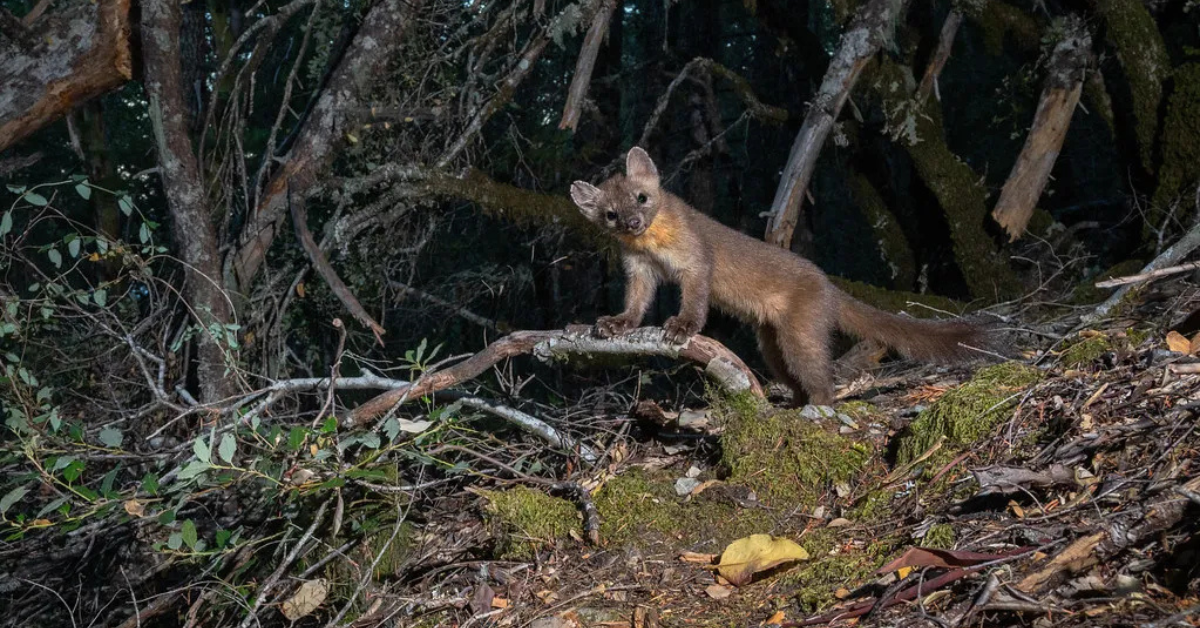
The Pacific Northwest has no shortage of charismatic wildlife, but one of its cutest residents is also one of its most mysterious. Meet the coastal marten, also called the Humboldt marten—a small, soft-furred member of the weasel family that quietly roams Northern California’s forests.
To better understand how these elusive animals are doing, researchers from Oregon State University Institute for Natural Resources recently wrapped up a three-month survey across Northern California. Using wildlife cameras and hair-sampling stations, the team identified 46 individual martens—28 males and 18 females—providing one of the clearest snapshots yet of the species’ current range.
The study found martens favor dense forests with more than 50% canopy cover, large trees, snags, and hollow logs. In Northern California, they were most often detected along higher-elevation forested ridgelines with steady snowpack, as well as in lower-elevation coastal ravines.
That habitat preference is also what puts the species at risk. Old-growth-style forests are increasingly threatened by climate-driven wildfires and certain forest management practices. Researchers say there are still major gaps in basic knowledge, including how many coastal martens remain and whether their populations are growing or shrinking.
Once common in the region, coastal martens were nearly wiped out by fur trapping and logging and were presumed extinct until a small population was rediscovered in coastal Northern California in 1996. Today, the species is federally listed as threatened and continues to face risks from habitat loss, vehicles, disease, and rodenticides.
For conservationists, the new findings offer valuable guidance for future land management decisions—and a hopeful step toward keeping this rare forest dweller from fading back into obscurity.