
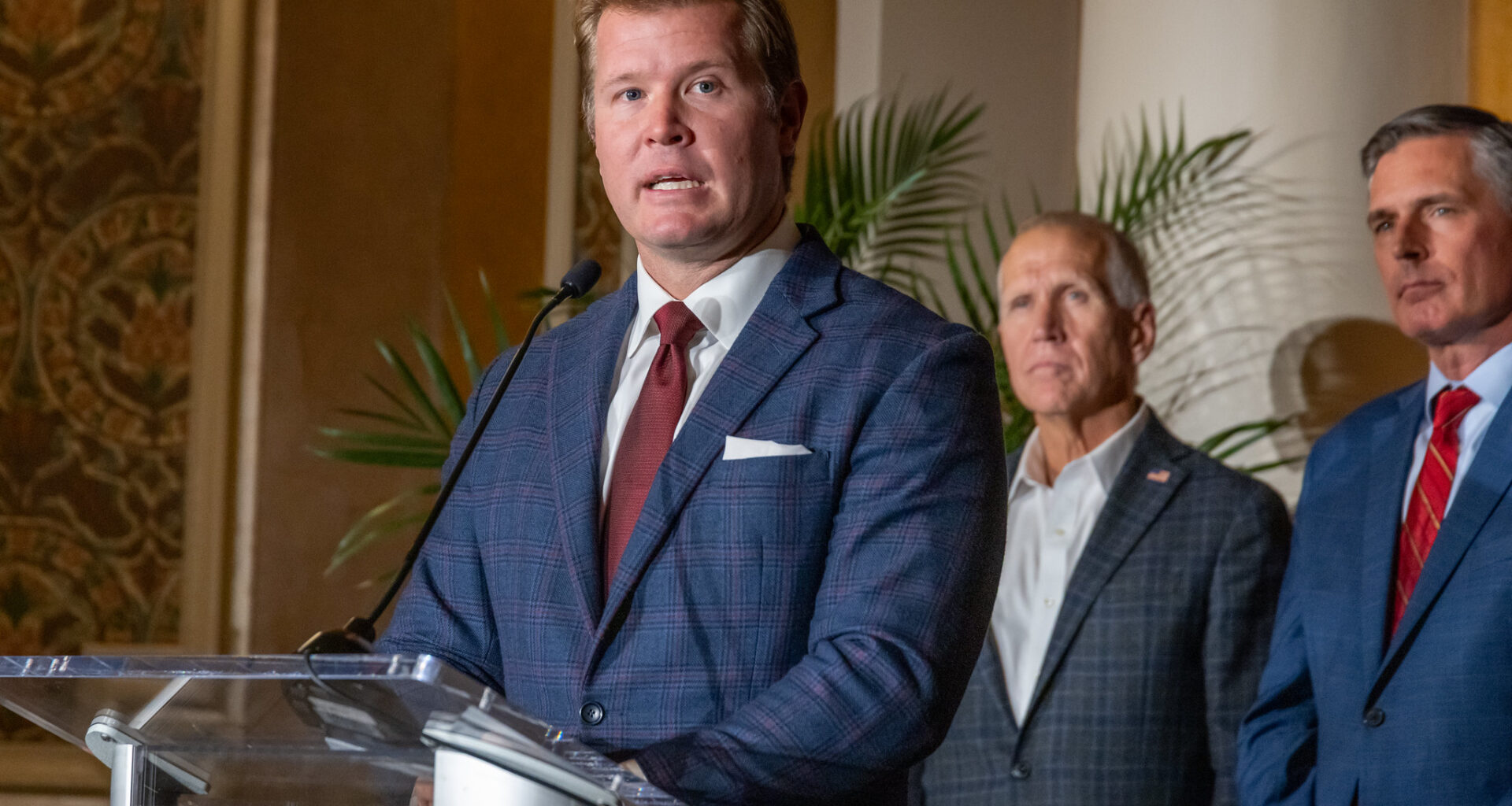
U.S. Sen. Tim Sheehy, the Treasure State’s junior senator, has signed onto a friend-of-the-court brief filed at the United States Supreme Court that argues against the common understanding of birthright citizenship, and leans heavily on case that was originally used to deny Native Americans citizenship in the nineteenth century.
Sheehy, a Republican, joined other members of Congress, including fellow U.S. Sen. Ted Cruz, R-Texas, and Rep. Jim Jordan, R-Ohio, in the court filing that says citizenship should be based on the person or parents’ allegiance rather than where a person is born.
The case is one of the most-watched legal issues before the Supreme Court as it decides whether the commonly understood practice of birthright citizenship — that is, granting citizenship to those born on United States soil regardless of the parents’ nationality — is still in line with the U.S. Constitution’s 14th amendment, which was passed in 1866 and established former slaves who were born as chattel in the South were fully citizens.
The brief filed at the Supreme Court level by the America First Legal Foundation argues that birthright citizenship has been misconstrued for years, and Congress meant to exclude some people who were born on U.S. soil.
The meaning behind birthright citizenship
The legal argument about birthright citizenship stems from the 14th Amendment, Section 1, which reads:
“All persons born or naturalized in the United States, and subject to the jurisdiction thereof, are citizens of the United States and of the State wherein they reside.”
The lawsuit focuses on the clause “subject to the jurisdiction thereof.” Attorneys for the Congress members say that children who are born in America by parents not here through the normal naturalization process are not under the “jurisdiction” of America because they have come here without permission. As an example, the lawsuit points to children born to ambassadors in America are not citizens, nor would “invading soldiers” or their children be considered citizens.
“Illegal aliens and their children are present in the United States without consent, i.e., only by defying its laws,” the lawsuit argues.
To help justify their argument, attorneys for the Congressional representatives trace their position to English case law that extends back to before the Pilgrims and the Mayflower. Using “Calvin’s Case” from 1608, attorneys argue American law and citizenship depends not upon where a person is born, but rather who a person owed an allegiance to.
The attorneys also claim that former U.S. Rep. John Bingham, a Republican from Ohio who helped write the 14th Amendment, argued in Congress that citizenship belonged to “every human being born within the jurisdiction of the United States of parents not owing allegiance to any foreign sovereignty.”
Native American cases
The lawsuit also leans into a dark period in America’s history in which federal law discounted or disqualified Native Americans as citizens of the United States for allegedly having loyalty to a tribe — something that wasn’t corrected until 1924 when the Indian Citizenship Act was signed into law by President Calvin Coolidge.
Attorneys for the Congressional representatives said that even as far back as 1790 the United States refused to recognize children of tribal nations as citizens because they “owed partial loyalty to their tribes.” They claim that this proves that the framers and even the country itself understood citizenship as something more complex and nuanced than the location of birth. The amicus brief argues that because Native Americans were stopped from being classified as citizens the 14th Amendment those who wrote it meant that there were people who were born on U.S. soil but were not citizens, rather they were “aliens.”
Citing a Supreme Court from 1884, attorneys for the group of Congress members pointed out the nation’s highest court had failed to recognize birthright citizenship of Natives specifically because the justices believed “they owed allegiance to their tribes.”
No permission, no citizenship
The latter part of the amicus brief said that because many of the undocumented aliens currently in the United States do not have permission to be in the United States, that they are not “permitted” to “reside here” and so the 14th Amendment should not apply to them.
Relying on the case United States vs. Wong Kim Ark from 1898, attorneys point out in their friend-of-the-court brief, “Wong by its facts (and some of its language) is limited to children born of parents who at the time of birth were in the United States lawfully and indeed were permanent residents.”
The court documents also provide references to news stories that claim as many as 100,000 women travel to America annually to have children to become citizens, creating a sort of birth tourism, although both citations are at least seven years.
“The national security implications of misconstruing the citizenship clause are thus real, immediate and severe,” the brief warns the court. “If the court adopts plaintiff’s reasoning, then it will strip from Congress much of its power to prevent hostile nations from manufacturing nominal citizens — persons who bear no allegiance to this country and who may even seek to subvert her interests.
“…The touchstone for birthright citizenship under the Fourteenth Amendment is total allegiance to the United States, rather than merely being subject to its laws or some subset thereof.”