
SENDAI—In just three months, the political landscape has shifted dramatically for the upstart Sanseito party, with the ruling Liberal Democratic Party co-opting the conservative platform that fueled its initial success.
After making its mark in last autumn’s Miyagi gubernatorial election, Sanseito is now struggling to gain traction in the Lower House election, even in its Sendai strongholds.
HITTING THE STREETS IN SENDAI
In Sendai’s Miyagi No. 1 and No. 2 electoral districts, where Sanseito’s candidate outpolled the incumbent governor last fall, party leader Sohei Kamiya is focusing his campaigning, calling the districts “crucial.”
On Feb. 3, the eighth day of the official campaign for the Feb. 8 election, a raspy-sounding Kamiya rallied a crowd of about 700 supporters in the city.
“This time, it all depends on Miyagi,” he said. “We want the people of Miyagi Prefecture, who showed us such passionate unity during the gubernatorial election, to lead this Tohoku region.”
The crowd, with many wearing Sanseito orange hats, scarves and jackets, showed their enthusiasm, responding with shouts of “Go for it!”
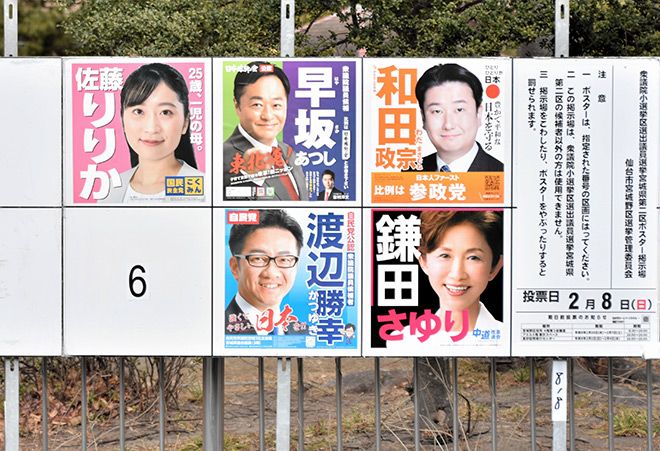
Standing with Kamiya was Masamune Wada, 51, a former Upper House member running in the Miyagi No. 2 district. Wada ran in last autumn’s gubernatorial election as a member of the Liberal Democratic Party.
Wada signed a policy memorandum with Sanseito opposing a controversial prefectural plan for a cemetery that would permit traditional Muslim burials—a project that Governor Yoshihiro Murai scrapped just before the election.
Wada’s platform also included “opposition to immigration policy.”
During that campaign, Kamiya’s four stump speeches for Wada each drew crowds of around a thousand onlookers.
Capitalizing on anti-Murai votes fueled by criticism of his long tenure, Wada surpassed the incumbent by more than 30,000 votes in the No. 1 and No. 2 districts, primarily among younger voters.
Although Murai ultimately secured his sixth term, Wada lost by a slim margin of only 1.83 percentage points.
“By making the issue of foreign nationals a point of contention, we were able to unearth support from non-affiliated voters and those who hadn’t been voting,” a senior Sanseito official recalled.
Three months later, Wada, now a Sanseito member, was campaigning at dusk at JR Sendai Station.
“Isn’t that the guy who ran against Murai?” one young passerby remarked.
Wada, who joined Sanseito in December, is the party’s only candidate in the Tohoku region with experience as a lawmaker and holds the top spot on its proportional representation list.
However, the hurdle for a breakthrough is high.
LDP STEALS SANSEITO’S THUNDER
Even during its national surge in last summer’s Upper House election, Sanseito secured only about 59,000 proportional representation votes in Sendai—roughly half the LDP’s total and trailing both the Constitutional Democratic Party of Japan and the Democratic Party for the People.
Sanseito has set a goal of winning 30 seats in the Lower House election, and Kamiya said the party hopes “to take about five seats in the single-seat districts.”
But the party faces a tough uphill battle, and the Miyagi No. 1 and No. 2 districts are no exception.
The stricter policies on foreign nationals that Sanseito has advocated for are now also being championed by the conservative administration of popular Prime Minister Sanae Takaichi.
A Sanseito official lamented, “We aren’t able to make it a point of contention.”
In the fight against the Takaichi administration, the official said, “I feel that conservative votes are returning to the LDP.”
Kamiya himself expressed a sense of crisis at the Feb. 3 rally.
“In the last (Upper House) election, we had an ‘Ishiba bonus’ and a tailwind blew for us without us doing anything,” he said, referring to former Prime Minister Shigeru Ishiba, who was beset by low approval ratings. “This time, a ‘Takaichi wind’ is blowing, so creating a tailwind (for Sanseito) is even tougher than it was during the gubernatorial election.”
(This article was written by Ikuko Abe, Ryo Oyama and Amane Sugawara.)