
San Diego faces economic challenges in the coming year, but one expert is guardedly optimistic about efforts to address affordability and the potential benefits of artificial intelligence.
Economists, business leaders and students gathered Thursday for the 42nd annual San Diego Economic Roundtable at the University of San Diego.
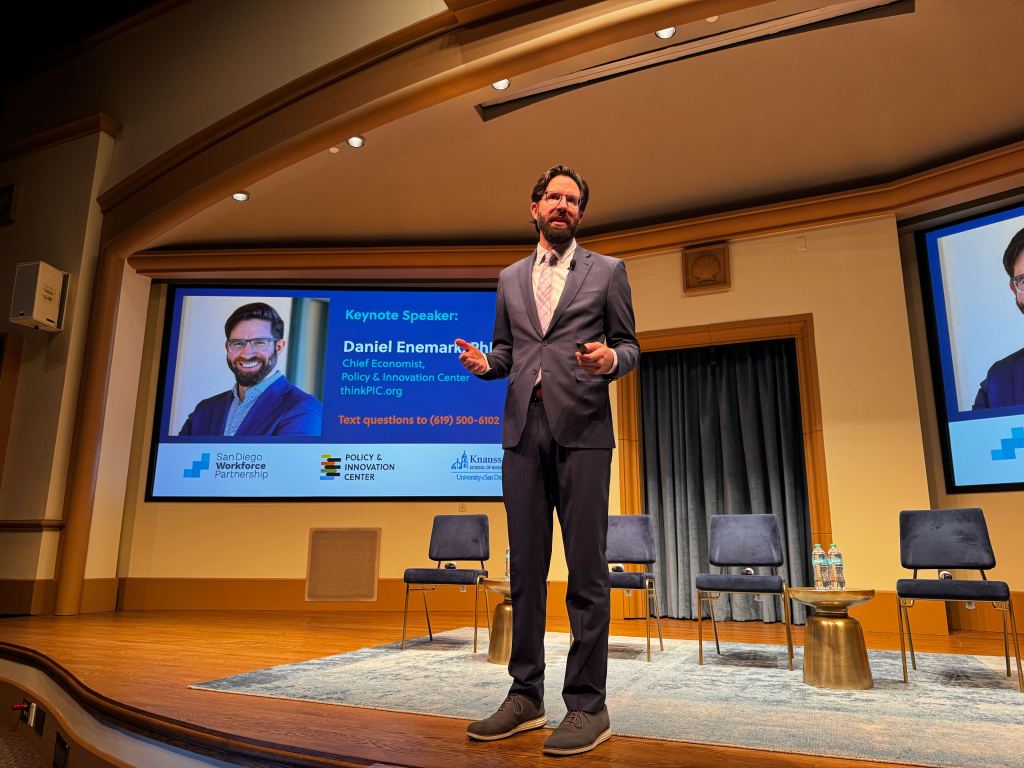
Keynote speaker Daniel Enemark, chief economist of the San Diego Regional Policy and Innovation Center, focused on economic challenges — housing, cuts to federal funding and segregation — but also looked at growth around AI and economic programs across San Diego County that may prove successful.
“I think that we can solve these problems,” he told the roughly 200 attendees. “I’m an optimist. But, we have to face the problems to solve them.”
Enemark started with several good things about San Diego County: A gross domestic product bigger than half of U.S. states, its No. 3 ranking in U.S. hotel occupancy (behind only Manhattan and Oahu in Hawaii), and that the county is home to the biggest concentration of military assets in the nation.
He said examples of things going well are a program from local nonprofit organization Casa Familiar that aims to convert low-income rentals into for-sale properties, the Black InGenius Initiative which gives academic guidance and assistance to Black youths in the county, and increased spending for behavioral health in San Diego County.
However, he kept returning to examples of how San Diego County was not working economically for large parts of the population.
“When people ask me how the economy is doing,” he said, “I ask, ‘for whom?’”
Affordability and segregation
Enemark said the region’s median income — $130,800, according to the U.S. Department of Housing and Urban Development — might seem high but has been eaten up by high inflation, which has historically run much hotter than the rest of the nation. He also showed how the median income has not kept up with housing costs.
He singled out Santa Barbara as an example of what San Diego could become. The coastal city was named the least affordable city in the U.S. by WalletHub last year. Its study was based on median home prices, tax rates, median incomes and more in the nation’s 300 largest cities. San Diego ranked No. 272, only 28 spots from the least affordable city in America.
“My worry is we become Santa Barbara,” Enemark said. “It’s great to live there if you can afford it — but you can’t.”
He said people who work in Santa Barbara can’t afford to live there, as is often said of San Diego. Enemark said you can see Santa Barbara’s population falling at a quicker rate than San Diego, and we could follow similar trends.
Enemark said San Diego County had a history of planning and land-use decisions that had a role in racially segregating the region.
He said that history is still alive with the distribution of different groups spread out throughout the county: Latino, Black and multiracial communities clustered in weaker economic areas than White and some Asian communities. He cited Brookings Institute data that ranked San Diego County as No. 50 out of 56 metro areas for racial inclusion in terms of income and employment gaps. Milwaukee, Wis., got the top spot.
Enemark said restrictive zoning, lack of homebuilding and other factors are keeping people of color out of San Diego County cities.
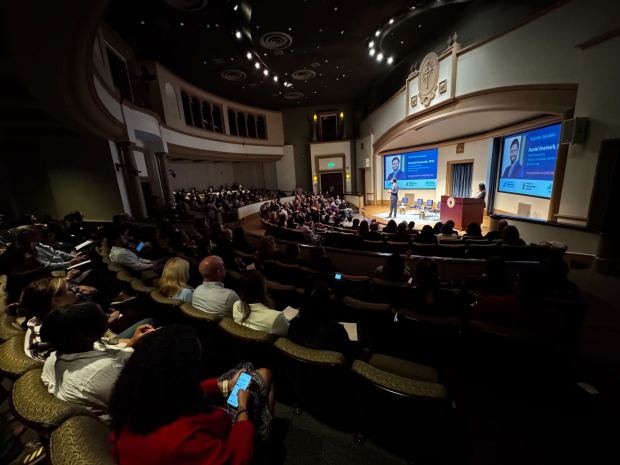 A crowd of roughly 200 attendees in early February attended the 42nd annual San Diego Economic Roundtable at the University of San Diego. (Phillip Molnar/The San Diego Union-Tribune)
Federal policy
Enemark cautioned that San Diego County was especially vulnerable to federal spending cuts from the Trump administration.
He said the U.S. Navy is the biggest employer in the region, followed by UC San Diego, Qualcomm, Sharp Healthcare, San Diego County and the San Diego Unified School District. Enemark said much of our employment base is tied to the public sector and research funding that goes to universities.
Enemark also used data from the Bureau of Economic Analysis that showed the San Diego metro area had the fifth-highest share of federal investment by metro areas in 2023, with most tied to defense spending.
“We have been tied to federal investment,” he said, “and we may need to think creatively about how we envision our economic future where there may be less of that investment.”
Artificial intelligence
Enemark cited several local companies involved in AI that may benefit from growth in the industry: Qualcomm, Illumina, Iambic Therapeutics, and General Atomics’ aeronautical division.
He cited predictions that identified the occupations most vulnerable to AI, which included office clerks, secretaries and administrative assistants (except legal, medical and executive), medical secretaries and administrative assistants, and insurance sales agents.
“AI is accessible to companies that have the resources to invest in it,” he said. “The companies that invest are going to be very dynamic, which is why it is really important in this region with our small businesses — which are such a big part of our economy — that they have access to some of these tools, too.”
Enemark said part of his concern with AI and technology was less about economics but more about a sense of decreased community. His examples included self-checkout, working from home, social media replacing in-person socializing, and AI replacing human interaction in several cases.