
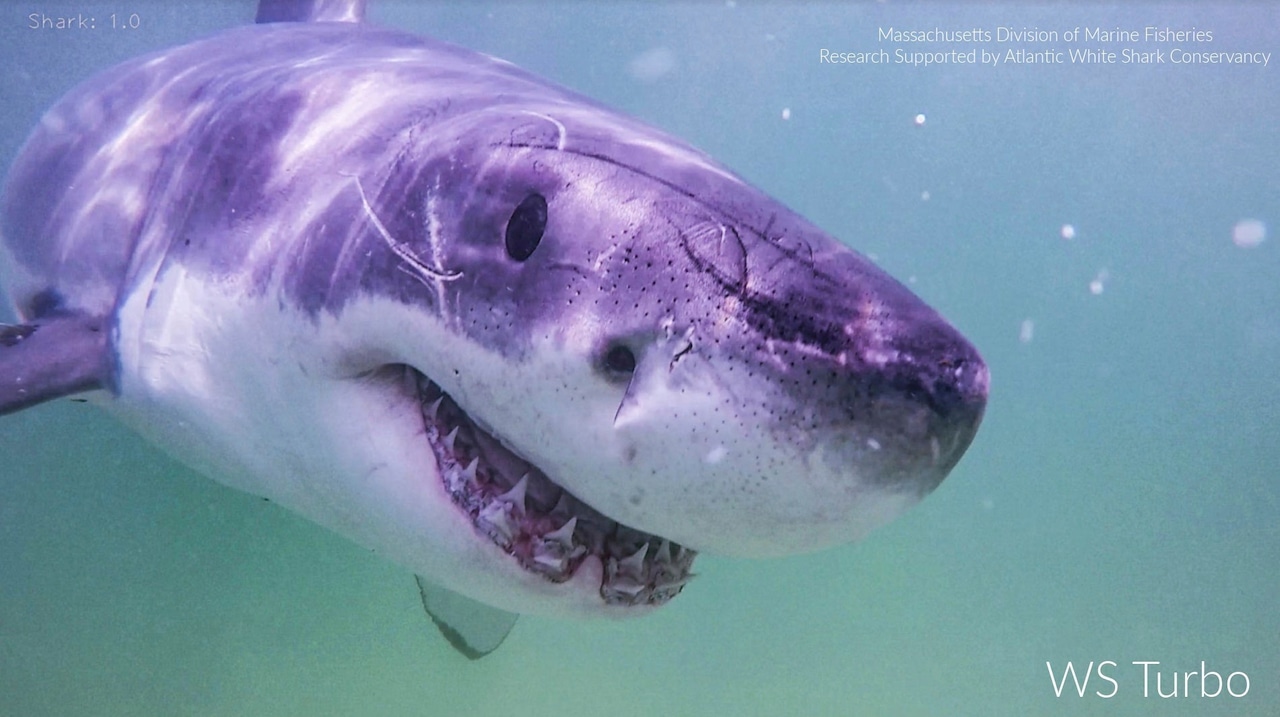
Tillamook was atwitter this week over reports that a tagged great white shark was swimming near the Barview Jetty.
A screenshot shared by Michael Domeier, president of the Marine Conservation Science Institute, showed a location ping for a 16-foot female white shark named Kara, last tracked Jan. 29 near Tillamook Bay.
We’ll note here that scientists tend to simply refer to the species as “white sharks.”
“As a community, we’re trying to step away from the sensationalized side of it, so we try to call them white sharks as opposed to great whites,” said Taylor Chapple, associate professor at Oregon State University’s Hatfield Marine Science Center and co-director of OSU’s Big Fish Lab. “The other thing I like to tell people is that it’s just sort of redundant because every shark is great.”
Domeier has studied sharks for decades and has appeared on several shows that are part of the Discovery Channel’s “Shark Week.” In an email, Domeier said Kara was one of six large adult white sharks tagged in October near Point Conception along the southern California coast.
“Although this is not an unprecedented migration for one of our tagged sharks, we’ve only had one other shark move that far north,” Domeier wrote. “We hope to follow Kara for a few years, eventually discovering where her pupping grounds are located.”
The Marine Conservation Science Institute’s Expedition White Shark app costs $3.99 and allows users to view the latest tracking locations for eight actively tagged sharks.
And while Kara’s sighting — more accurately her “pinging,” since no one has reported actually seeing the shark — sparked considerable social media chatter, white sharks along the Oregon coast are not unusual.
Chapple said white sharks are just one of 16 shark species seasonally spotted off the Oregon coast.
“Usually, it’s this time of year, January and February, when they’ll come up the coast from Mexico, California, and sometimes directly offshore,” Chapple said.
They come to Oregon to feed on marine mammals like seals and sea lions, but also seem to time their arrival with the seasonal availability of lingcod.
Just a week and a half ago, a person near Waldport captured video of a smaller white shark, probably about 9 feet long, eating a harbor sea.
Chapple has been studying and tagging sharks for more than 20 years, and he started OSU’s Big Fish Lab in 2019. At any given time, the Big Fish Lab has between 100 and 150 active tags on various shark species along the West Coast.
“ We put these tags on in order to learn where they’re going,” Chapple said. “ We always thought they were these coastal predators, but it turns out they only spend about half their time along our coasts.”
The other six months of the year, white sharks hang out in the middle of the Pacific Ocean, he said, about halfway between Baja and Hawaii, where they are believed to gather to mate.
White sharks can live 70 years. They are also one of the few warm‑blooded fish species, an adaptation that helps them be more effective hunters in cold water.
“They’re chasing down marine mammals, which are really dynamic, and so they need to be equally as dynamic,” Chapple said. “If you were a shark that was slow and lethargic, you can have a hard time catching a really fast and agile sea lion, for instance.”
California has more predictable hotspots where white sharks regularly gather to feed — such as the Farallon Islands near San Francisco, where they return annually to prey on elephant seals.
But Oregon doesn’t seem to have that same steady hunting ground. Instead, white sharks roam up and down the coast, and beyond. They’ve been regularly spotted near Port Orford and Newport, Chapple said. OSU has acoustic stations that have picked up shark tags at Seal Rock, Otter Rock, Cape Arago and Tillamook Head.
“They don’t seem to sit around and hunt in those locations as focused as we see down in California,” Chapple said. “In Oregon, they’re much more spread out and they’re much less predictable.”
White sharks have also been spotted farther north in Grays Harbor, Washington and Haida Gwaii in British Columbia.
It’s also worth noting that white sharks generally do not pose a danger to humans.
“They are not out to get us. They have been honing their skills as predators for 400 million years, and they’re really good at it,” Chapple said. “ We’re just not on the menu. The sharks are incredibly discerning, and they know what they want.”
The only fatality of the 31 documented shark attacks off the Oregon coast happened in 1975, when a California couple’s boat capsized 200 miles northwest of Astoria.
One way to support the Big Fish Lab’s work is through Oregon’s shark‑themed license plate. The “Vibrant Ocean” specialty plate features three shark species commonly found in Oregon waters: a salmon shark, a thresher shark, and a blue shark — not a white shark.