

MGO CPA LLP are most popular:
within Real Estate and Construction and Law Practice Management topic(s)
with readers working within the Accounting & Consultancy industries
Key Takeaways:
VPNs can make remote employees appear to be working in another
state and complicate income sourcing and apportionment.
Cost-of-performance states source income where the work is
physically performed, not necessarily where the company’s
headquarters, customers, or servers are located.
Misaligned data can expose organizations and employees to
unexpected multistate tax filing and withholding obligations.
Virtual private networks (VPNs) have become the quiet backbone
of remote work. They keep data secure and employees connected, no
matter where they log in. But there’s a hidden side effect that
few companies consider: when a VPN makes it appear as though an
employee in Texas is working from a server in California, the data
trail can mislead tax systems, auditors, and even internal finance
teams.
With each state applying unique sourcing rules, and budget
shortfalls prompting closer scrutiny, that digital illusion can
translate into very real tax exposure.
The Sourcing Framework
One of the obligations for companies providing services is
determining the correct state in which those services are sourced
for income tax purposes (and possibly sales and payroll tax
purposes). In this context:
Sourcing means the method a state uses to
assign a portion of a company’s receipts (especially from
services or intangibles) to that state.
There are two primary methods for sourcing income:
In cost-of-performance (COP) states, receipts
are attributed to where the “income-producing activity”
is performed.
In market-based sourcing (MBS) states,
receipts are attributed to the state where the customer receives
the service benefit or where the intangible is used.
Most states now use market-based sourcing. However, a handful of
states use cost-of-performance rules or mix them with market-based
regulations.
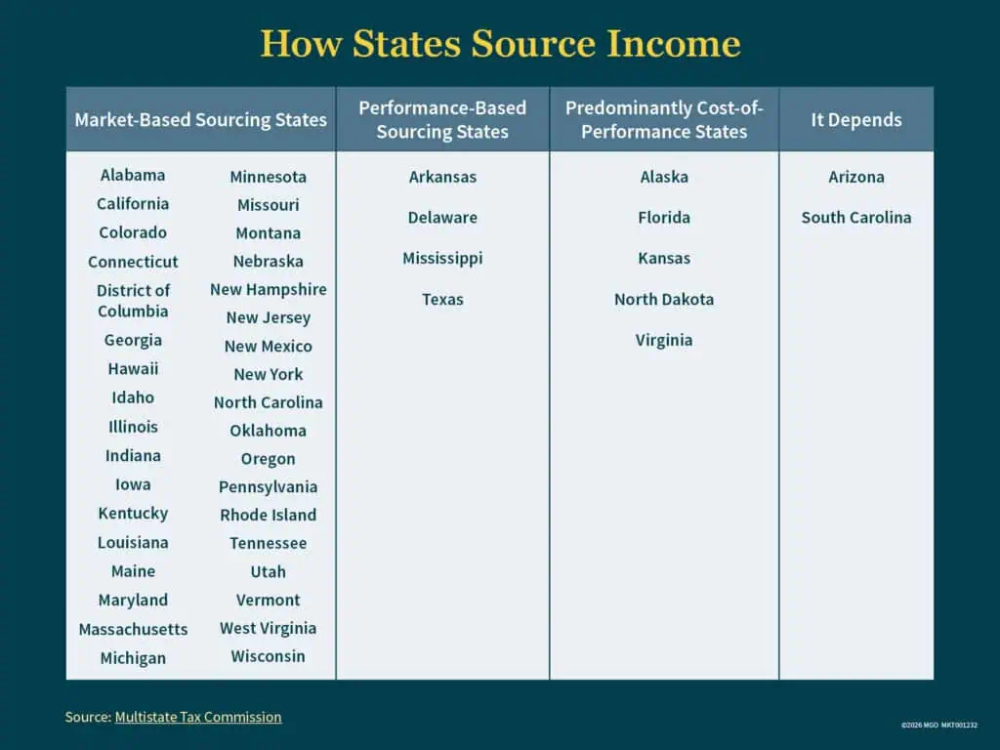
Remote Work + VPN = Sourcing Risk
Now, layer remote working arrangements, VPNs, and multistate
operations onto that patchwork of sourcing rules across states.
A VPN essentially acts as a tunnel between an employee and a
server location. So, for example, the system may show the employee
working in California based on an IP address or VPN endpoint, even
though the employee is working from their home in Texas or a
client’s office in North Dakota.
If the company reports time or allocates revenue based on the
VPN location rather than tracking the employee’s actual
physical work location, the sourcing basis may be incorrectly
skewed.
With a cost-of-performance sourcing state, the place where the
work is performed is critical. If the employee is physically in
Texas but the VPN makes it appear that the work was performed in
California, the company may misassign where the income-producing
activity occurred.
When employees travel or work in multiple states, tracking their
location can be complex. Without accurate records, such as
timesheets with locations, travel logs, and other documents, the
company and its employees may face unexpected multistate filing
obligations.
One Employee, Three States, and a Surprising Tax Bill
Here’s an example of how tax obligations can catch employees
off guard. Say ABC Company is based in California and hires a
remote employee living in Texas and regularly traveling to
corporate locations in Oklahoma and Kansas for work.
The employee may assume that because their home state of Texas
has no individual income tax, they don’t have to file any state
income tax returns. However, Oklahoma requires workers to file
non-resident income tax returns if they earn $1,000 or more in the
state and requires employers to start withholding state income tax
if employees earn more than $300 in any quarter. Kansas requires
workers to file non-resident income tax returns and their employers
to withhold income taxes if the employee spends one day
working in the state.
Since the company has corporate locations in Oklahoma and
Kansas, it presumably is aware of its income, sales, and payroll
tax obligations in those states. But the employee could be caught
off guard at tax time when they realize they need to file
non-resident returns in two states.
Income-Sourcing Issues to Address
Consider the following three steps to protect your organization
and its employees:
1. Track Actual Work Locations
If an employee is physically working at a location other than
your premises, you should have a process to capture that location,
even if they’re using a VPN. For example, maintain timesheets
that specify the state, travel logs for employees working in other
states, and periodically confirm the employee’s state of
residence. These records help support audit positions and align
apportionment with where the work is performed rather than the
virtual network location.
2. Communicate With Employees
Employees should understand that if they work in another state
due to travel or relocation, they may trigger individual income tax
or withholding obligations in that state. Communicate with them
clearly so they’re not surprised by multistate filings or
withholding changes.
3. Establish Internal Controls for Sourcing
Revenue
Consider how you track where services are performed for sourcing
purposes. Don’t rely solely on VPN logs or billing addresses.
Make sure you have a process for reconciling the employee’s
actual location.
Budget shortfalls are forcing many states to pursue audits
around remote work and income sourcing, so ignoring the issue and
hoping you won’t get audited isn’t a sound strategy.
The content of this article is intended to provide a general
guide to the subject matter. Specialist advice should be sought
about your specific circumstances.