
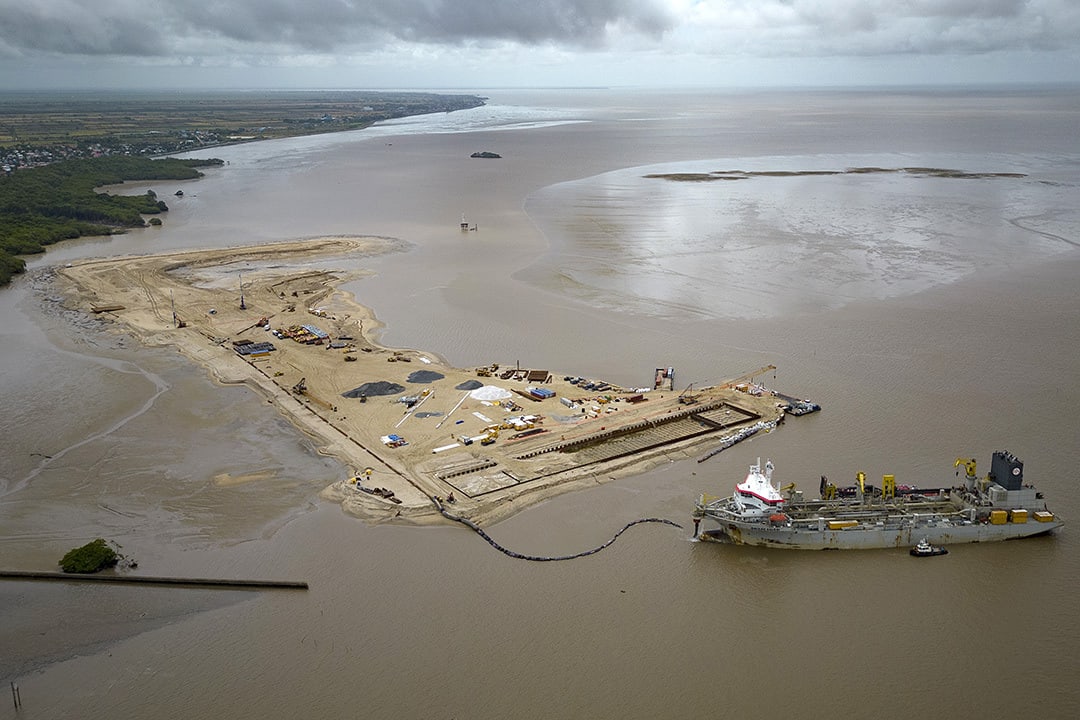
However, Guyana faces severe climate vulnerabilities. Most of the population lives on a low-lying coastal plain, protected only by a system of seawalls, extensive drainage canals, and mangrove forests. Although Guyana’s oil production represents a negligible share of global emissions, it poses direct environmental risks: spills could damage marine ecosystems, while increased industrial activity brings air and water pollution, habitat destruction, and general environmental degradation.
Despite this, oil revenues could help fund improved flood defenses and climate adaptation infrastructures. In a 2025 interview with the New York Times, President Ali said Guyana can balance climate leadership with fossil fuel exploitation, saying that oil revenue will be used to fund investments in infrastructure and the energy transition.
Economic. If its oil assets are not sustainably managed, Guyana risks falling victim to the so-called resource curse, of which neighboring Venezuela is a cautionary example. Compounding this risk, Guyana’s oil income is surging just as the world is shifting toward electrification and lower-carbon energy, threatening to lock the country into dependence on a depreciating asset and underscoring the importance of economic and energy diversification. While some analysts point to Norway as a model country [PDF] that has avoided these pitfalls, Guyana does not yet have the institutional capacity to replicate it. Guyana has created a sovereign wealth fund to help control oil revenues and fund national development, but it is too early to tell whether the country will be able to maximize the long-term social and economic benefits from its resources and strengthen its democracy.
The International Monetary Fund has commended Guyana’s strong economic growth, noting its economic outlook “remains highly favorable.” But public reactions to the government’s management of its newfound wealth have been mixed. According to the Inter-American Development Bank, approximately 58 percent of Guyana’s population lives in poverty despite the oil boom. The management of the country’s new oil wealth was a key issue in Guyana’s 2025 presidential election, with some opposition parties arguing that oil revenues benefit politically connected elites more than ordinary citizens and promising they would seek to renegotiate the contract with ExxonMobil.
Political. Guyana has long struggled with corruption, including bribery, embezzlement, and a weak rule of law. The country’s politics are also largely organized along ethnic lines, with the two major parties, the People’s Progressive Party/Civic (PPP/C) and the People’s National Congress (PNC) party, drawing primary support from the Indo-Guyanese and Afro-Guyanese populations, respectively. In 2020, Guyana held a general election after President David A. Granger’s government (led by a PNC-dominated coalition) lost a no-confidence vote in 2018. It was the first to occur since the 2015 oil discovery and was highly contested, leading to a delayed transfer of power when Granger refused to accept the results. The advent of oil revenues intensified the political stakes [PDF] surrounding the election, as it generated expectations of broad economic improvements. Additionally, a major criticism of the opposition during the campaign was the ruling coalition’s failure to secure a better oil deal with international companies. If not properly managed, the influx of oil wealth risks further undermining democratic governance, entrenching inequality in an already unequal society, and reinforcing ethnic divisions.
This work represents the views and opinions solely of the authors. The Council on Foreign Relations is an independent, nonpartisan membership organization, think tank, and publisher, and takes no institutional positions on matters of policy.