
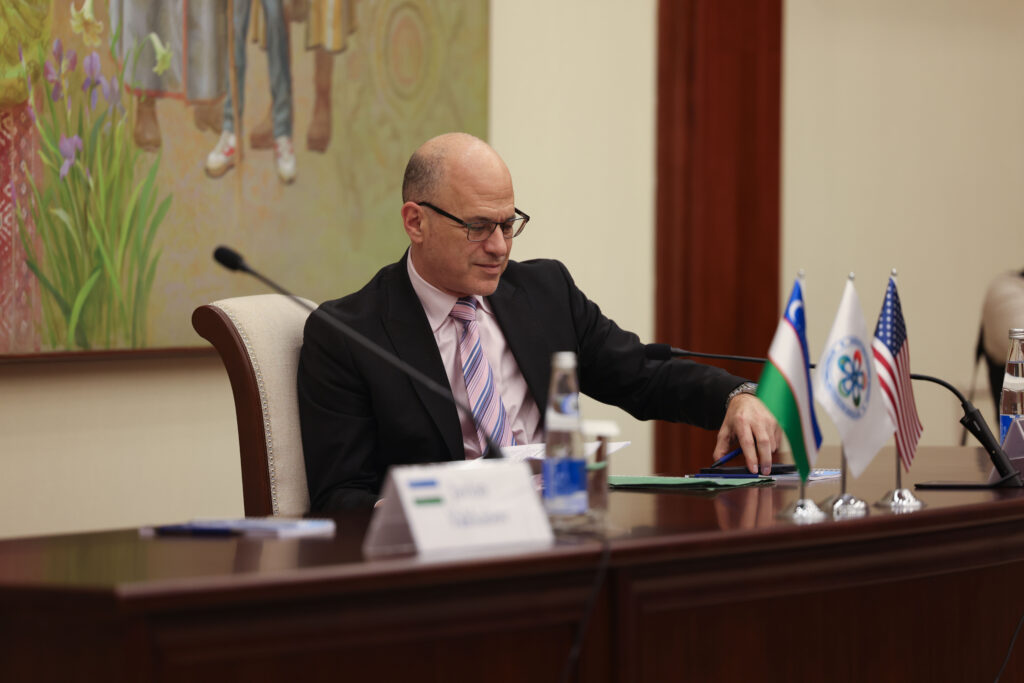
Thank you for that wonderful introduction, Ambassador Vakhabov. Ambassador Vakhabov has neglected to say what an important role he has played in the development of U.S.-Uzbekistan relations as ambassador in Washington for, I think, over five years—six years—and of course the important role he played before that and since then working at the Institute. So, it is my pleasure to accept his invitation and join all of you.
Ambassador Vakhabov, esteemed colleagues, members of the diplomatic corps, and friends: it is an honor to be here today.
I am exceptionally grateful to the International Institute for Central Asia for hosting this discussion and for providing a forum that reflects the spirit of cooperation and regional dialogue that defines the C5+1 partnership. Although circumstances prevented me from joining you last October as we marked the tenth anniversary of the C5+1, I am especially pleased to have this opportunity now—at a moment when our cooperation is not only enduring, but accelerating.
When our governments launched the C5+1 in Samarkand in 2015, we set out to create a forum where the five Central Asian states and the United States could work together on common economic, energy, and security issues.
Now, more than a decade later, the C5+1 has matured into a durable and results-oriented platform that reinforces the United States’ unwavering respect for the sovereignty, independence, and territorial integrity of every Central Asian country. It reflects a shared understanding that regional cooperation strengthens national resilience.
Before highlighting specific achievements, I want to underscore that the principal credit for the success of the C5+1 belongs to the countries of Central Asia themselves. The vision and leadership shown by the region’s governments—including the government here in Uzbekistan—particularly their willingness to deepen cooperation and overcome long-standing barriers—have made the C5+1 an effective mechanism rather than a symbolic one. That success was on full display in November, when President Trump and the leaders of the five Central Asian countries gathered in Washington for the very first C5+1 White House Summit. That meeting sent a clear signal: this partnership is not only durable, it is strategic—and it enjoys sustained political commitment at the highest levels.
Now, the economic pillar of C5+1 engagement has been among its most visible successes.
Our efforts to strengthen economic ties between the United States and Central Asia long predate the C5+1, including through the Trade and Investment Framework Agreement, which we have used for more than two decades. At the same time, the C5+1 gave that work new energy and a regional dimension, aligning assistance and policy reform with the goal of greater connectivity and shared growth.
Together, we have worked to:
Harmonize customs and border procedures Strengthen food safety and sanitary standards Promote secure and inclusive digital infrastructure Enhance intellectual property protection Support entrepreneurs and regional marketplaces
We have also promoted regional energy cooperation, facilitated cross-border electricity trade, and trained more than 2,000 energy specialists, while strengthening cooperation on shared resources in the Syr Darya and Amu Darya basins.
Working in the C5+1, the broader region, and through international lenders and financial organizations, the United States has also supported both hard and soft infrastructure projects to develop the Trans-Caspian Trade Route. These efforts have contributed to helping that route handle larger and larger amounts of cargo, more quickly, and more efficiently, giving the C5 countries a key alternative trade route to the United States and international markets.
Since President Trump’s historic peace summit that brought Armenia and Azerbaijan together, we continue to advance the Trump Route for International Peace and Prosperity (TRIPP), which will facilitate transit connectivity from Central Asia through the South Caucasus and onward to the West – a historic step toward building strong, interconnected economies and sustaining peace in the region.
Recent months have also underscored a clear truth: the success of the C5+1 depends not only on governments, but on the energy, innovation, and confidence of the private sector. Last week, Special Envoy for South and Central Asia Ambassador Sergio Gor opened the B5+1 Forum in Bishkek, where one of the largest U.S. commercial delegations ever to visit Central Asia came together with regional partners. The presence of so many leading American companies sent a powerful signal: the United States sees Central Asia not as a peripheral market, but as a region of growing strategic and commercial importance.
As Ambassador Gor emphasized, this administration is committed to peace through prosperity—the principle that durable stability is built through economic opportunity, infrastructure, and commercial integration. Initiatives such as enhanced trans-regional connectivity linking Central Asia to global markets reflect this approach, strengthening economic ties while reinforcing regional resilience.
The results are already tangible. At the Washington Summit, the United States and Central Asian partners announced more than 20 commercial agreements and memoranda of understanding valued at approximately $40 billion. These deals span energy, transportation, aviation, technology, and logistics—and they are only the beginning. More agreements are in development, driven by strong demand on both sides.
The message from the United States government to American companies is clear: the United States stands behind its businesses abroad. There is no deal too small if it creates jobs, strengthens American competitiveness, and advances our national interests. This hands-on approach—where diplomacy supports commerce and commerce reinforces strategic partnerships—is a defining feature of our engagement in Central Asia today.
The B5+1 platform will continue to play a critical role in this effort. Since its launch, task forces have brought together businesses and policymakers to identify barriers, develop solutions, and deliver practical recommendations across priority sectors—from critical minerals and finance to e-commerce, logistics, and information technology. Together, these efforts demonstrate that the C5+1 is not only a diplomatic framework, but a delivery mechanism—one that
converts shared vision into concrete outcomes for our economies and our people.
Energy security is also fundamental to economic growth, and it is an area where cooperation has deepened significantly. Over the past decade, the United States has supported Central Asian efforts to improve energy efficiency and attract private investment in new technologies. We have also shared technical expertise as countries explore diversified energy options—including nuclear power—to meet rising demand. More recently, both Uzbekistan and Kazakhstan have announced plans to build nuclear power plants, and the United States lent its technical expertise to help diversify energy supplies in Central Asia.
Meanwhile, the region’s abundant reserves of critical minerals are attracting global interest. Through the C5+1 Critical Minerals Dialogue, launched in 2024, we are working together on geological exploration, mining and processing, and integration into global supply chains. This cooperation strengthens the resilience of American industries while ensuring that Central Asia fully benefits from its extraordinary mineral wealth. This cooperation took an important step forward earlier this month at the February 3–4 Critical Minerals Ministerial in Washington, where Uzbekistan and Kazakhstan joined our global partners and allies to secure global supply chains for components vital to technological innovation, economic resiliency, and national security.
Prosperity cannot endure without security. The United States remains a reliable partner in strengthening the peace and stability of Central Asia. Through the C5+1, we have expanded regional cooperation to counter terrorism, combat extremism, and confront emerging threats in cyberspace. C5+1 programs also improved customs and border security while facilitating legitimate trade, resulting in major seizures of illicit goods including dangerous synthetic drugs that threaten the lives of people in America and Central Asia.
Together we have trained over 1,000 law enforcement officials, improved border security, and enhanced information-sharing. These measures are already reducing vulnerabilities. A striking example came in 2025 when Kyrgyzstan and Tajikistan reached a historic agreement to resolve their longstanding border disputes through the Khujand Treaty. By demilitarizing contested zones and coordinating water management, they not only reduced the risk of conflict but also set a powerful precedent for regional security cooperation.
The United States also partners with governments to combat human trafficking, disrupt transnational criminal organizations and narcotics traffickers, and strengthen border security. These efforts build trust and resilience, enabling the region’s people to pursue prosperity free from the shadow of exploitation.
Now equally important are the ties that bind our people. We have supported hundreds of people-to-people exchange programs that brought Central Asians together in the region and on programs to the United States, including youth, journalists, influencers, and experts in a variety of fields and sectors. Through C5+1 cooperation, we have also demonstrated our respect and support for local languages, culture, and history, including by elevating cultural heritage partnerships that preserve Central Asia’s extraordinary history and present it to global audiences. Since 2015, we have funded over 28 projects across Central Asia for cultural heritage preservation, trained dozens of museum professionals, and created a partnership among Central Asian history museums. And with the C5+1 Joint Statement of Intent on Cultural Heritage Preservation released following the Summit in November, our leaders reaffirmed the importance of protecting and preserving the unique cultural heritages of the C5+1 countries for years to come.
It is through such connections that our diplomacy is most deeply rooted. The friendships formed between young entrepreneurs, scientists, artists, and students will sustain the partnership long after today’s policymakers have passed the baton.
Now, looking ahead, the C5+1 is entering its second decade with confidence and purpose.
The launch of the Board of Peace, with the participation of Uzbekistan and Kazakhstan, reflects a shared commitment to dialogue, conflict prevention, and cooperative security beyond the region.
Looking forward, the United States remains committed to deepening engagement with Central Asia through the C5+1—expanding trade and investment, strengthening energy and critical mineral supply chains, and reinforcing collective security in an increasingly complex global environment.
Ladies and gentlemen, the C5+1 is more than a diplomatic platform. It is a community—six nations bound together by a commitment to sovereignty, prosperity, and peace.
Ten years ago, we planted the seed of that community in Samarkand. Today, we see how it has grown—through cooperation, trust, and shared vision. And tomorrow, with your continued leadership and the engagement of our peoples, it will flourish still further.
Thank you, and I look forward to the discussions and ideas this forum will generate as we embark on the next decade of partnership.
Thank you very much