

UK ‘ended 2025 firmly in the slow lane’ – what the experts say
Reaction to the news that the UK grew by just 0.1% in the final quarter of 2025 (see earlier post) is rolling in, and City experts aren’t impressed.
Lindsay James, investment strategist at wealth managers Quilter, warns that the picture is ‘rather bleak at the moment’.
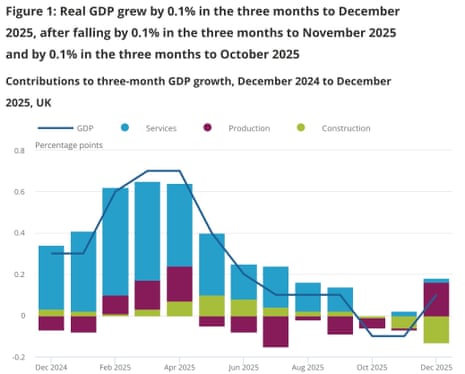
“A long list of data revisions from the ONS has revealed the UK economy barely kept its head above water in the final quarter of last year, with GDP growth coming in at just 0.1% after downward revisions to the previous two data prints. December saw a meagre uplift of 0.1%, which was in line with expectations, but November’s growth has been revised down to 0.2% from the 0.3% first reported.
“The Christmas period was weak by historical standards, and that is laid bare in today’s data. The services sector, which had previously been noted as the largest contributor, showed no growth and its impact was revised down from 0.2% to nothing in the three months to November too. Surprisingly, production output grew by 1.2%, having fallen by 0.1% in the three months to November, but it was outweighed by a fall of 2.1% in the construction sector which followed a 0.9% fall previously.
Scott Gardner, investment strategist at JP Morgan Personal Investing says the economy failed to hold onto the stronger growth seen in early 2025:
“The UK economy ended 2025 firmly in the slow lane, undershooting expectations and remaining in a low gear in the final quarter of the year as businesses and consumers digested the Chancellor’s November Budget. This marks a clear reversal in fortunes for the economy after strong growth shown in the first half of the year failed to carry over into the rest of 2025.
“Many will be hoping that the slow pace of economic expansion in the final quarter is only temporary after the Jaguar Land Rover shutdown stunted growth in the Autumn and led to a sharp fall in productivity. Services performed well over December, but construction and industrial production activity declined. Consumer spending showed more promising signs and has bounced back as real wage growth has fed through into higher retail and online spending.
 Photograph: ONS
The Unite union are calling for more investment to lift growth; their general secretary Sharon Graham says:
“Today’s figures are further proof that the UK economy will not get the growth we were promised until we reverse our historic levels of underinvestment.
“The figures also show that real household disposable income fell in 2025. Families up and down the country are getting poorer in real terms.
“We need to stop the rot and start delivering for everyday people.”
Key events
Show key events only
Please turn on JavaScript to use this feature
Reeves: Confident of stronger growth this year
Chancellor Rachel Reeves has predicted there will be stronger growth in the UK economy this year than in 2025.
Speaking after this morning’s data showed annual growth rose to 1.3% last year, Reeves says the government is creating the “conditions for growth”. She cites the six cuts to interest rates since the 2024 election, inflation set to fall towards the 2% target, reductions on energy bills set for April, and the planning and infrastructure bill.
Reeves says:
We can’t turn things around overnight, but we have created the conditions now for the economy to grow and it is doing just that.
I’m confident that the decisions that we have made to return stability to the economy, to bring investment to our economy, and the changes we’re making around planning an regulation will help deliver stronger growth this year, building on the economic growth we’ve seen in 2025.
‘We can’t turn things around overnight, but we have created the conditions now for the economy to grow and it is doing just that.’
Chancellor Rachel Reeves reacts to the ONS figures that report a growth of 0.1% for the final quarter of 2025https://t.co/KZOBgYGFRC pic.twitter.com/sCAP4z8Tg1
— Sky News (@SkyNews) February 12, 2026
The chancellor also spoke about GDP per capita accelerating last year – it did indeed rise by 1.0% annually in 2025, but actually shrank in the third and fourth quarters.
Andrew Sentance, a former Bank of England policymaker, reckons the UK is on track for “the most dismal decade for growth in 100 years”.
It may be a little early to be calling this race (we’re only halfway through the decade!), but Sentance has spotted that annual growth in the 2020s is below the historic average, and the weakest since the ‘roaring 20s’.
GDP up 0.1pc in the final quarter of last year – continuing the recent pattern of very weak growth. Economy grew by just 1.3pc in 2025 as a whole, with the 2020s on course for the worst UK growth performance since the 1920s – the most dismal decade for growth in 100 years! pic.twitter.com/5TGYitvu4K
— Andrew Sentance (@asentance) February 12, 2026
ShareBAT expected to cut jobs through AI productivity drive
British American Tobacco (BAT) is set to cut jobs and increase its use of AI as part of efforts to “simplify” its operations.
BAT, which sells cigarettes, tobacco and other nicotine products, announced a new AI-driven productivity programme this morning. Interim finance chief, Javed Iqbal, said it will allow BAT to simplify and automate using data analytics and AI tools, adding it would affect staffing levels.
He told a call:
“It will have an impact on the size of the organisation.”
The UK economy may shift out of the ‘slow lane’ in the current quarter, although it’s still unlikely to hit top gear.
NIESR, the economic research institute NIESR, has predicted that UK GDP is expected to grow by 0.3% in the first quarter of 2026.
Fergus Jimenez-England, associate economist at NIESR, says:
“Today’s GDP figures show that growth in 2025 was 1.3 per cent, coming in slightly below expectations. The fourth quarter only just scraped together a positive growth figure, with services disappointingly showing no growth.
That said, surveys point toward a recovery in business sentiment in the New Year after months of damaging speculation in the run up to the Autumn Budget.
With the Spring Statement upcoming in March, the Chancellor should look to support this change in sentiment by avoiding a repeat of last year and refrain from further policy changes.”
In a relief for struggling homeowners, the number of people falling into arrears on their mortgages – or having their property repossessed – has fallen.
Industry body UK Finance has reported a 4% decrease in homeowner mortgages in arrears in the last quarter of 2025, while the number of buy-to-let (BTL) mortgages in arrears fell by nine per cent compared with the previous quarter.
UK Finance says:
In the fourth quarter of 2025, there were 80,490 homeowner mortgages in arrears of 2.5 per cent or more of the outstanding balance. This was a four per cent decrease compared with Q2 2025. The overall proportion of mortgages in arrears remains low, at 0.92 per cent of homeowner mortgages and 0.5 per cent of BTL mortgages.
Within this total, 27,780 homeowner mortgages were in the lightest arrears band (representing between 2.5 and 5 per cent of the outstanding balance), four per cent fewer than in the previous quarter.
The number of BTL mortgages in arrears also fell, down nine per cent compared with the previous quarter, to 9,520.
Mary-Lou Press, president of the National Association of Estate Agents, comments:
“We are starting to witness the positive impact of proactive lender engagement and the resilience shown by many borrowers despite ongoing cost-of-living pressures and higher interest rate environments over recent years. The fact that arrears levels are a fraction of those seen during the 2009 financial crisis offers important reassurance about the overall stability of the housing market.
“The decline in buy-to-let arrears is particularly notable. A stable and financially secure landlord base is essential to sustaining supply in the private rented sector at a time when demand remains extremely high. Continued lender flexibility and early engagement will be key to ensuring landlords can manage financial pressures while maintaining much-needed rental homes.
ShareAnalysis: UK economy limps along. but there are reasons for optimism in 2026
Our economics editor, Heather Stewart, also sees reasons to be more optimistic for 2026:
Policymakers at the Bank of England’s rate-setting meeting last week pointed the way to a seventh interest rate cut, perhaps as soon as next month, despite leaving rates unchanged at 3.75%.
That was largely because, alongside post-dated tax rises, Rachel Reeves’s budget included a slate of price-cutting measures, including a reduction in energy bills, which will help inflation to move back down to target.
The Treasury will be hoping that another rate cut, alongside its anti-inflation measures, will cheer up wary consumers and reassure businesses. Forward-looking surveys have pointed to an upturn of late, though there is continued anxiety about job cuts.
Reeves will have been encouraged by news that business investment, which Labour sees as crucial to improving the UK’s flailing productivity, was up 3.5% in 2025 (though it fell in the fourth quarter).
More here:
Although today’s GDP report was disappointing, the UK’s economic prospects are brighter, analysts at Nomura argue.
They told clients:
It was a lacklustre end to 2025 for the UK economy, with growth of just 0.1% q-o-q in Q3 and Q4. Consumer spending grew modestly in Q4 but remains depressed relative to the UK’s peer group, while business investment fell.
Prospects look brighter, however, with expectations (BoE, consensus, ourselves) for an economic recovery in 2026 and beyond. Lower interest rates should help, but any bounce in growth will likely require a fall in the saving ratio – especially if the BoE’s view of weak real income growth proves correct.
ShareIEA cuts forecast for oil demand growth
The International Energy Agency has cut its forecast for oil demand growth this year.
In its monthly report, the IEA has revised its forecast for world oil demand growth for 2026 “moderately lower” to 850,000 barrels per day as “economic uncertainties and higher oil prices weigh on consumption”. That’s up from 770,000 barrels/day in 2025.
The IEA also predicted global oil supply will rebound in the coming months, after an “exceptional plunge in January” due to extreme winter weather in North America, and disruptions at Kazakhstan’s key export terminal since November.
Today’s GDP report is not great news in the fight against inflation, reports Professor Costas Milas, of the University of Liverpool Management School:
At face value, today’s GDP reading looks “good” on the inflation front. According to my own estimates, output gap (that is, output relative to “trend” output) is estimated at -1 per cent ended up at 2025Q4, down from -0.8 per cent in 2025Q4. This is in line with the BoE’s latest Monetary Policy Report and should drag CPI inflation down. The problem, however, is that the negative output gap contributes very little to inflation developments.
As I show in my latest LSE Business Review blog the recorded negative output gap is less important for CPI inflation than the persistence of inflation or public inflation expectations, the latter remain elevated and close to 3 per cent. A quick drop in inflation is far from certain.
ShareStarmer: The economy is growing
Prime minister Keir Starmer has claimed that the (modestly) growing economy means people have ‘more money’ in their pockets.
Posting on X, he says:
Job number one is easing the cost of living pressure that many people still feel.
Today’s GDP figures show our economy is growing. That means more money back in your pocket.
I know there’s more to do, but we are heading in the right direction.
Job number one is easing the cost of living pressure that many people still feel.
Today’s GDP figures show our economy is growing. That means more money back in your pocket.
I know there’s more to do, but we are heading in the right direction.
— Keir Starmer (@Keir_Starmer) February 12, 2026
However (as flagged earlier) GDP per head actually shrank by 0.1% in October-December, meaning that the population grew faster than the economy in the final quarter of the year.
As GDP per head is a key measure of living standards, this suggests people became slightly less prosperous in the final three months of last year.
ShareFTSE 100 hits record high over 10,500 points
Despite the UK’s weak growth, the London stock market has hit another record high this morning.
The FTSE 100 share index rose over the 10,500 point mark in early trading to hit a fresh intraday high of 10,535 points, up 63 points or 0.6%.
It was lifted by Schroders, the UK asset management firm, which has accepted a £9.9bn takeover over from US investor Nuveen. This pushed Schroders’ shares up by almost 30% this morning.
The UK economy may pick up, slightly, in the first half of this year, economists suggests.
Andrew Hunter, associate director and senior economist at Moody’s Analytics, says:
“The fourth-quarter GDP data confirm that the U.K. economy ended 2025 on a subdued note with GDP expanding by just 0.1%, in line with the third quarter’s reading.
Household and government consumption grow modestly, but this was offset by a contraction in fixed investment and a slump in exports. The survey evidence has improved in recent months and we expect the pace of growth to pick up slightly over the first half of 2026, benefiting from further monetary easing and stronger growth in European trading partners.
But persistent global headwinds and fiscal consolidation will prevent a more meaningful acceleration.”
ShareBudget uncertainty blamed for weak growth
Experts are blaming budget uncertainty for the UK’s weak end to 2025.
Danni Hewson, head of financial analysis at AJ Bell, says:
“Subdued, sluggish, and slow – three words that sum up UK economic growth during the last three months of 2025 and in the year as a whole.
“Whilst the chancellor can celebrate the fact the UK enjoyed the fastest growth of any European G7 country last year and that growth was a smidgeon higher than in 2024, she does have to bear responsibility for the choices made and the timing of her last Budget. The service sector, which is often the powerhouse of the UK economy, has struggled to deal with reduced confidence which was exacerbated by the months of speculation and pitch rolling ahead of last year’s unusually late Budget.
Adam Hoyes, senior asset allocation analyst at wealth manager Rathbones, is concerned by the 2.7% quarterly decline in business investment in Q4 2025:
Uncertainty ahead of the Budget at the end of November probably played a role here, but it still underscores what we see as the structural cause of the UK’s poor growth rate in recent years – persistently low rates of investment. Any further uncertainty created by a potential change of occupants at Number 10 and 11 is unlikely to improve that situation in the short term.
ShareBoE deputy governor: reasonable to expect rate cut over next couple of meetings
A Bank of England deputy governor has predicted that UK interest rates will be cut again soon.
On a visit to Manchester, Sarah Breeden told the Business Live website (no relation) that a rate cut could come in the next couple of meetings.
She said:
“If we continue to have the economy develop as we expected and if there are no shocks – to be clear those are two big ifs… I think it’s reasonable to expect there to be a cut over the next couple of meetings.”
Breeden is one of the four members of the Bank’s Monetary Policy Committee who voted to cut rates last week, but were outvoted by the other five.
ShareBank of England could cut rates in March to spur growth
Britain’s weak growth will put more pressure on the Bank of England to lower interest rates.
The Bank held borrowing costs unchanged last week, but the money markets narrowly expect a cut in March.
Luke Bartholomew, deputy chief economist at Abderdeen, says:
“The UK economy managed to eke out some very modest growth at the back end of last year. On a purely national accounting basis, the economy started 2026 with very little momentum. But looking at various surveys, there were some tentative signs that sentiment turned a corner and started to improve after the budget last year, which could help deliver a pick-up in activity this year.
However, recent political uncertainty may see that sentiment bounce reverse. And it is still hard to see what will drive a sustained increase in the underlying rate of growth this year.
All of which means that the Bank of England is set to continue to lower interest rates to try to support growth, and we expect the next cut at the March meeting.”
TUC general secretary Paul Nowak is calling for ‘quickfire’ rate cuts:
“It’s welcome that the economy kept growing in December, and last year’s growth of 1.3% was the strongest for three years.
“But many workers are not yet feeling the benefit in their pockets. Household incomes are still being squeezed by a relentless cost-of-living crisis.
“Many working families don’t have any money left over to spend on the things that keep our economy moving – meals out, shopping on the high street, and family days out. That’s bad for families and bad for the wider economy.
“This doom loop must end. Ministers must stay laser-focused on cutting working people’s household costs and improving living standards this year.
“And the Bank of England must go further and faster with quickfire interest-rate cuts in the months ahead.
Britain’s economy ended 2025 on “a lacklustre note”, says James Smith, developed markets economist at ING, with growth of just 0.1% in the final quarter.
Smith adds:
What’s particularly eye-catching from the release is just how weak business investment (-2.7%) and construction (-2.1%) came in during the final few months of the year.
The former will have been heavily influenced by volatile car production, linked to a major cyberattack at the tail-end of the third quarter, even if it’s tempting to blame it on the wider uncertainty in the run-up to the Budget and the weakness in business confidence.
ShareNew housebuilding slumped in Q4
However, today’s GDP report also shows the government is struggling to hit another target – to boost housebuilding.
Private housing new work fell by 3.6% in October-December, which helped to drag output in the wider construction sector down by 2.1% in the quarter.
Budget concerns stalled construction output by an estimated 2.1% across 7 of the 9 sectors in Q4 2025. New work and repair and maintenance both fell by 2.6% and 1.5%, respectively but it was new housing, which fell the hardest down by 3.6%. Overall development confidence remained… pic.twitter.com/PVHl0S7Kz4
— Emma Fildes (@emmafildes) February 12, 2026
ShareUK ‘fastest growing G7 economy in Europe’ in 2025
Today’s GDP report gives us a chance to compare the UK’s economic performance in 2025 against its major rivals.
Keir Starmer promised to deliver the fastest growing economy in the G7 – and today the government can boast that the UK outpaced the largest economies in Europe.
UK GDP is estimated to have increased by 1.3% annually in 2025, the ONS reported this morning (see earlier post), stronger than in 2024 but still pedestrian compared to long-term trend growth rates.
That beats France, which reported 0.9% growth in 2025, Italy, where the economy grew by 0.7% from the year earlier, and Germany, where gross domestic product rose by just 0.2% in 2025. “Weak, weak, weak”, as Tony Blair once put it.
However, we can’t do a full G7 league table yet as we don’t have Q4 GDP data from Japan, the US or Canada.
Canada’s GDP is officially estimated to have risen by 1.3% in 2025, which would match the UK, while the US is expected to grow more quickly than that.
Chancellor of the Exchequer Rachel Reeves points out that the UK is the fastest growing G7 economy in Europe, saying:
“Thanks to the choices we have made, we’ve seen six interest rate cuts since the election, inflation falling faster than predicted and ours is the fastest growing G7 economy in Europe.
The Government has the right economic plan to build a stronger and more secure economy, cutting the cost of living, cutting the national debt and creating the conditions for growth and investment in every part of the country.”