
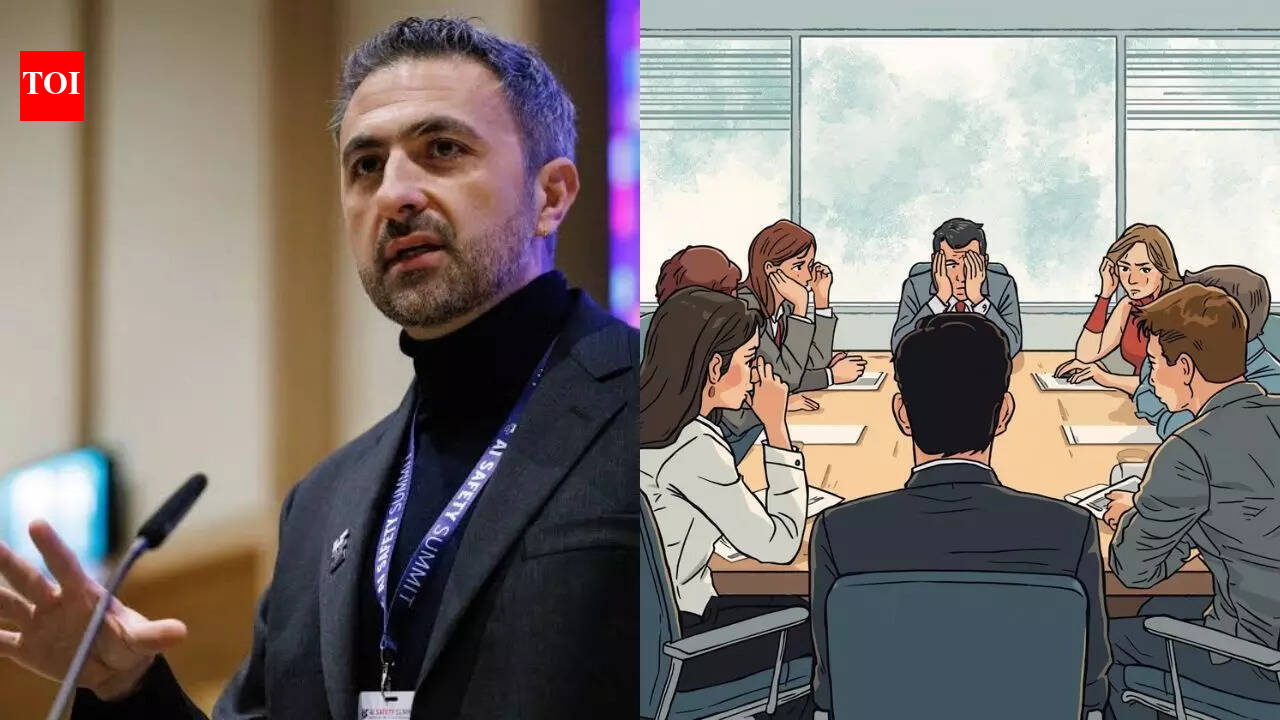
 Slowly and steadily, AI is truly taking over jobs in the real world, replacing human effort for minimal time and monitored efficiency, placing them on the sidelines to stand by and correct the errors, if any. In a society that is going gaga over the possibilities of artificial intelligence and spending millions of dollars to create robots, chatbots and software, all to reduce/replace human work, this development is eerie and a warning bell. Now, Mustafa Suleyman, Microsoft’s CEO of AI has issued a 12-18 month warning to white collar workers about their jobs. According to him, the tasks performed by them could be “fully automated” within the time frame. He said he believes the technology is advancing toward “human-level performance on most, if not all, professional tasks.” In this case, tasks that are done while “sitting down at a computer” such as a lawyer, accountant, project manager and marketing professional, “will be fully automated by an AI within the next 12 to 18 months.”In an interview with the Financial Times, he insisted that the transformation isn’t theoretical or predictive, but rather a development that’s already underway. He highlighted software engineering as an early case study, asserting “AI-assisted coding” had become a standard practice in the sector. “Many software engineers report that they are now using AI-assisted coding for the vast majority of their code production,” he said, noting this transformation happened “in the last six months.”The British AI entrepreneur leading the division focused on advancing consumer AI products and research within Microsoft Corp., explained that engineers’ roles have shifted to a more strategic focus, including debugging, careful analysis, and designing system architecture.This means AI tools can perform numerous human tasks in minimal minutes and completely eradicate the need for humans to draft contracts, analyse spreadsheets, oversee projects, develop campaigns, and complete other tasks at a standard level. Thus, raising the questions over the future of professionals currently employed for the tasks.
AI in future: Boon or bane?
Suleyman’s claim echoes those made by many big tech titans recently. Dario Amodei, CEO of Anthropic, cautioned that AI might displace half of entry-level white-collar positions within the next six to twelve months. Similarly, some radical forecasters have predicted that unemployment rates could reach as high as 80% if widespread automation hits. The prospect of AI replacing white-collar jobs has also raised alarms in political spheres. Senator Bernie Sanders described the scenario as an “economic earthquake” if it materialises. This would mean wages, pensions and communities could be destabilised if companies replace human employees with software, especially in the US where many of these roles form the backbone of numerous businesses, large or small. The Stanford Digital Economy Lab, using ADP employment data, found that entry-level hiring in “AI-exposed jobs” has dropped 13% since large language models started proliferating. The report said software development, customer service and clerical work are the types of jobs most vulnerable to AI today. Researchers from the University of Pennsylvania and OpenAI found that some educated white-collar workers earning up to $80,000 a year are the most likely to be affected by workforce automation.A 2025 report from the World Economic Forum estimated that the introduction of AI, robotics and automation could displace 92 million jobs by 2030 while adding 170 million new roles. While the youth can definitely get trained for these new roles, those who have spent decades in white-collar careers might face difficulty in transitioning into new AI-based roles. Some roles expected to be affected include receptionists, accountants or bookkeepers, salespeople, research and analysis, warehouse workers, insurance underwriting, retail and more.
White-collar workers: Better safe than sorry
In a conversation with The Guardian, California-based Jacqueline Bowman shared how she swapped her career in content marketing for becoming a therapist. She shared how layoffs and publication closures in 2024 “dried up” her work and led her to become an editor reviewing AI-written copies. “I now had to meticulously fact-check every single thing in the articles. And at least 60% of it would be completely made up,” she said. “I would just end up rewriting most of the article. So something that would take me two hours when I was writing it by myself now took me four hours, making half the money,” she told the outlet. By January 2025, she was unable to afford her health insurance as her fee was reduced to half of what it was earlier, leading her to think of an alternate career that wouldn’t be replaced by AI soon. “But there’s another subsection of people who are going to say: ‘Hey, AI took my job, AI ruined my life. I’m not going to go to an AI therapist,’” she said. “So in that way, I do think that there’s still going to be an audience who wants a human therapist.”Not only in California, Janet Feenstra also transitioned from the role of an academic editor to a baker in Malmö, Sweden. The 53-year-old, originally from the US, worked as a freelance editor, improving texts written by researchers whose first language wasn’t English. However, over the years, the use of AI threatened to dismiss her need. “I didn’t want to wait until it was too late,” she said. “I felt scared … I’m divorced, I have two children to look after and I need financial security.” Thus, she enrolled in culinary school to learn something she “was fairly sure that AI would not replace anytime soon.”While Carl Benedikt Frey, an associate professor of AI and work at the Oxford Internet Institute told the outlet that manual work “is going to be harder to automate,” he predicted that AI will have an impact “across a very wide range of industries.” “If the dishwasher breaks down in my home, I can take a picture and I can quiz the large language model of my choice, and I’m more likely to be able to fix it myself these days without calling an engineer,” he shared as an example. Do you need to be worried? While examining your field of career is a must in the current scenario, Frey stated there is no need to “paint a scenario where everybody’s going to be out of work five years from now, and we need to rethink everything”.