
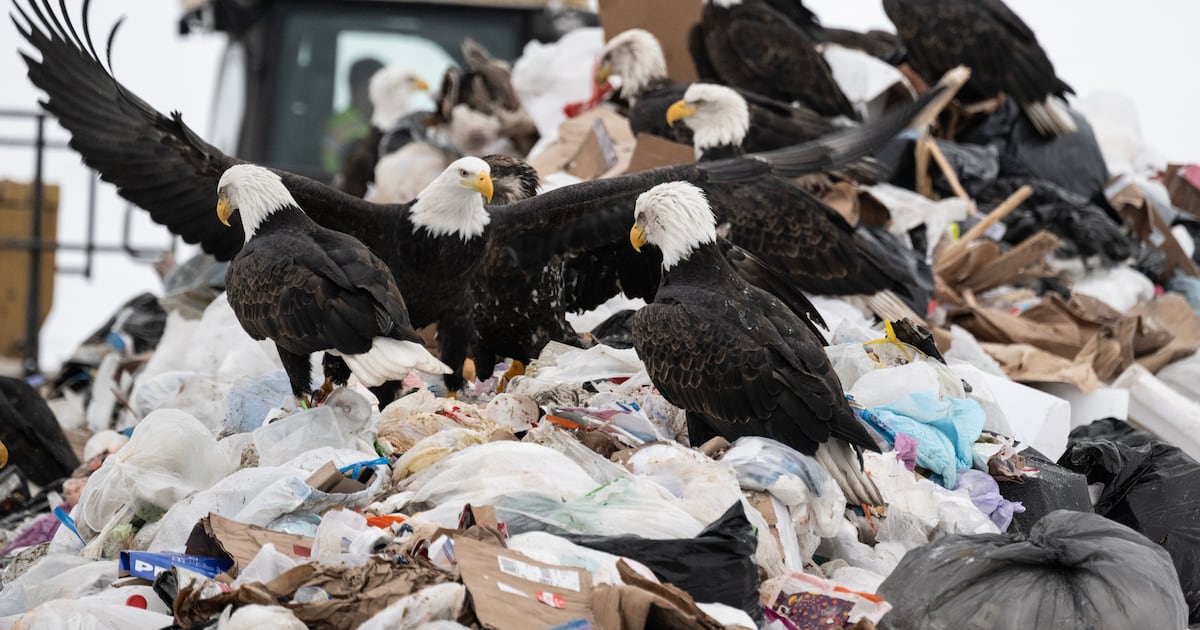
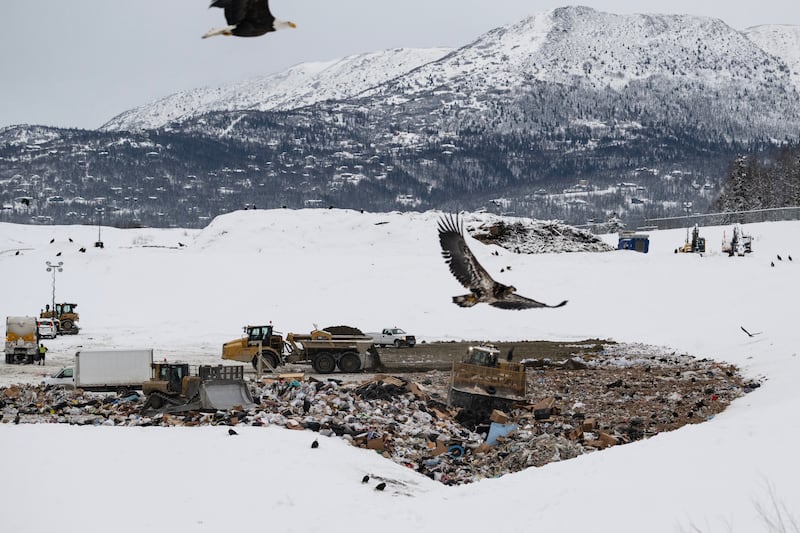
 Bald eagles fly over the working face of Anchorage Regional Landfill on Jan. 15. The landfill frequently draws hundreds of eagles in winter, though the number can fluctuate broadly. (Marc Lester / ADN)
Bald eagles camouflage well with refuse at the Anchorage Regional Landfill. So well that it can be difficult to comprehend the scope of their numbers in a sea of black and white trash bags and the mottle of other debris.
Upon close inspection on a mid-January day, more than 50 rooted through the trash as a giant compactor made passes nearby. Dozens upon dozens surrounded the mound, resting on the contours of the ground and perched in the trees along the perimeter.
All told, there were hundreds of bald eagles that day at the Eagle River landfill. It’s typical for winter, staff says, but it still might be one of the most jaw-dropping wildlife displays that takes place regularly in Anchorage, surprising to residents who are used to seeing eagles only occasionally and usually one or two at a time.
Kevin Sager, the Anchorage Regional Landfill’s working foreman, said eagles start arriving around fall freeze-up and seem to disperse when the rivers flow again in spring. They generally don’t bother the equipment or pose a direct problem to operations, according to Sager. He said he’s not aware of an instance where an eagle was stricken or killed in his 20 years working there.
“We’ve been working with eagles so long that I would say we have a good working relationship,” Sager said. “Those eagles, they know when to get out of the way.”
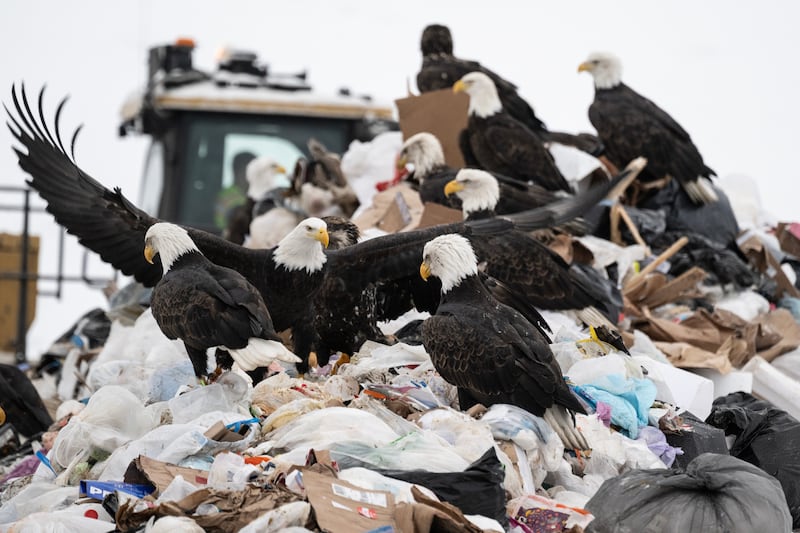 Bald eagles congregate on a mound of trash at Anchorage Regional Landfill as a compactor works nearby. (Marc Lester / ADN)
 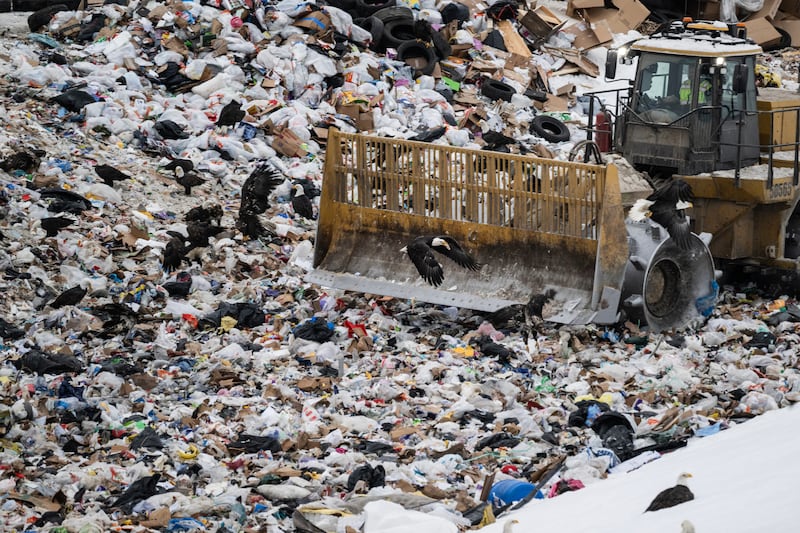 Bald eagles root through garbage at Anchorage Regional Landfill. (Marc Lester / ADN)
Though commonplace, Anchorage officials see the commingling of trash and bald eagles, a federally protected species, as a challenge worth addressing and a symptom of bigger issues. The Anchorage Regional Landfill is the state’s largest, and environmental stewardship is a core mission, said Kelli Toth, director of Solid Waste Services.
“You’ve got a population of almost 300,000 people generating about four to six pounds of garbage daily per person, and we’re bearing all of this in one location,” said Toth.
“We protect the air. We protect the water. We protect the ground. And we also protect the other aspects of the environment like the eagles,” she said.
Ongoing effort
From a pickup truck, Toth and Sager provided a close look at the landfill’s eagle-garbage interface in mid-January. From the landfill’s perimeter road, an overhead view shows that the landfill’s “working face” — the uncovered refuse actively moved and compacted — is dwarfed by the surroundings of the 300-acre landfill.
That day and every day, a bulldozer moved trash, hauled in by a parade of trailers, then a 125,000-pound compactor rolled its giant spiked wheels over the top to pack it. Eagles — and ravens to a lesser extent — find winter meals in the food scraps.
Toth said Solid Waste Services deploys three strategies to mitigate eagle activity at the landfill.
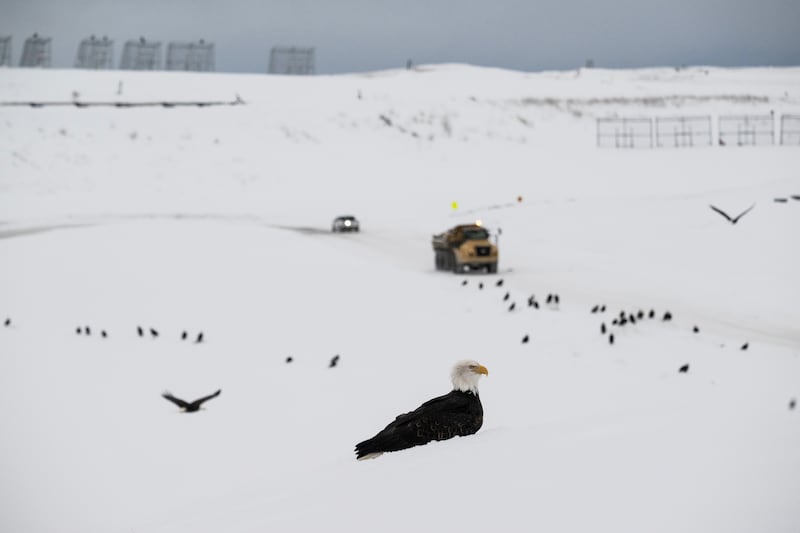 Dozens of bald eagles rest on the ground of Anchorage Regional Landfill as a truck hauls in waste on Jan. 15. Hundreds of bald eagles congregated at the landfill that day, a number staff say is typical for winter. (Marc Lester / ADN)
The first could be heard intermittently — sharp pops fired to harass the birds. Seven days a week all year, a USDA wildlife specialist works to manage bald eagle activity at the landfill. Marc Pratt, supervisor of USDA’s Animal and Plant Health Inspection Service Wildlife Services Program, said its specialists use noisemaking devices such as pyrotechnics, horns and propane cannons, as allowed through its permits. They’ve been at it since 2000, Pratt said.
In a written response to questions, Pratt said the primary goal is to reduce the threat of bird collisions with military and civilian aircraft that operate in nearby flight paths. USDA also aims to prevent damage to the landfill’s liner that protects groundwater, protect equipment and serve “the general health of the wildlife.”
The second strategy coincides with state regulations requiring that the working face is covered each day. Sager said a 6-inch layer of gravel and “alternate cover,” often wood chips, is spread over the top of the newly filled area daily. “Before my guys leave at 6 o’clock, the whole top is covered with gravel,” Sager said.
Once that’s done, “the buffet goes away,” Toth said.
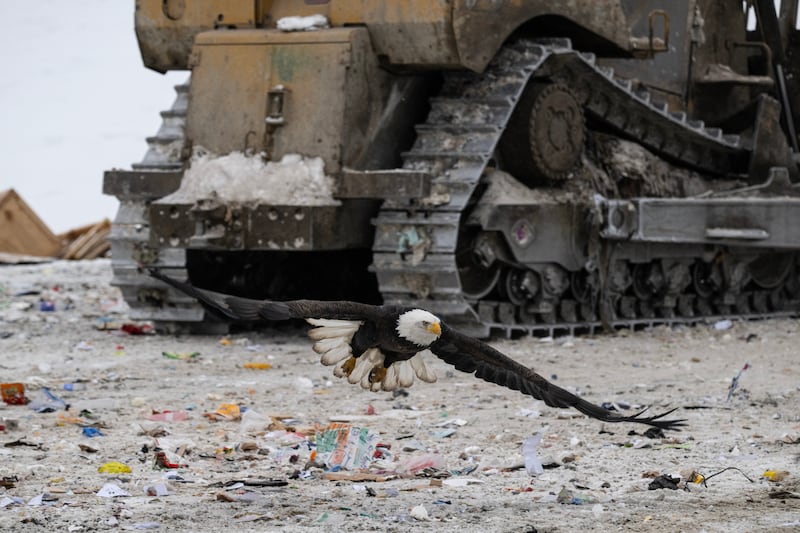 A bald eagle flies near a dozer at Anchorage Regional Landfill. (Marc Lester / ADN)
 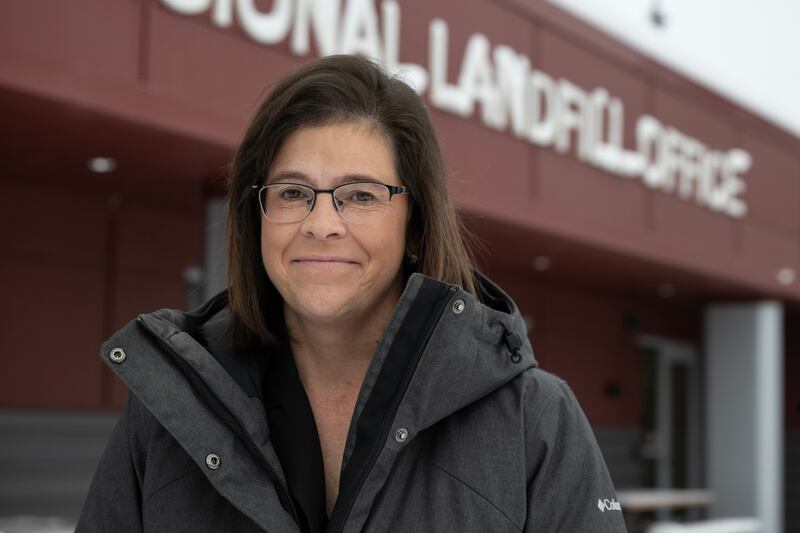 Kelli Toth, director of Solid Waste Services, said SWS is currently investigating the viability of a waste-to-energy project that would mostly transform current landfill operations. (Marc Lester / ADN)
In recent years, Solid Waste Services has ramped up its effort to divert food scraps from the landfill, Toth said. Part of the year, it offers curbside collection in its service area for organic material, though not all food scraps are permitted. Households and commercial customers can also dispose of organic waste at the SWS Material Recovery Facility. Toth said they hope to expand its availability, which has been three days a week from May through September. Though diverting organics is voluntary, a reduced disposal fee serves as an incentive.
Diverted food scraps go to Quality Topsoil and Organics to become a soil amendment product. Toth has other destinations in mind as well and pilot projects underway. “The big vision is that we could, as a city, collectively divert large volumes of food scraps to feed livestock,” she said.
“If we can keep it out of the landfill, all the better,” Toth said. “It generates less smell, less landfill gas and it also isn’t as appetizing for the birds.”
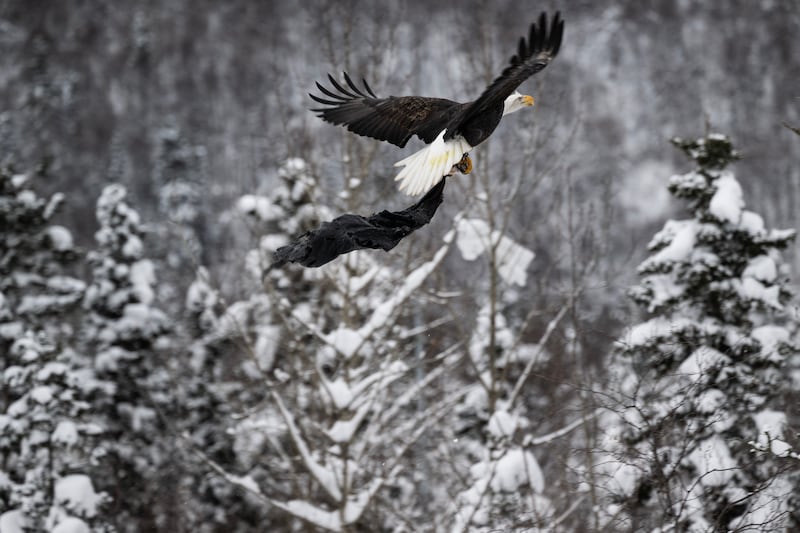 A bald eagle carries plastic garbage toward a tree near the Anchorage Regional Landfill. (Marc Lester / ADN) The eagle feeder
Anchorage resident Tom Lakosh said he has been feeding eagles during winter months in East Anchorage for years, even though wildlife managers and eagle experts discourage the practice because it could bring harm to the birds.
Lakosh’s goal, he said, is to draw them from the Anchorage Regional Landfill, where he fears they eat meat and fish that have been exposed to toxic chemicals.
“They’re getting poisoned at the city dump,” Lakosh said as he threw chicken and other items to eagles in a Muldoon Road parking lot in December. That day, dozens of bald eagles roosted in trees nearby, some swooping down to clench the food chunks in their sharp talons and carry it away in the blink of an eye. Lakosh said he gets donated fish, chicken and other items from Anchorage stores he didn’t disclose.
 Tom Lakosh whistles to nearby bald eagles on Dec. 26. Lakosh said he feeds eagles to provide an alternative to eagles that feed at the Anchorage Regional Landfill. A U.S. Fish and Wildlife representative said feeding eagles is discouraged. (Marc Lester / ADN)
 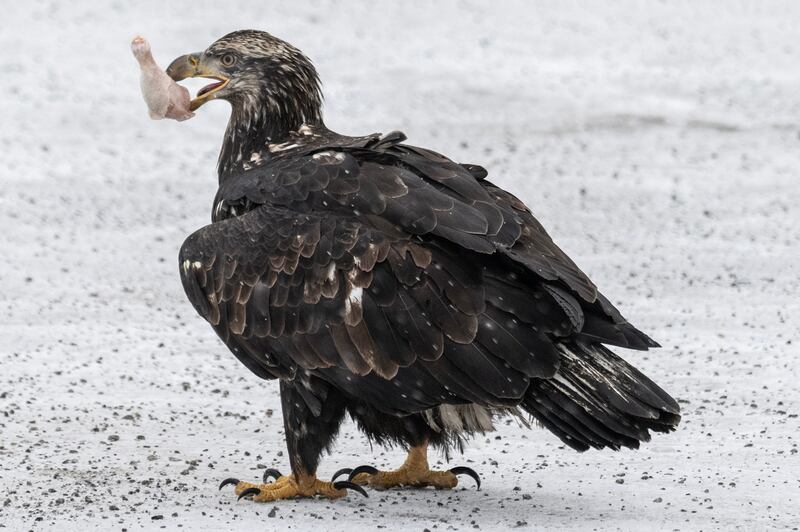 A bald eagle holds a chicken drumstick during a feeding by Tom Lakosh in a parking lot in East Anchorage on Dec. 26. “Feeding in the middle of Anchorage doesn’t necessarily mitigate or take away the risk of eagles at the landfill,” said a U.S Fish and Wildlife representative. (Marc Lester / ADN)
Eagles are a regularly visible feature near Chanshtnu Muldoon Park near the east end of DeBarr Road. Lakosh said some come to hunt in the area because the nearby Chester Creek doesn’t freeze in winter.
Jordan Muir, raptor and permit chief for the U.S. Fish and Wildlife Service’s Migratory Bird Management program in Alaska, said feeding eagles isn’t strictly illegal — but it is discouraged.
“These issues pop up a few times every year across the state,” Muir said.
Bald eagles fall under the rules of the Bald and Golden Eagle Protection Act, which he said prohibits anyone without a permit issued by Fish and Wildlife from “taking” eagles, defined as pursuing, shooting at, poisoning, wounding, killing, capturing, trapping, collecting, molesting or disturbing. Muir said “disturbing” eagles is further defined in the act.
“To meet the standard of ‘disturb,’ someone has to interfere with feeding, nesting or other behaviors to a point that reduces the survivorship or productivity of an eagle,” he said. Feeding eagles alone may not cross that line, Muir said.
“However, we do discourage the public from feeding eagles, because, one, it habituates them to anthropogenic food source resources, which disrupts the normal feeding and behavioral patterns,” Muir said.
Muir said that if eagles are harmed or taken as a consequence of feeding, then that person could be held legally liable.
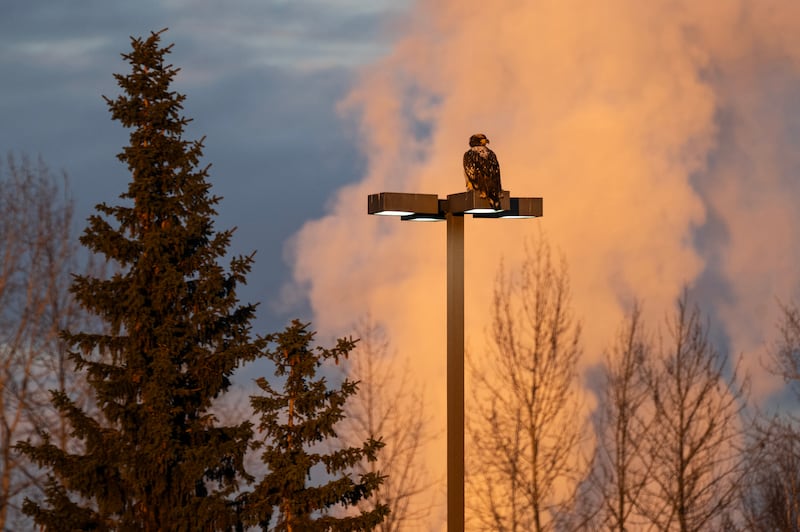 A bald eagle rests on a light pole in a parking lot along Muldoon Road on Dec. 24. (Marc Lester / ADN)
 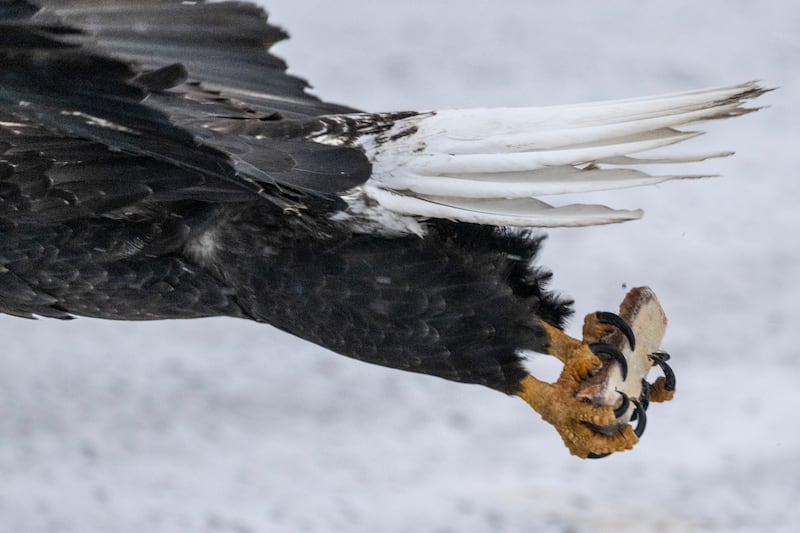 An eagle flies away with food tossed to it by Anchorage resident Tom Lakosh in East Anchorage on Dec. 26. (Marc Lester / ADN)
Lakosh said he too thinks that people shouldn’t habituate eagles, but he believes that has already happened. “They’re at the dump, and it’s a matter of getting them away from the toxins,” he said. In December, Muir said that, generally speaking, redirecting eagles with food is not an effective strategy. “Feeding in the middle of Anchorage doesn’t necessarily mitigate or take away the risk of eagles at the landfill,” he said. “It just adds another risk by attracting them to these areas with power lines, with people, dogs and that sort of thing.”
Bird Treatment and Learning Center, one of just a few providers of care and rehabilitation to wild birds in Alaska, said it has treated four bald eagles and two ravens that have come to them from the Anchorage landfill since 2017. Statewide, 17 eagles and ravens have come into Bird TLC’s care from landfills around Alaska. Laura Atwood, Bird TLC’s executive director, said the origin of the ailments is hard to pinpoint, though.
“Of all of these, toxicity is the most likely to have happened at the dump,” Atwood said. “It’s hard to say about the injuries — did they happen at the dump or were the birds at the dump for the easy food because they were injured?”
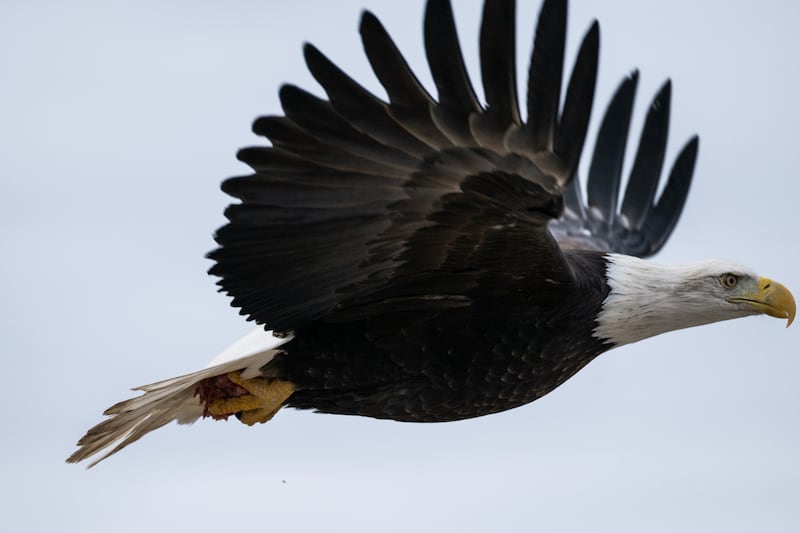 A bald eagle flies off after having been tossed food. (Marc Lester / ADN) Rethinking the landfill
On an early February day drenched in sunshine, the atmosphere was different than that busy January day. As two Solid Waste Services trucks parked in parallel to unload, no eagles disturbed the open face of trash, though some rested on snow mounds and branches in the vicinity. No popping noises harassed the birds away.
Pratt, of USDA’s Wildlife Services, said the number of eagles can fluctuate at the landfill from a handful to several hundred, depending on conditions like temperature and snowpack, and the availability of natural food sources.
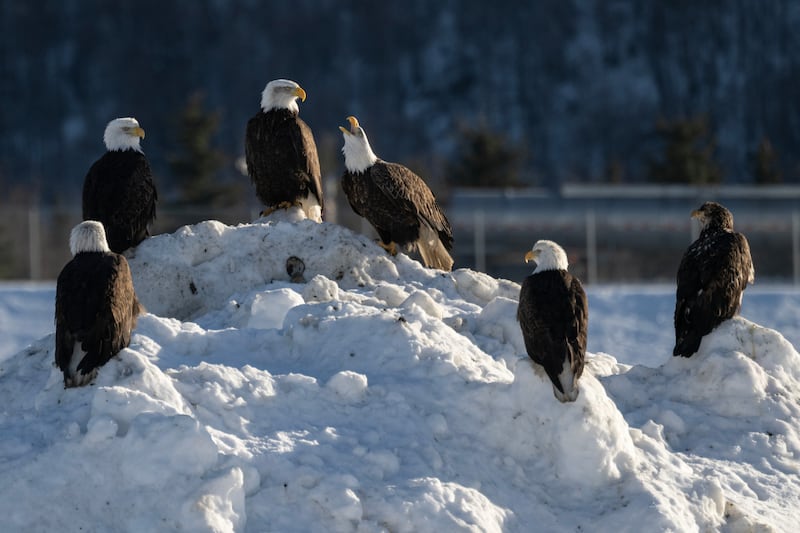 Several bald eagles gather on a snow mound at Anchorage Regional Landfill on Feb. 6. (Marc Lester / ADN)
 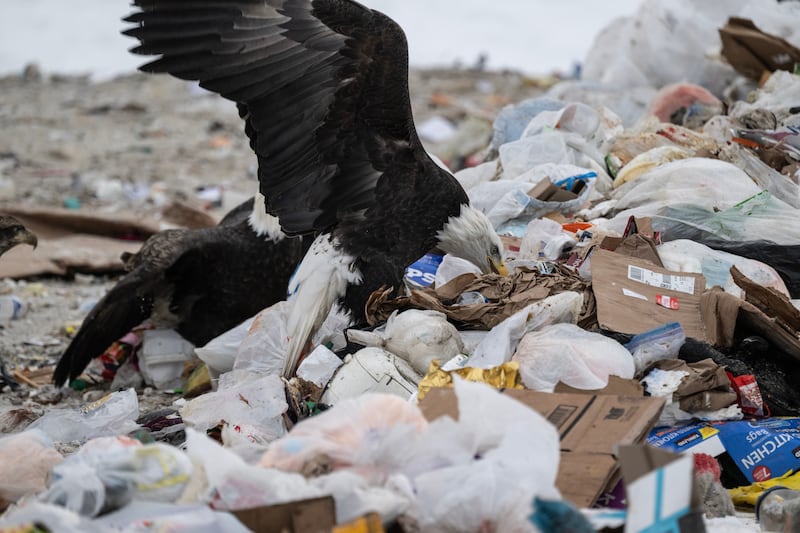 A bald eagle digs into a mound of refuse at the Anchorage Regional Landfill. (Marc Lester / ADN)
In 2024, President Joe Biden signed into law the designation of the bald eagle as the national bird. Toth said she envisions a day when none of them congregate at the landfill. Current strategies reduce eagle activity, she said, but it’s not a complete solution. That would require transformative changes, and such planning is ongoing, according to Toth.
“Instead of doing any of this burying of any trash, it would go into an incinerator,” Toth said of one possible future.” And then we would turn that heat and steam into electricity.”
It’s an achievable goal, Toth said, as proven by many landfills in the U.S. and Europe, but no final decision has yet been made here. Solid Waste Services is now investigating several aspects of such a project, including available technologies, its power output potential and how it might be used. With eventual support from the Anchorage Assembly, SWS can begin putting together a business plan to secure funding.
“We’re asking the questions and we’re trying to find alternatives, because we know that is not ideal,” Toth said as the flutter of eagle activity carried on in all directions at the landfill in December.
“I want to show up there one day and see that all of that trash that we’re burying is being utilized for good,” she said.
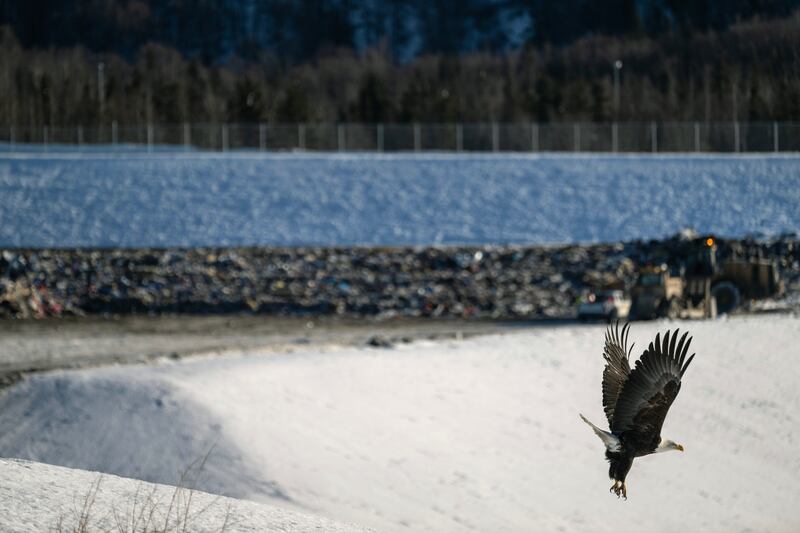 A bald eagle takes flight at the Anchorage Regional Landfill on Feb. 6. (Marc Lester / ADN)