
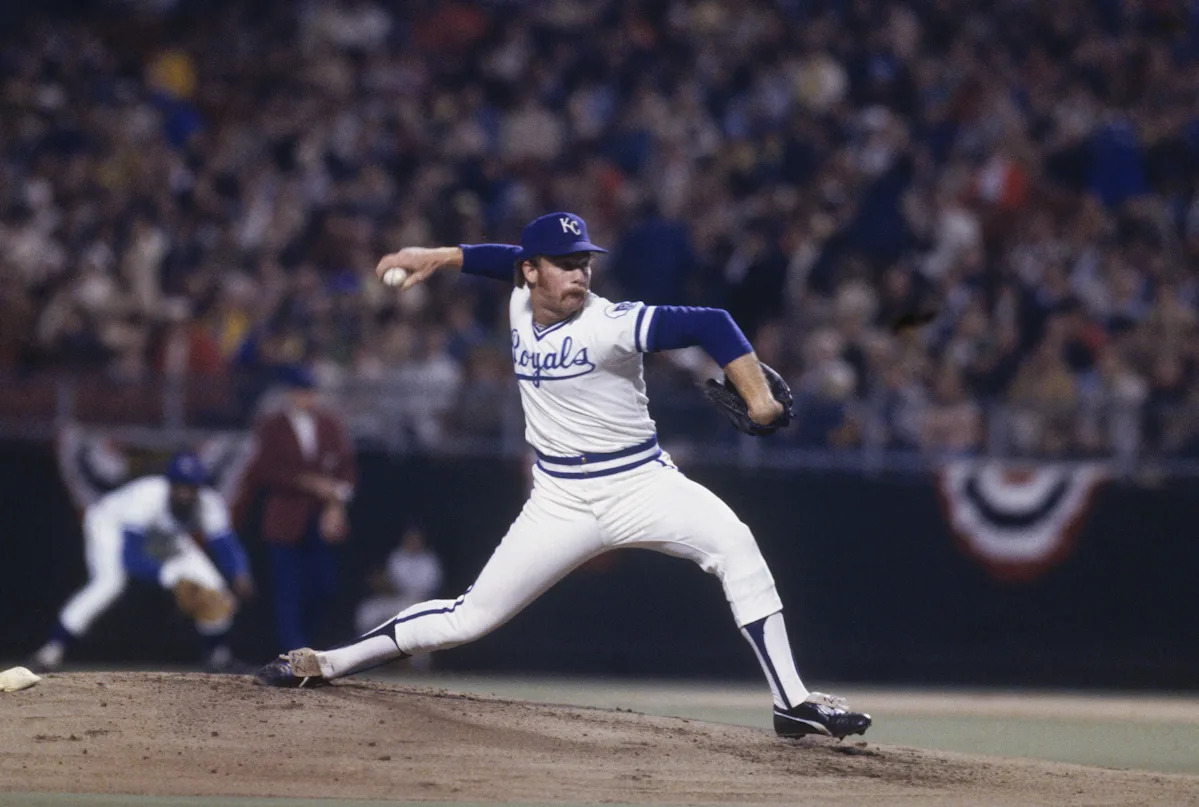
With apologies to Steve Busby, Paul Splittorff, and 1972 Roger Nelson, the first true ace of the Kansas City Royals was a Brooklyn, New York native named Dennis Leonard.
After graduating from high school, Leonard walked onto the baseball team at Iona University, a small Catholic (4,000 students) college located just north of the Bronx. Leonard began concentrating solely on pitching and, with some exceptional coaching, turned himself into a prospect.
Advertisement
Arm injuries scared off several teams, but the Royals stayed committed and selected Leonard with their second-round choice in the 1972 draft. Leonard shot through the Royals’ minor league system, moving from Rookie League Kingsport to Waterloo to San Jose to Omaha in just three seasons. Despite having already thrown 223 innings at Omaha in 1974, the Royals brought Leonard up at the tail end of the season for a cup of coffee. By his own admission, Leonard said his arm was tired — and the results showed: 22 innings over five appearances with a 5.32 ERA.
Leonard was primarily a fastball-curveball pitcher at this juncture of his career. He started the 1975 campaign in Omaha but was recalled to Kansas City when Lindy McDaniel went down with prostate problems. Leonard, under the tutelage of Royals pitching coach Galen Cisco, overcame a slow start and caught fire after the Fourth of July, winning 12 of his final 15 decisions. He finished the season with a record of 15–7 and was named the Royals Pitcher of the Year, an award he would win three times in his career.
When evaluating the career of Dennis Leonard, you must break it into two pieces: regular season and postseason.
Often brilliant in the regular season, Leonard was a bit like Clayton Kershaw. He struggled at times during the postseason. Why? Who knows. I’m sure some of it was arm fatigue. Leonard was a true workhorse, averaging 272 innings per season over the Royals’ five-year playoff run from 1976 to 1980. Some of his postseason troubles were just plain bad luck.
Advertisement
In the 1977 ALCS, manager Whitey Herzog temporarily lost his managerial compass and called on Leonard in the ninth inning of Game Five to protect a one-run lead and deliver the Royals to their first World Series. At that point, Whitey was desperate, having burned through three pitchers in the eighth. Watching the game on TV, I felt confident with Leonard in the game. After all, he was one of the top pitchers in baseball. Three outs? No problem.
In retrospect, Whitey probably should have stuck with lefty Steve Mingori, who recorded the final two outs of the eighth, or gone to his closer, Mark Littell. As the saying goes, if “ifs” and “buts” were candy and nuts, we’d all have a Merry Christmas.
Paul Blair led off the inning with a bloop single. No knock on Blair or the hit — he was a professional hitter and did what he had to do: get on base. Roy White, another underrated player of the era, drew a walk. Instead of letting Leonard work his way out of it, Whitey panicked and brought in another starter, Larry Gura. Mickey Rivers singled to tie the score.
Now Whitey was in a full-blown meltdown. He called on Mark Littell to try to escape the inning with the game tied. Littell, a great guy who was possibly still scarred by the 1976 ALCS, got Willie Randolph on a liner to center that was deep enough to score White. Littell then got Thurman Munson to ground out before former Royal Lou Piniella hit a tough one to George Brett at third. Brett booted it, allowing Rivers to score the insurance run. Littell retired Reggie Jackson, but the damage was done.
Advertisement
Royals Stadium was a morgue. Sparky Lyle, a true closer, came in and put the Royals down 1-2-3, the final two outs coming on Freddie Patek’s smash to Graig Nettles, who calmly started a 5-4-3 double play to end the game.
How much of that was on Leonard and how much was on Whitey? It doesn’t matter now. It’s ancient news.
Thanks to the strike and split schedule in 1981, the Royals became the first team in baseball history to make the playoffs with a losing record. Leonard was cruising in Game One, holding the powerful Oakland A’s scoreless into the fourth inning. With two outs, Tony Armas hit a ball to George that should have ended the inning. Unfortunately, it didn’t. George booted that one too, putting runners at first and third. The next batter, Wayne Gross, made them pay by cranking a three-run home run to give Oakland an insurmountable lead.
How often do we see that happen? An error on a ball that should have ended an inning, and the next batter takes one downtown. It happens so often there should be a nickname for it. Send in your suggestions.
Advertisement
Despite his postseason disappointments, Leonard was a standout in the regular season. Between 1975 and 1981, Leonard won 130 games, the most by any right-hander in baseball. Understand, there were some pretty good right-handed pitchers at the time — guys like Tom Seaver, Fergie Jenkins, Nolan Ryan, Jim Palmer, Catfish Hunter, and Luis Tiant, just to name a few.
Leonard won 20 games three times in his career, back when winning 20 meant something. It’s crazy how starting pitching has changed. In Leonard’s day, a starter was asked to throw 225–300 innings and make 35–40 starts every season. He was expected to go at least seven innings, if not longer. Leonard did all of that and more.
His name still dots the Royals’ single-season and career pitching records. His career marks of 103 complete games and 23 shutouts will probably never be broken. He still holds the single-season team records for starts (40), complete games (21), innings pitched (294.2), and strikeouts (244). I wouldn’t be surprised if those records stood for a long, long time.
His best season was 1977, when he led the league with 20 wins and finished fourth in the American League Cy Young voting. Amazingly, Leonard never made an All-Star team, which is one of the great injustices in baseball. He was almost always a slow starter, but once the weather warmed up, there was rarely anyone better.
Advertisement
Over his career, he had many outings that would be considered gems. The guy had 23 career shutouts, so that alone gives you some idea.
I think his best game came on September 17, 1980, at Royals Stadium, when Leonard pitched a brilliant three-hit complete-game shutout against the Angels. He struck out nine and walked only two in a game that took just 2:17 to complete and scored an 88. Leonard retired 17 of the last 18 Angels he faced, striking out seven of them.
Emotionally, his finest hour probably came on September 8, 1986, at the Stadium against the Twins. Leonard had pitched gamely in 1986 (more on that later), and I’m sure he knew the end was near. On that evening, he dialed it back and threw another three-hit complete-game shutout — the last of his career. He made four more starts, but this was the final peak.
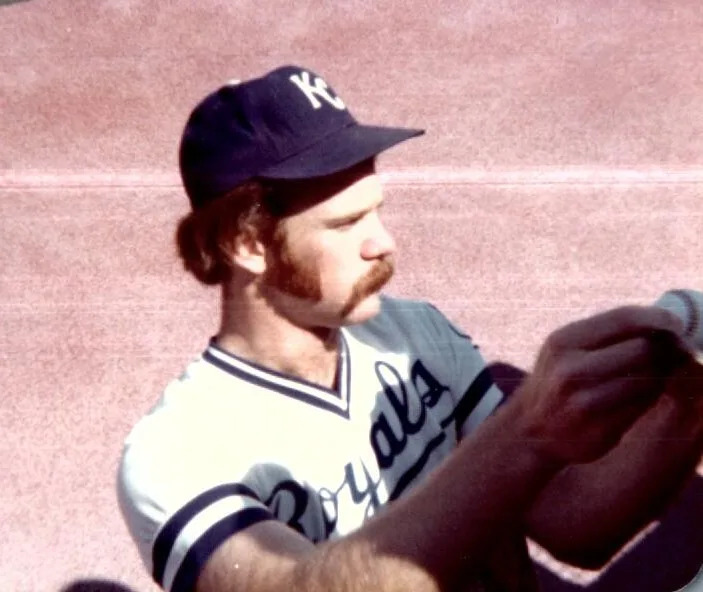
Leonard was always one of the most popular Royals of his day, with his unruly red hair and trademark Fu Manchu. He was friendly and engaging with fans. Leonard had a somewhat unusual twist in his delivery — he would cock his wrist during the windup. It was a bit unorthodox, but it worked. Thankfully, no pitching coach tried to change him. As his career progressed, Leonard added a slider and later a changeup to his arsenal. The slider was particularly devastating and led to a spike in his strikeout numbers.
Advertisement
Later in his career, Leonard battled a series of injuries that certainly kept his career numbers from being even more impressive. In the summer of 1982, Buddy Bell sent a liner through the box that broke two fingers on Leonard’s pitching hand. That injury cost him two and a half months, and though he came back late in the season, he wasn’t right.
He got off to a promising start in 1983 before snapping his patellar tendon in a late-May game against the Orioles. That type of injury is typically the death knell for a professional athlete, but Leonard put himself through four surgeries and a grueling rehab so he could pitch again. The guy was a warrior.
He missed the rest of 1983, all of 1984, and nearly all of 1985 before making a dramatic return to the mound on September 6. He threw one scoreless inning against the Brewers while a crowd of more than 26,000 gave him a long, emotional standing ovation.
Leonard came to spring training in 1986 feeling like a rookie. He made the squad and ended up recording 30 starts and throwing 192 innings. But at age 35, with an ERA north of 4.40, the end was near. His first start of the 1986 season was classic Leonard — a three-hit, complete-game shutout win over the Blue Jays.
Advertisement
The Royals released him after the ’86 season, and Leonard chose to retire. He was elected to the Royals Hall of Fame in 1989. He’s also an inductee in the New York State Baseball Hall of Fame, the Oceanside High School Hall of Fame, and the Missouri Sports Hall of Fame. Pretty impressive for a college walk-on.
The final numbers: 144 wins against 106 losses with a 3.70 ERA. He still sits at number two in career wins and number three in career strikeouts in Royals history.
Dennis Leonard will always be one of the greatest Royals.