
Welcome to Different Strokes, a look at unique home design choices that beg for further explanation.
Palm Springs and midcentury-modern architecture go hand-in-hand, thanks to legendary designers like Richard Neutra and Albert Frey who brought their modernist visions to the California desert. Decades later, the homes they built are attractions to the more than 100,000 people who visit Palm Springs each year for Modernism Week alone, as well as many more of the city’s estimated million annual visitors.
Canadian architectural designer and illustrator Calum Srigley is one of them. He’s been drawn to the Southern California city and its signature architecture ever since he and his wife, Kathie, eloped there in 1999. “We both immediately fell in love with the desert landscape and the architecture that seemed so suited to the casual lifestyle we experienced,” he says. “We visited annually after that, always finding more to love, and I grew more deeply engaged with the midcentury-modern architecture, observing its strong connection to the land.”
In fact, Calum and Kathie loved it so much they wanted to recreate a Palm Springs-style home as their primary residence some 1,545 miles north in British Columbia. “The idea was to incorporate my design studio with a casual living environment to provide the setting for our next chapter of life,” Calum says. “A place to work but also enjoy our surroundings more.”
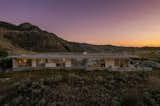
The 1,600-square-foot house where Calum Srigley and his wife, Kathie, live in Savona, British Columbia, has a low-slung profile inspired by midcentury homes in Palm Springs, California.
Step one was finding the right site. The couple landed on a hilltop property in the unincorporated community of Savona, an area with semi-arid grasslands and hills near a lake. Calum and Kathie already had a connection to the place; they met horseback riding nearby. And, even better, the landscape, with its large rock outcroppings and plenty of cacti and sagebrush, looks not unlike the Southern California environs the couple hold dear.
The next step was pivotal: finding the right builder. Calum, who studied architecture at the University of Edinburgh, had a clear vision for the residence, drawing inspiration from Palm Springs’s Frey House II (also built into a rocky hill). He found a partner in contractor and carpenter Paul Douglas, co-owner of the custom home-building company Malcolm Homes based in the neighboring Kamloops. “The design called for these very thin lines and a tautness that this style of home has that are very difficult to achieve in the modern-day world because we have new building regulations,” Calum says.
The low-slung home comprises a 1,200-square-foot one-bedroom main house with a den, kitchen, and living space that’s connected via an enclosed breezeway to a 400-square-foot split-level studio. The ability to host was an important consideration for both Calum and Kathie, as between the two of them the couple have four adult children and eight grandkids. “Every weekend in the summer, we’re like a hotel,” Calum says. “The house has to morph from being comfortable for two to being able to accommodate up to 10 or 11 sleeping there, and 15 to 20 gathering there.” Outside, a vintage Shasta trailer provides additional space for guests. (The couple often take the trailer down to Palm Springs for a month in the winter.)
Though the desert modern aesthetic emerged as a response to Southern California’s climate, the couple think their Palm Springs-inspired house “looks as though it belongs” on its British Columbia site, too. “It neither dominates nor is overwhelmed by its setting,” Calum says of the property, which they’ve taken to calling “Palm Springs North.” We talked to Calum and Paul about how they worked together to stay true to the vision of a Palm Springs midcentury in the Great White North. Our conversation has been edited and condensed for clarity.
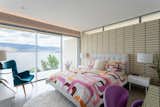
Calum drew inspiration from Albert Frey’s longtime Palm Springs residence, the Frey House II, for much of the structure’s design.
Calum, connecting with Paul was an important part of the process. How did you find him and what about it was so pivotal?
Calum Srigley: I found him through the internet. We were looking for land all over, and we knew we wanted a sort of a dry, desert-like climate, because we love Palm Springs. Kamloops is that way. It’s kind of high desert cattle country, and so we found this wonderful piece of land.
When you talk to contractors or builders, in my experience, they either get it or they don’t. When I described the design to Paul, I understood immediately that he would be challenged by it but was up for it and was interested, which just sealed the deal.
Paul Douglas: To those who know what they’re looking for, it will blow their mind with some of the stuff that we ended up having to do to create and achieve a very simple, clean look. Even things like windows going right up to the roof. From a structural standpoint, they’re not load-bearing. There’s so many things like that, when you know. There are layers of complexity that reveal themselves the longer you look at the house.
![Six-foot cantilevered overhangs prevent the summer sun from hitting the home’s triple-glazed windows directly. "In the summer, we turn off the [gas-powered] heat in the house and it heats the pool," Calum says.](https://www.newsbeep.com/us/wp-content/uploads/2026/02/1771470434_127_original.jpg)
Six-foot cantilevered overhangs prevent the summer sun from hitting the home’s triple-glazed windows directly. “In the summer, we turn off the [gas-powered] heat in the house and it heats the pool,” Calum says.
What were some of the challenges in making this particular style of house? You mentioned floor-to-ceiling windows. How did you make that work?
PD: It started with a good design. There was already an initial plan on how we were going to achieve this. A structural engineer gave validity to some of the components. The success came from the collaboration of just having these discussions about, ‘How can we best achieve the end goal?’
CS: There was an initial concept which was quite simple. I thought if I could keep this simple, the costs would stay down. An aspect of the home that was really important to have was six-foot overhangs. The roof cantilevers over the walls all over the house. That’s not easy to do. It speaks to the skill of the builder and also the engineering. But it’s a simple wood-frame house that looks like a steel house.
The home’s site has a huge seasonal temperature disparity. It gets really hot and really cold, sometimes with subzero temperatures. Palm Springs certainly gets hot, but it doesn’t get so cold like that. How did you reckon with adapting the style to suit the climate? How did you make a house that isn’t just frigid in the dead of winter?
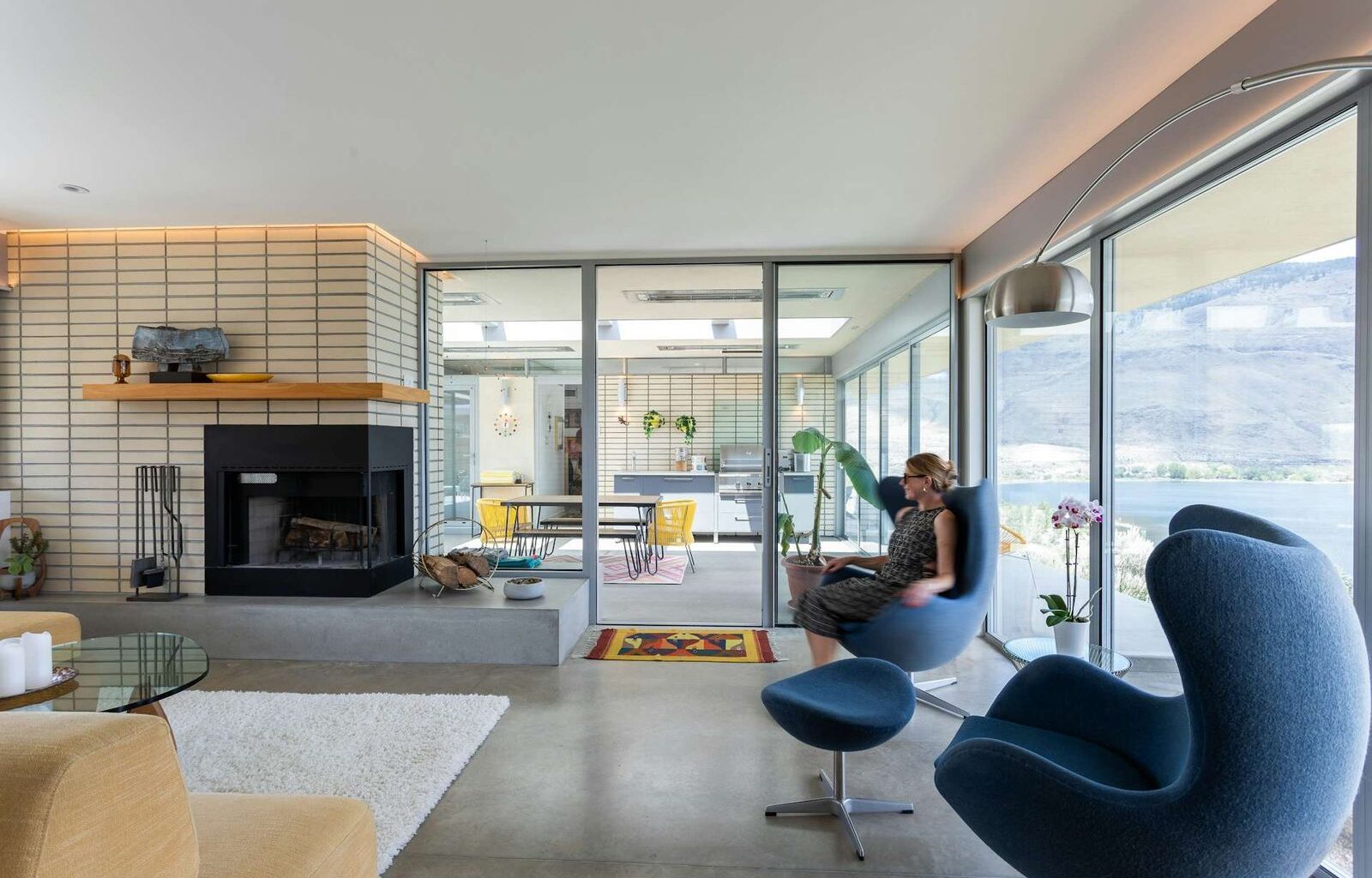
CS: It has polished concrete floors, which are heated. The [window] glazing is triple. It has aluminum-frame windows, because they’re high and they’re wide and they’re all glass. You can’t do that with vinyl. You can’t do it with wood. It’s got to be metal. In North America now, with the energy codes, it’s very hard to get aluminum windows that are affordable. So all of the windows came from Europe. They came from Belgium, Poland, and Spain.
PD: When we first met, one of the goals was to be able to build a home that was essentially passive, that even in the extreme heat, you don’t need air-conditioning. Those six-foot overhangs Cal designed so that at no point is the sun directly in the windows creating thermal heat gain. The sun hits right at the right at the ground level. It was those types of little details that really go a long way to be able to make it bearable in the summer with minimal cooling.
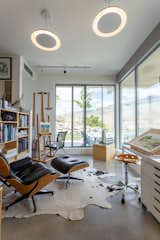
The interior decor also plays up the home’s midcentury vibe.
Calum, how does the place work for your life at this stage?
CS: We wanted a house that would be comfortable for two but could expand to accommodate our large blended family by making some rooms do double duty. For instance, the design studio, which is split level, can accommodate four guests with fold-down bunk beds and a pullout queen bed from under the raised floor. The TV room also converts to a guest bedroom with a queen Murphy bed.
If you look at the plans, there’s basically a [rectangular] box, which is the house, that’s 1,200 square feet. Then there’s another box which is the studio, which is 400 square feet. Between them is this breezeway. At first I thought, I just want to keep that open. When we started living here, what we didn’t really count on was the wind. We get up to 60 to 80 kilometers an hour [37 to 50 mph], and it is brutal. So I closed in the breezeway with sliding glass doors. My wife runs an exercise class, and in the middle of winter, she’s running it out of the breezeway. We’ve got heaters in the ceiling and the ladies love it. The house has proven to be incredibly adaptable to our changing lifestyle.
We’ve created a couple of microclimates around the courtyards. If you look at the plan, we have a concrete breeze-block wall that goes around. It’s our walled garden. So it can control the wind. It creates heat gain. We had a fantastic tomato crop.
Are there any other homes that look like yours in the area?
CS: Let’s just say we stand out. We are the “glass house” in our town. Plus, building is not as simple as it was in the ’60s. New energy codes and building practices meant we had to be creative and really sweat the details.
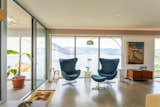
Polished concrete floors with in-slab heat help ensure the home stays comfortable year-round.