
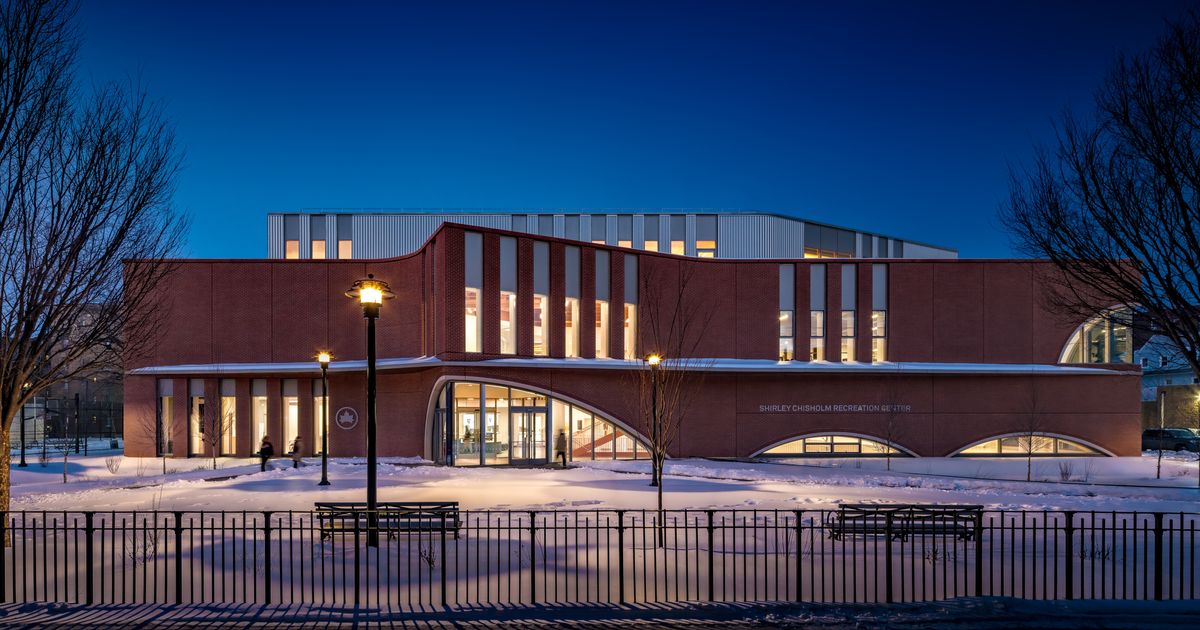
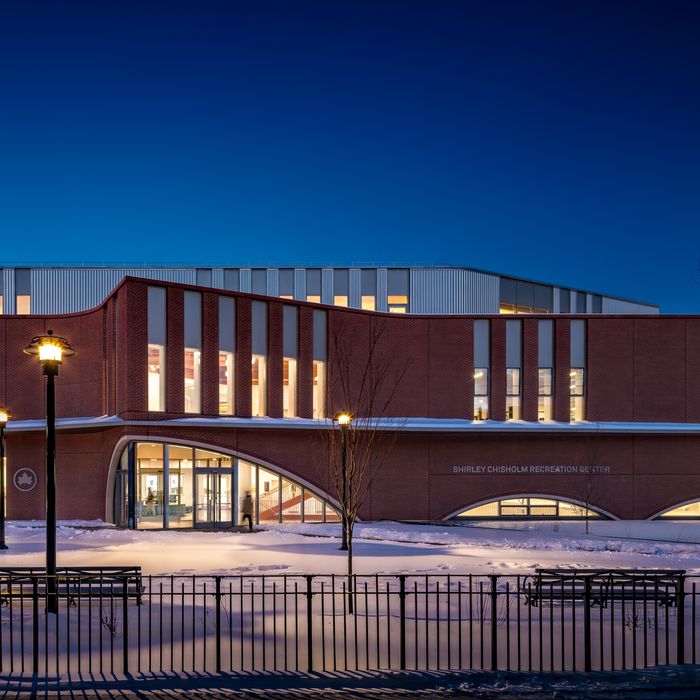
Almost immediately after the Parks Department’s new Shirley Chisholm Recreation Center opened in the Little Haiti section of East Flatbush in early February, the building hummed with teens vigorously hanging out. They slumped, joked, strolled, shot hoops, rested between sets, and generally gave the impression there was nowhere they’d rather be. That’s one immediate measure of good architecture: the pleasure quotient. The building was designed to make the most of leisure time. Sure, you might suffer through a deep squat, grit your teeth for another lap in the pool, and complain about a stretch, but you do all that because it makes you feel good.
Is architecture responsible for that overflow of wellness? In theory, it’s the equipment that counts. Whether you’re riding an exercise bike in a basement or a penthouse, the payoff for your body is the same. But Shirley — which is what the architects call both their building and the pioneering Black congresswoman it honors — is a public space that could compete with a Manhattan condo both in its amenities (podcast booth, dance studio, learning kitchen) and its deluxe design. The pricing, though, is bare-bones: As at all Parks Department rec centers, membership is free for those 24 and under, $150 a year for adults, and $25 for seniors.
The Department of Design and Construction, the city agency responsible for most new civic buildings, has a program meant to yield architecture that goes beyond the serviceable, and this is a showcase project. In theory, any studio, based anywhere in the world, can team up with a locally licensed firm and compete for public jobs. In practice, the difficulties of working for the city — and the fact that prestige often substitutes for profit — have limited the pool. In recent years, Studio Gang has embraced those challenges. The firm, headed by Jeanne Gang, is celebrated for big gestures: Aqua Tower’s wavy balconies and watery façade in downtown Chicago, the Gilder Center’s Flintstones chic. Shirley, however, is a boldly modest project that works because of the way it combines a few well-chosen flourishes with off-the-shelf details.
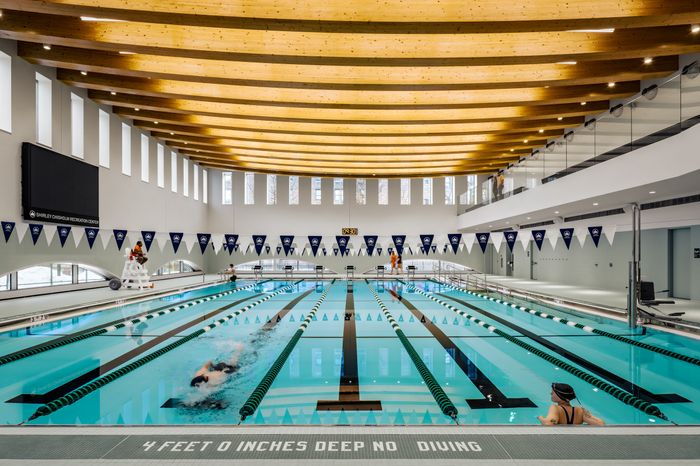
The competition-size pool beneath a ceiling of fish-belly timber beams.
Photo: Alexander Severin
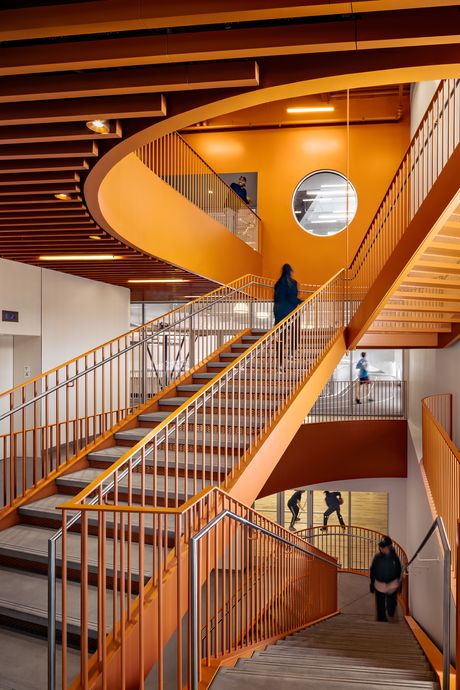
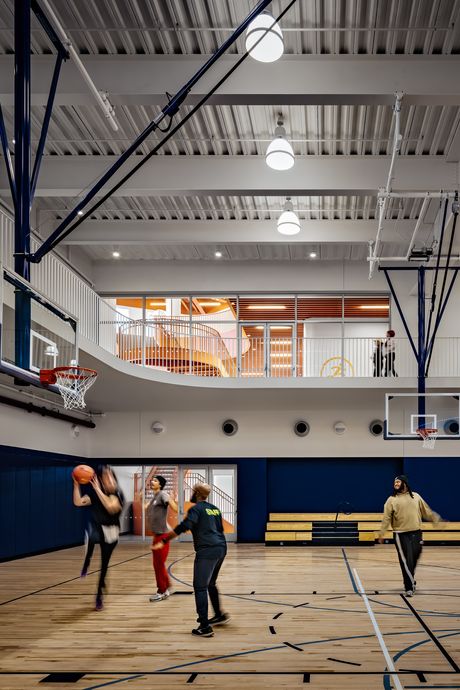
From left: Pick your sweat style: down for basketball, through for track, up for weight room. Photo: Alexander SeverinPhoto: Alexander Severin/Alexander Severin
From top: Pick your sweat style: down for basketball, through for track, up for weight room. Photo: Alexander SeverinPhoto: Alexander Severin/Alexande… more
From top: Pick your sweat style: down for basketball, through for track, up for weight room. Photo: Alexander SeverinPhoto: Alexander Severin/Alexander Severin
As you enter, you’re presented with several variously alluring paths. First, head to the back of the lobby and peer through glass walls to behold the competition-size pool, where backstroke swimmers gaze up not at a tangle of ducts but at a ceiling of fish-belly timber beams, giving the experience a certain Scandi élan. Crucially, a long entry ramp angles into the water along one edge of the pool, which is liberating for those who swim more comfortably than they can walk. From the lobby, a sherbet-orange staircase leads down to the basketball court or up to the gym. Along the way, the design bubbles with circles — a cylindrical reception desk, arched windows, porthole windows of assorted sizes and heights, a stairway landing that mirrors the curve of the indoor track, curved landings on the stairs, Shirley Chisholm campaign buttons stenciled on glass. These touches add up, making the building feel more organically enveloping and less like a box full of boxes.
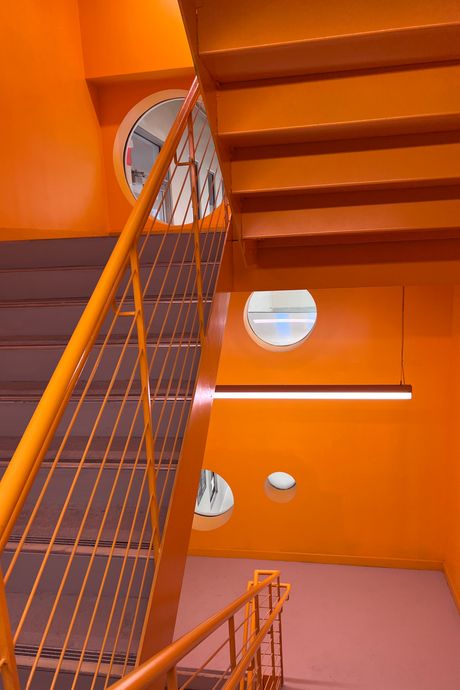
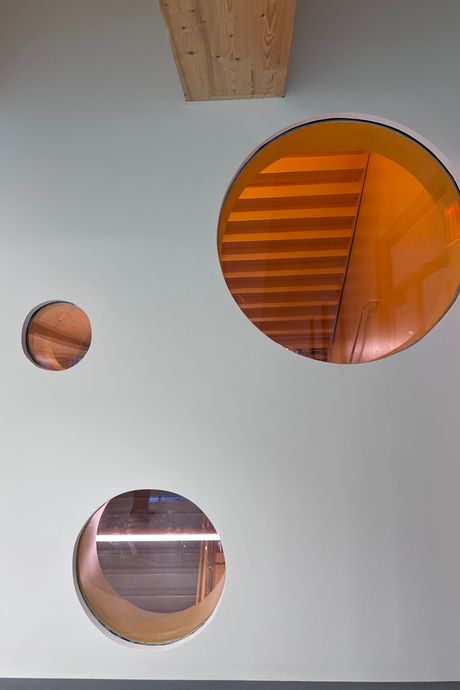
From left: Peekaboo porthole windows keep the building playful. Photo: Justin DavidsonPhoto: Justin Davidson
From top: Peekaboo porthole windows keep the building playful. Photo: Justin DavidsonPhoto: Justin Davidson
The good vibes can get a little strained. The building enfolds Vanessa German’s East Flatbush People’s Museum of Love and Wonder, a collection of cloying installations. German asked neighborhood children to complete sentences like “In the future, my dream is …” She tucked each slip of paper into a big transparent bead, then assembled the lot into a cluster, secured in a vitrine and placed by a window: glass behind glass next to glass.
The building’s collection of uses could just as easily have been packed into a windowless cinderblock warehouse with simplicity outside, bustle and noise inside. Instead, Studio Gang’s design advertises its vibrancy but keeps costs under control by appearing more complicated than it is. From a nearby park bench, it looks like three different pieces of a jigsaw puzzle stacked so that tabs and blanks don’t line up. In reality, it’s a straightforward three-story rectangle with different sequences of arches and slot windows on each floor. Segments of arches seem to disappear into the ground, daylighting the buried basketball court from above. At the top, three corners are chamfered and the fourth is a roof terrace, almost as if a smaller white building were levitating above the base.
Two different-size arches meet at the corner entrance.
The cheerful lobby doubles as a hangout spot.
The dance studio with a view — actually, a double view — of the neighborhood.
Vanessa German’s The Dreaming Vessel.
photographs by Justin Davidson
At ground level, one side is pinched out so that the entrance comes forward to greet the visitor on the diagonal. There, two different arches and two glass walls intersect at the corner, making the façade look like a cross-section of the interior — the architectural equivalent of wearing a skeleton costume. That kind of fancy detail might provoke a bean counter’s agita; it’s a literal corner begging to be cut.
If such a move survived public scrutiny without getting whittled away, it’s partly because the project had a relatively generous budget of $141 million but also because it was built under a new set of regulations meant to smooth the potholed road from conception to completion. In the traditional method for public construction, called “design-bid-build,” the city comes up with a budget, commissions a design, solicits bids from construction companies, picks the cheapest, and supervises the process by requiring innumerable approvals and generating abundant — often expensive — delays. The result is that kids grow up and move away in the time it takes to renovate their local library branch. The system is set up to drag, theoretically to combat corruption, and as a result, money is wasted instead of stolen.
In 2019, then-Governor Andrew Cuomo persuaded the State Legislature to allow the city to use the design-build process on certain kinds of projects; in those cases, a construction company and an architecture firm (here, Consigli and Studio Gang) compete for the job as a unified team. From the beginning, design ideas, building techniques, and costs are worked out in tandem. The DDC keeps a contingency fund in reserve to cover overruns without needing to stop the clock and consult a whole battery of bureaucrats. The trajectory is smoother than it has been for decades: It took a year to design Shirley and two to build it, cheetah speed compared with the usual sloth pace. Quicker is cheaper and not (necessarily) worse.
This rec center, the first of four to benefit from the design-build process, doesn’t settle for good enough. In fact, it’s the most appealing building for many blocks around. Even more important, it doesn’t signal suspicion of its neighbors. Plenty of nominally welcoming buildings issue all kinds of warnings in the name of security or durability (or, in effect, neglect) — benches are steel, fences are high, doors are locked. Studio Gang designed this project not to contradict itself. This is architecture with an invitation: Come. Stay. Enjoy.
Related