
 Portland International Jetport in October 2023.
The Portland International Jetport has reached a $125,000 settlement with the city of South Portland in a dispute about the removal of trees and disturbance of wetlands along Interstate 295 as part of a runway approach project last year.
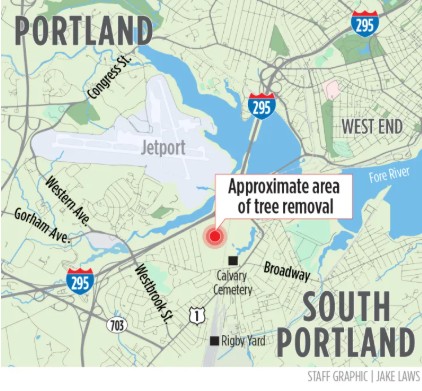
The agreement approved by the City Council Tuesday night provides remediation for at least 158 trees that were removed at 1531 Broadway and 36 Dawson St., according to Milan Nevajda, the planning director. The $125,000 includes mitigation for 83 trees per the tree ordinance, and the jetport will plant a minimum of 75 mature trees in a buffer area near the residential properties on Dawson Street, Nevajda said.
The settlement includes a $50,000 civil penalty — $1,000 for each of the 50 trees whose removal was deemed a violation of the city’s tree protection ordinance, a $50,000 donation to the city’s Tree Mitigation Fund and $25,000 toward the city’s legal costs. The violations will be removed once all of the criteria are met.
The tree buffer will include a combination of balsam fir, northern white cedar and gray birch. These native trees were selected because they are compatible with the existing landscape and they will grow tall enough to create a screen but not too tall to need to be cut down later by the jetport, Nevajda said. The tree plantings will be coordinated with the city arborist.
The jetport will also be required to stabilize sediment in the 5-acre area and restore the wetlands with a plan approved by the city, the Maine Department of Environmental Protection and the Army Corps of Engineers. The recommended wetland restoration plan includes seeding native vegetation, planting about a hundred shrubs, smoothing any soil displacement and lightly grading the area to mimic natural topography, said Tom Tetreau, an environmental scientist with Stantec — the consultants hired by the jetport.
The agreement is the result of months of formal negotiations between the city, the jetport and the Roman Catholic Diocese of Portland, which owns both parcels. City Manager Scott Morelli welcomed the outcome because it secures financial penalties, establishes long-term environmental protections and avoids drawn out litigation with uncertain outcomes.
Some neighbors, however, were dissatisfied with the agreement, wanting a more substantial financial penalty.
“How would each of you feel if this happened in your backyard?” said Julia Edwards, a resident.
Cassie Moon, who lives next to the parcel on Dawson Street, said that even though she would have liked a more sizable settlement and for more of the process to happen publicly, she’s happy that the process is over.
“I don’t know if we could get anything better by dragging it out,” she said.
WHAT HAPPENED
In January 2025, the jetport removed 221 trees and damaged wetlands in a wooded area behind Calvary Cemetery on Broadway and an adjacent parcel on Dawson Street, both owned by the diocese. The jetport was charged with violating the conditions of a tree-removal plan for a runway approach that was approved by South Portland planning officials in 2019, and the diocese was charged for allowing the violations to happen on its property.
Nicholaus Richard, the code enforcement director, found that the work involved the removal of a significant amount of trees, disturbance of wetlands, and a violation of erosion and sediment control requirements, and he issued violations in the spring to both the jetport and the diocese.
A stop-work order was issued in January 2025 because of these concerns. Eighty-five trees that remained standing will be removed this week, Nevajda said. These trees are exempt from mitigation requirements, like replanting or fine payment, because the jetport was able to prove that all of them are above or near the threshold for flight paths.
THE DETAILS OF THE DISPUTE
The jetport and the city couldn’t agree about the extent to which federal aviation law overrides the city’s tree protection ordinance passed in 2022.
The ordinance stipulates that tree protection approval is not required for trees that are removed to maintain safe clearance for aircraft. But the jetport and the city had different understandings of what glide path maintenance required.
Gordon Smith, the lawyer representing the jetport, said that federal law not only mandates clearing trees that protrude into the glide path but also the removal of “future airport hazards” or trees that are estimated to grow into the approach path in the near future. He said that it is common industry practice to clear trees and other obstructions within 10 feet of the approach surface, if not completely.
Dwight Anderson, an engineering consultant with Stantec, said that the three most common trees in the area — white pine, red oak and red maple — each have a growth rate of about one to two feet per year. “If we don’t remove below the surface, we’ll be in there almost every year,” he said.
Nevajda pushed back against this urgency during the initial board of appeals meetings last summer. The original plan said that obstructions would be removed by 2020, but that project was delayed for years without shutting down the runway, he said.
“Is it an essential safety removal feature?” Nevajda said. “Is it necessary for FAA compliance or not? And if it is, how is it that six or seven or eight years can happen without much ado?”
Some of the 221 trees that were removed were clearly above the threshold and needed to come down for airport clearances, Nevajda said. But others were more debatable.
And Nevajda said that the jetport did not go through the necessary process to get exemptions approved.
For situations in which tree removal is unavoidable, there is a mitigation process — either planting trees on-site, off-site or donating to the Tree Mitigation Fund, with preference in that order. With a lack of transparency, the planning board had no way of knowing if the trees that were removed were exempt or properly mitigated, Nevajda said.