
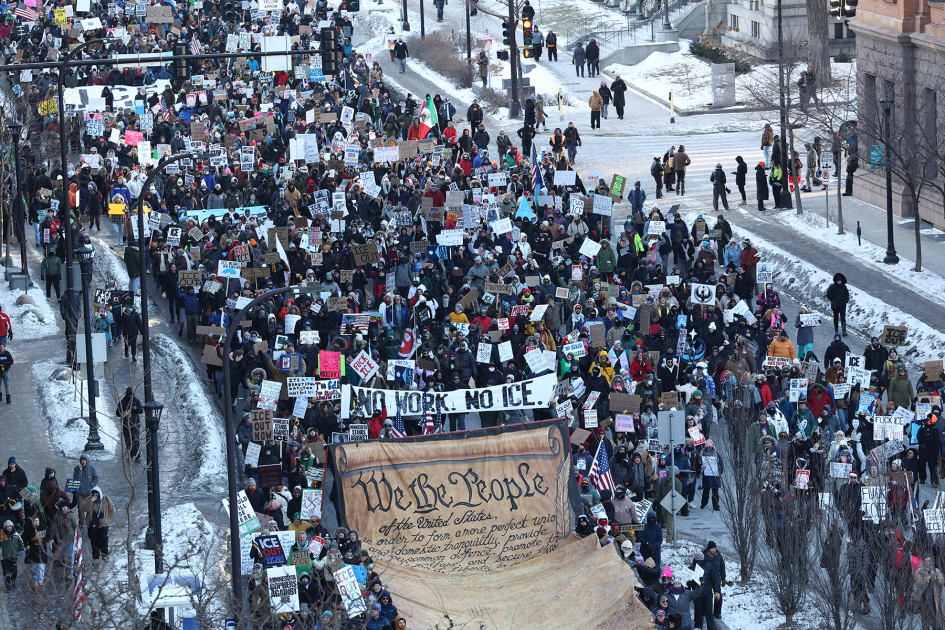
The Trump administration’s immigration crackdown has sent shockwaves across the United States. Far-reaching detention operations across the country led by Immigration and Customs Enforcement (ICE) agents have sparked thousands of anti-ICE and pro-migrant protests. In early January 2026, the Department of Homeland Security (DHS) massively expanded “Operation Metro Surge” in Minnesota, making it the agency’s largest-ever operation. Within three weeks, federal migration enforcement officers shot and killed two people in incidents that were recorded from multiple angles by bystanders in videos that quickly went viral.
These shootings inflamed already heightened tensions between demonstrators and law enforcement agents and triggered hundreds of anti-ICE protests across the country. As the operation continues despite Trump’s promise of “de-escalation,” and amid a fresh ICE operation in Maine, it’s clear that the fight over migration in the US is far from finished.
The situation in the United States is not unique – these protests represent a fraction of the larger picture of demonstrations over migration worldwide. ACLED records migration-related demonstrations in over 75 countries since the beginning of 2025. From peaceful demonstrations to episodes of violence perpetrated by radical groups, sentiments toward migration manifest differently across regional and political contexts.
ACLED’s protest data provide four key insights on surges in pro- and anti-migration mobilization. These findings reflect how migration demonstrations are a global phenomenon – albeit much more concentrated in major destination countries – and point to how migration and migration crackdowns play a role in polarizing societies around the world.
1. When states crack down on migrants people take to the streets
Protests are often a manifestation of a topic’s political relevance, and migration is no exception. This is true across the spectrum: ACLED tracks both demonstrations against migrants and those demanding more open migration policies.
Protests around migration often reflect deeper political divides. In many cases, the debate over migration is tied to a wide range of other issues, from affordability and housing to crime and respect for human rights. Reflecting this contentiousness, most countries with a large number of anti-migrant demonstrations also see sizable pro-migrant demonstrations: Both types of demonstrations become more frequent when migration is at the forefront of political debate.
2. Elections and controversial legislation drive spikes in migration mobilization
Demonstrations, both for and against migration, tend to spike around significant political developments, such as major elections or controversial legislation.
As more governments around the world enforce stricter migration laws and carry out large deportation operations, concerns about human rights and the legality of these measures are driving mass mobilization in support of migrants.
On the other hand, anti-immigration demonstrations increase when the public perceives immigration as a security or economic issue, when political discourse focuses on a lack of measures to control migration, or when open immigration policies are announced.
3. High-profile crimes allegedly involving migrants cause protests to surge
In many cases, high-profile criminal incidents can also catalyze a surge of both pro- and anti-migration demonstrations. Partially because these spikes in demonstration activity often occur in the immediate aftermath of a criminal incident, contested narratives and misinformation can bring massive numbers of people to the streets, often in opposing groups.
4. Extremist groups capitalize on anti-migration demonstrations to grow their public profiles
Extremist groups across the world frequently participate in or organize anti-migrant demonstrations. These groups often define themselves along nativist, racial, and/or religious lines. As a result, they may see migrants as targets and participate in demonstrations against them to grow their public profile and drive recruitment, seeking to mobilize people around the idea that immigration represents a security concern.