
Two programs represent a gold standard of elder care in Michigan: the Green House model of care and Programs of All Inclusive Care for the Elderly, or PACE
The idea is to help prevent residents from expensive, sometimes low-quality, care
Other states make it easier to open these programs
DETROIT — Afternoon sunshine floods into the large window of her private bedroom, making even more clear at this moment Tanya Hollins’ incredibly good fortune.
Hollins could easily be one of the some 35,000 residents in a Michigan nursing home.
Instead, she’s here this day, showing a visitor a collection of photos taped to her wall: herself grinning in a cowboy hat, another as she stands with Santa Claus.
The 69-year old pushes her walker a few inches, reaching now for a tiny jewelry box.
“I painted it myself — I did,” she says, smiling. “It’s a pretty color, don’t you think?
Related:
Does she ever get bored?
She explodes into laughter.
“They keep us busy here, busy all the time.” She shakes her head as though it was the silliest question she’s ever heard.
“This is home. This is better than home. I love it.”
Hollins and her nine housemates are lucky.
Despite complicated health conditions and advanced age, they likely will be able to avoid time at a nursing home — facilities that in best cases can feel institutional, and in worst cases, can be places of frequent short-staffing and neglect.
Hollins and her nine housemates are part of two national efforts that some say are the gold standards of care for the nation’s oldest residents. The goal is to delay nursing home care, or even prevent it altogether.
The first initiative is this Green House home — a communal living arrangement that stresses a home-like environment where relationships flourish. Crucially, they restore decision-making to older residents, such as allowing them to choose what they would like prepared for dinner. They also empower front line staff.
The “power of normal”
Susan Ryan, CEO of Aging Innovations, calls it “the power of normal.”
By design, Green House homes are small — 10 to 12 people, compared with nursing homes, which can house more than 100 residents and employ hundreds of staff.
In Detroit, there are two Weinberg Green Houses. Unlike others that stand alone as houses, these two Green House homes are on the second and third floors at the Thome Rivertown Neighborhood for older adults.
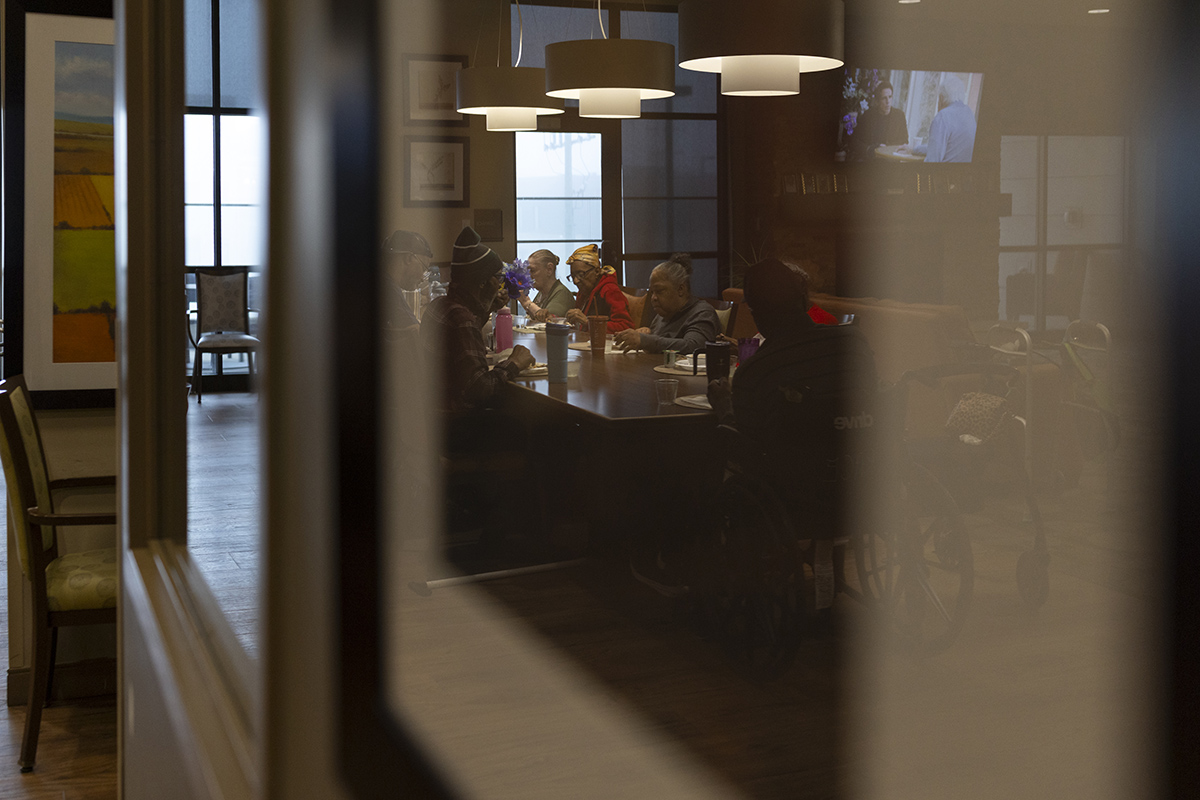
Rather than ever-present medication carts, nursing stations, and dining hall trays of a nursing home, there are private rooms and an open kitchen. Residents who can help do so — setting the large dining room table for dinner or folding laundry, for example.
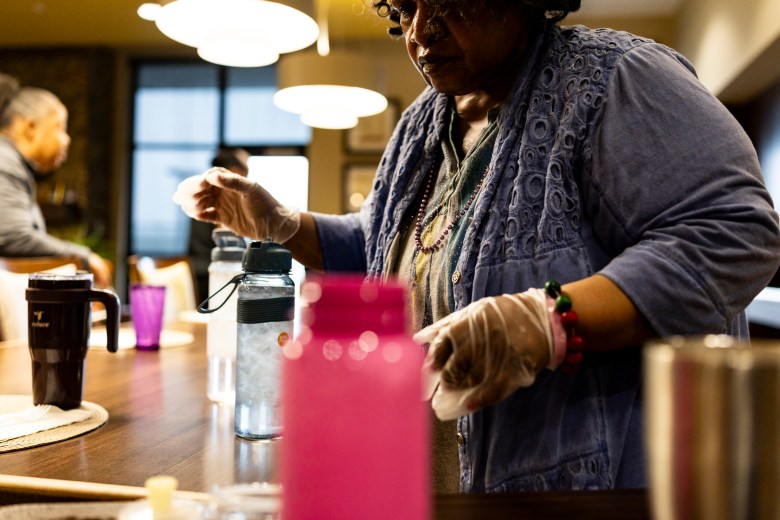 Green House resident Deborah Robinson puts waters on the table ahead of dinner for residents at the Thome Rivertown Senior Apartments. The Rivertown neighborhood offers programs including PACE, providing medical care and support services for residents.(Emily Elconin for Bridge Michigan)
Hollins and her housemates help choose their meals that staff prepare in an open kitchen that invites casual conversation during meal prep. Residents share meals at the dining room table.
In the open shared space, housemate Debra Robinson, 66, is laying out plates and silverware for the smothered chicken and gravy now finishing in the oven. Another housemate, Robert Betty, 77, is letting others know that dinner’s nearly ready.
It’s a communal approach that, compared to the decision-making of a nursing home hierarchy, restores “control, dignity, and a sense of well-being” to residents, or “elders,” as they are called, Ryan said.
“It’s ensuring that elders are allowed to have access to some of the same, same things that the rest of us have access to,” she said. “We don’t live in institutions. Why would elders live in institutions?”
The weekdays are equally individualized.
One-stop shop
Every morning, at about 9 o’clock or so, the elders meet at the front door of their second-floor home in the Thome Rivertown Neighborhood near downtown.
Their destination: a national service called the Program of All Inclusive Care for the Elderly, or PACE. This one-stop shop downstairs fills their days with music, dance, exercise and, last week, a 47-piece local orchestra for entertainment.
But it also houses a team of social workers, doctors, podiatrists, dentists and others. Together, they ensure the kind of care that — when delivered routinely — will tamp down the odds of these residents and other PACE participants ending up in a hospital and then a nursing home.
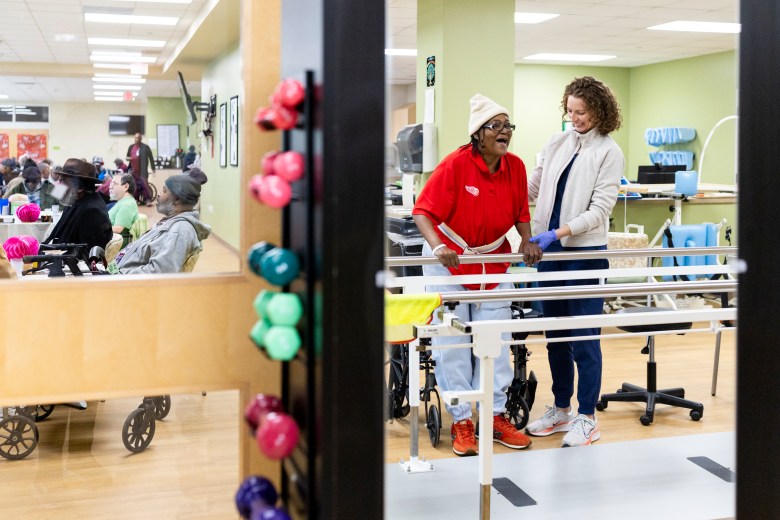 Physical therapy in nursing homes and elsewhere may be limited by insurance — to two weeks or while there’s improvement, for example. But at the PACE program in Detroit, it continues indefinitely, helping participants to maintain their strength in an effort to help them avoid nursing homes. (Emily Elconin for Bridge Michigan)
In this sprawling space, the Green House residents will join about 350 other older Detroit area residents throughout the week. They arrive — most coming from their own homes and independent- or assisted living homes — on PACE buses.
Each person is eligible because they have been deemed medically fragile enough for a nursing home. The idea, though, is to keep them in the community.
“We want to help them maintain their independence, their dignity,” said Sicily Baker, day center manager.
In addition to two hot meals each day, there are dances, movies, exercise classes and field trips as well as physical therapy and visits to the doctor or social worker — all in this same collection of rooms.
On this particular morning, smooth jazz spills from a speaker in one room, as residents eat breakfast or catch up on their days.
Some residents sew or fill in coloring books or crossword puzzles.
Others scroll through phones.
“They’re in charge,” Baker says.
Savings
Despite the individual care and low staff-client ratio, supporters of PACE and Green House homes say they save tax dollars.
To understand the savings is to first consider a nursing home and its hierarchy of staff and multiple divisions of labor, said Robert Jenkins, a long-term care consultant who helped establish some of the nation’s first Green Houses more than 20 years ago.
A certified nursing aide in a nursing home usually has a narrow and prescribed set of duties around personal care. A dietary aide helps with meals. A nurse passes medications. An activities director shepherds engagement.
 The purpose of Green House living is “to get away from more of the assembly line structure of institutional healthcare settings,” said Robert Jenkins, who helped develop some of the nation’s first sites.
A Green House home “pulls hours back from all of these departments that operate behind walls, away from the residents — laundry, housekeeping, dietary.”
Instead, one “universal worker” — a familiar face for residents — also cooks and does light house-cleaning, he said.
Workers like Mesha Dix and Kimnalla Simmons in Detroit.
Both previously worked as certified nurses aids in nursing homes. Shifts there were an impossibly long list of tasks that allowed for little interaction with residents — help with the showering, change linens, and move on to the next resident.
“It was running from call light to call light and going up and down hallways,” said Simmons, as she and Dix began filling drink glasses for dinner.
Here, Dix and Simmons are each known as a shahbaz, part of a small staff who execute those tasks, but also plan meals with the elders or — just as importantly — simply sits and talk with residents. Play board games. Reminisce. Make plans.
Upstairs this afternoon, shabhaz Keyon Gordon is chatting with elder Aura Brewer about nothing in particular — just the day, how she is.
Nothing rushed.
He, too, used to work in a nursing home. In addition to those personal care duties at the Green House, he makes dinners and bakes cakes for the elders.
“Here, it’s about relationships, too,” he said.
It’s another hallmark of a Green House — empowered staff — and it’s critical to that feeling of home — along with plants and pets and welcoming living spaces, Rani Snyder, president of The John A. Hartford Foundation, told Bridge. The nonpartisan philanthropy works to improve care for older adults.
Green House homes are about “resident autonomy and choice and dignity,” she said. “They emphasize meaningful interactions.”
Green House homes also can save money — at least in the long run, say advocates for older adults.
In Detroit, the monthly cost for the twenty Green House residents is $7,067.40 each. In comparison, the average cost for a semi-private nursing home room was $10,570 in 2024, or $11,574 for a private room, according to life insurance company Genworth, which operates Care Scout, a website that allows consumers to compare long-term care costs.
“The Green House is to try to get away from more of the assembly line structure of institutional health-care settings and put it back into what is a real home environment,” said Jenkins, the consultant. “You’re both empowering the direct care staff so that they have input and control and management, but you’re also making that a more efficient process.”
In short, he said, “you have fewer middle managers that you’re working through.”
Moreover, empowered staff are less likely to leave — a cost savings in an industry racked by high turnover of staff and the high costs of recruiting and training replacements.
At the height of the pandemic, Green House homes reported substantially lower turnover rates — 33.5% for shahbazim, according to Aging Innovations, which runs the Green House Project. In comparison, nursing homes reported more than 100% turnover rates for certified nursing assistants in some areas, according to research published in the peer-reviewed journal Health Affairs.
Why aren’t there more?
Michigan now has 14 PACE programs. That’s significantly more than just about any other state. Only California, with 38 sites, and Pennsylvania, with 18 sites have more.
It has twelve Green House homes at six sites, including the two homes in Detroit’s Rivertown neighborhood.
Both the PACE and Green House homes serve just a sliver of older Michiganders, compared to the more than 35,000 nursing home residents.
Michigan AARP and others have renewed calls for small homes such as Green House sites, especially since COVID, which proved particularly deadly for nursing home residents.
The biggest hurdles to expanding both programs are start-up costs.
“You have to build out a building. You have to fully equip it — build out a clinic and have staff hired and trained and on site before you can enroll one participant, said Christine Vanlandingham, CEO of Region IV Area Agency on Aging in St. Joseph.
There, it took $6 million to get a PACE program up and running, she said. Today, about 250 older area residents arrive at the program, some choosing to come five days a week and others just a few times a month.
Expanding the programs can happen with nonprofit help, fundraising, and local tax dollars, but it will take state investment, too, said Paula Cunningham, of Michigan AARP.
It’s not easy, she acknowledges.
“We can figure this out together. We can all be at the table, sit down and figure out: How do you restructure what you currently have? Are there dollars for that?” she said. “I don’t have all the answers, but the answers are out there.”
Related
Thank you to our Michigan Health Watch Sponsors
Bridge Michigan Health Watch is made possible by generous financial support from our sponsors. Sponsorship supports our independent journalism mission but does not constitute sponsor endorsement of individual articles or editorial content. Bridge Michigan journalism remains fact- and data-driven and independent at all times.
Please visit the About page for more information and to subscribe to Health Watch. Interested in becoming a sponsor? Contact Emma Carr.
Republish This Story
