
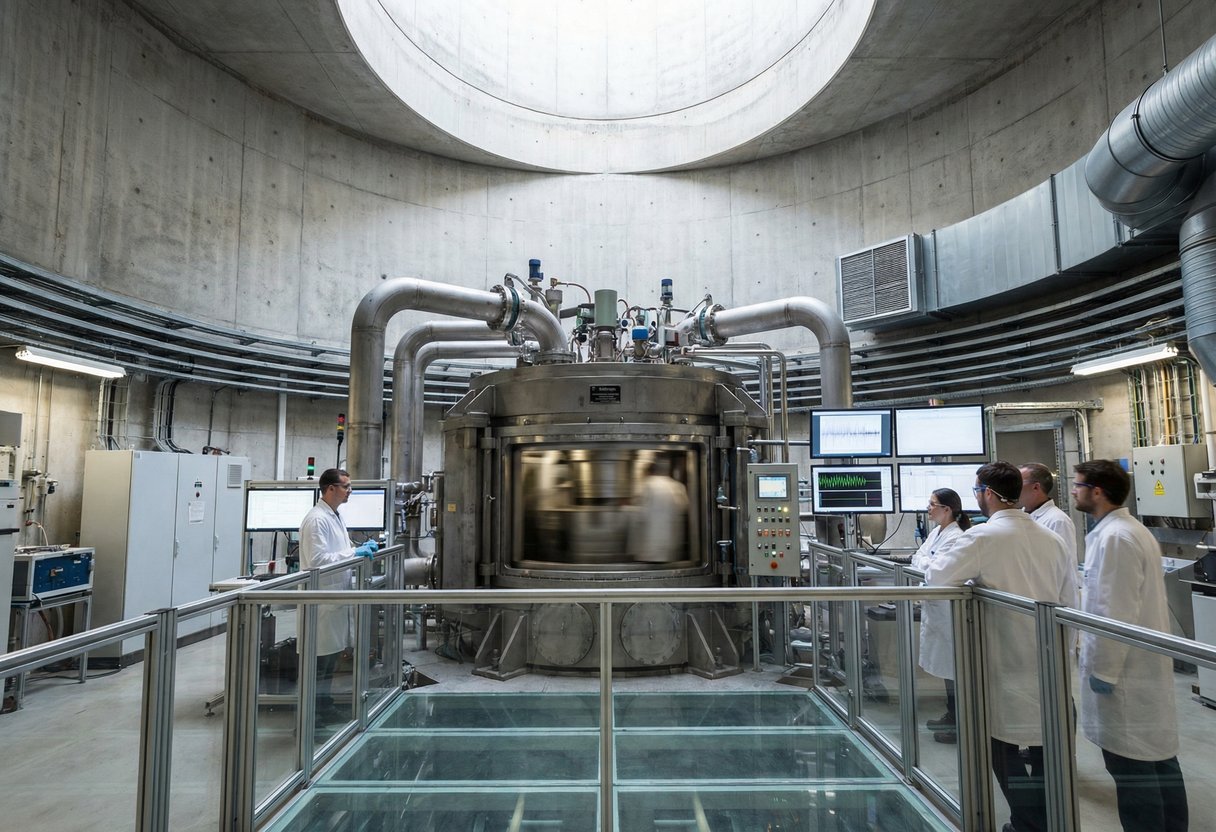
A machine in China promises to make years behave like hours. If physics hates shortcuts, why are so many scientists lining up to take this one?
Fifteen meters beneath Zhejiang University in Hangzhou, a centrifuge named CHIEF1900 hurls scale models into crushing gravity to fast‑forward nature’s clock. Built by Shanghai Electric Nuclear Power Group for €260 million, it delivers 1,900 g‑tonnes and eclipses both China’s previous CHIEF1300 and the US Army Corps facility in Vicksburg. A vacuum-based cooling system keeps the beast in check while scientists watch dams age, slopes fail and pollutants creep in hours instead of years. The center is opening to international teams, betting hypergravity can rewrite how we test infrastructure and manage risk.
China’s groundbreaking CHIEF1900 centrifuge
China has unveiled CHIEF1900, a hypergravity centrifuge built to bend our sense of scale and time—scientifically, by accelerating experiments. Developed by Shanghai Electric Nuclear Power Group, the machine stakes a claim to the title of most powerful of its kind. It outmuscles China’s own CHIEF1300 and the U.S. unit in Vicksburg. What does that buy science? Plenty, as researchers line up to stress-test ideas that normally take decades.
The pitch is simple yet formidable: simulate extreme gravitational conditions with control and repeatability. That makes intractable questions testable in the lab, where variable isolation and instrumentation can do their best work.
The impressive scale and design behind CHIEF1900
CHIEF1900 can deliver up to 1,900 g-tonnes—46% more than CHIEF1300—and well beyond the 1,200 g-tonnes of the Vicksburg centrifuge. That margin translates into larger models, harsher loads, and cleaner signal-to-noise during measurement.
Built 15 meters underground at Zhejiang University in Hangzhou, the €260 million project took 5 years and a tight-knit team in engineering and environmental science. To tame heat and vibration, the designers created bespoke components and a vacuum temperature control system that marries liquid cooling with airflow. The aim is precision under strain.
Revolutionizing research through hypergravity
Hypergravity shrinks landscapes and accelerates timelines. A small physical model spun at high g can mirror a vast structure over long periods, compressing months or centuries into hours. For example, a 3 m dam model at 100 g can represent a 300 m wall (scale laws make the math tractable).
Assess dam safety and overflow dynamics
Probe earthquake resilience and soil-structure interaction
Study landslides and deep storage of nuclear waste
Track pollutant migration through soils over millennia
Refine large wind turbines and high-speed rail resonance
The global implications of hypergravity leadership
China’s bet on hypergravity is also a diplomatic one. Zhejiang University’s center invites international teams to co-design experiments and share data across disciplines. Media coverage, including the South China Morning Post, frames CHIEF1900 as a strategic leap (a signal of both capacity and intent).
If it works as advertised, expect a wave of time-compressed evidence to influence standards in civil engineering, energy, and environmental risk. The frontier won’t be theory alone; it will be better models and better measurements. And, indeed, a faster path from hypothesis to result—with gravity doing the heavy lifting.