
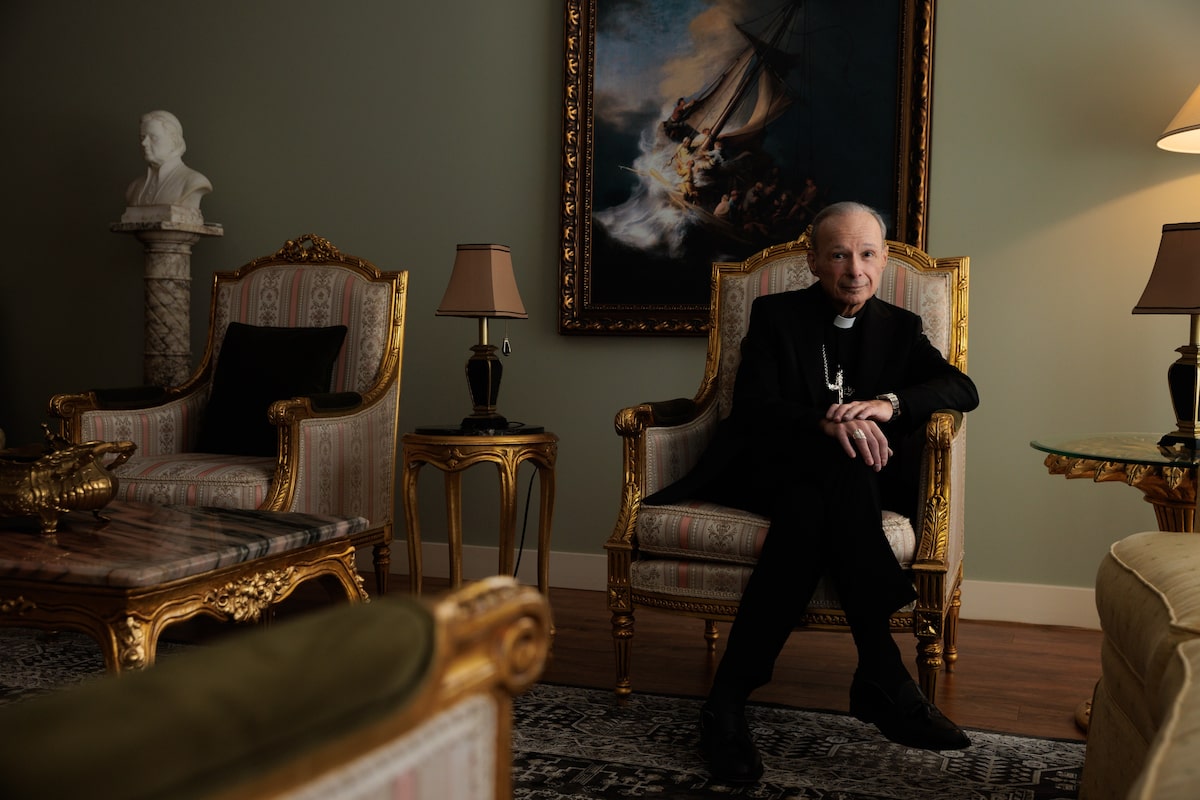
Bishop Raymond Poisson says the concept of ‘collective religious practice’ addressed in Quebec’s bill to limit public prayer is too broad and ill-defined.Nasuna Stuart-Ulin/The Globe and Mail
Each spring, before hundreds of boats leave the harbours of Quebec’s Magdalen Islands, the fleet receives a benediction.
In a tradition dating back 150 years, a Catholic priest visits the islands’ largest quay to bless the boats, whose crews will spend the following nine weeks setting and checking lobster traps in the Gulf of St. Lawrence.
Later, the priest leads a mass in the nearby church, before the congregation heads back to the quay to send a wreath of flowers out to sea in memory of fishermen who have lost their lives.
The launch of the fishing boats is an annual celebration on the remote island chain that sits deep in the Gulf of St. Lawrence. But the blessing has now been caught up in Quebec’s latest bid to expand secularism rules, as a bill limiting the right to public prayer winds its way through the provincial legislature more than 700 kilometres away.
Quebec government tables bill banning prayer rooms in public institutions
After passing a controversial ban on religious symbols in 2019, the Quebec government is now planning broad new restrictions on religious practices in the province, including a crackdown on communal prayer. The move stems from public outrage over Muslims in Montreal praying on streets and in parks, sometimes as part of pro-Palestinian demonstrations.
New legislation would ban any “collective religious practice,” unless it receives municipal authorization. But amid uncertainty over what constitutes a public display of religion, Quebec municipalities and religious leaders say they’re being dragged into a battle that has nothing to do with them.
Antonin Valiquette, mayor of the Îles-de-la-Madeleine municipality, said before the question of the boat blessing arose, he hadn’t paid much attention to the new secularism bill. He figured it mostly affected the big cities – not the archipelago’s roughly 13,000 inhabitants.
“I’m 44 years old,” he said. “I have never seen a religious demonstration disturb the public peace in the Îles-de-la-Madeleine. It has never happened.”
Quebec Secularism Minister Jean-François Roberge speaks during question period at the legislature in Quebec City on Nov. 13, 2025.Jacques Boissinot/The Canadian Press
Quebec Secularism Minister Jean-François Roberge confirmed this week that the benediction on the Magdalen Islands likely would require a permit under the new rules, though he saw no reason the tradition wouldn’t be allowed to continue. The legislation says municipalities can give the green light to religious events that are brief and don’t present public safety concerns.
Mr. Roberge said the new rules are necessary to tackle what he suggested is a growing problem. During legislative committee meetings, he pointed to several examples of Muslim prayers conducted in public places in Montreal, including in front of the city’s Notre-Dame Basilica during pro-Palestinian protests last year. “We didn’t have this before, and now we do,” he said.
But Raymond Poisson, bishop of a Catholic diocese north of Montreal, said the concept of “collective religious practice” is overbroad and ill-defined. He pointed out that priests are asked to bless more than just boats – for instance, motorcycle blessings at the start of the summer season are also a popular tradition.
“I think we’re complicating things for no reason,” he said.
Under questioning by opposition lawmakers, Mr. Roberge has endeavoured to clarify which activities would require a permit. Funeral processions from a church to a cemetery? Not a problem, he said. Food drives organized by religious groups? All good.
A group of friends meeting for a Bible reading in a park? Probably fine, as long as it’s discreet. For an event to need authorization, Mr. Roberge said, “it has to be obvious.”
But Mr. Valiquette worries that municipalities will be left to make subjective decisions about what is and is not a religious display. “There are so many possible scenarios,” he said.
Supreme Court tentatively schedules landmark Quebec secularism case for March
Groups representing Quebec municipalities say the bill will further burden local governments that have their hands full with more prosaic concerns, such as housing shortages and crumbling infrastructure. They say the vast majority of Quebec municipalities report no problems related to secularism.
“Issues with people praying in the street, that hasn’t happened to me yet,” said Michaël Pilote, mayor of Baie-Saint-Paul and first vice-president of the Quebec federation of municipalities. He said local governments already have the legal tools they need to intervene in cases where people are blocking streets.
But Mr. Roberge said police are reluctant to act when people use prayer as a form of protest, for fear of being seen as infringing on their Charter rights. “The guidelines are not clear enough in situations involving religious demonstrations,” he told the committee. The minister declined an interview request.
The scope of the new legislation is wide-ranging. In addition to tackling public prayer, it would extend the province’s workplace ban on religious symbols to anyone working in daycares, colleges, universities and private schools. Quebec’s original secularism law, which is now being challenged at the Supreme Court of Canada, banned religious symbols for some public-sector employees, including elementary and high school teachers, police officers and judges.
The new bill would also prohibit prayer and other religious practices in public institutions, effectively banning prayer rooms at Quebec colleges and universities.
Critics say the legislation is a thinly veiled attempt to exploit anti-Muslim sentiment for political gain. In a brief presented to the committee, the National Council of Canadian Muslims said Quebec Muslims “feel less and less that they belong” in the province.
Bishop Poisson said there’s no reason to treat religious demonstrations any differently from other public events. “We must be careful not to build a society where the laws prohibit everything except what is permitted,” he said.
“I want to live in a country where everything is permitted except what is prohibited. There’s a big difference.”