
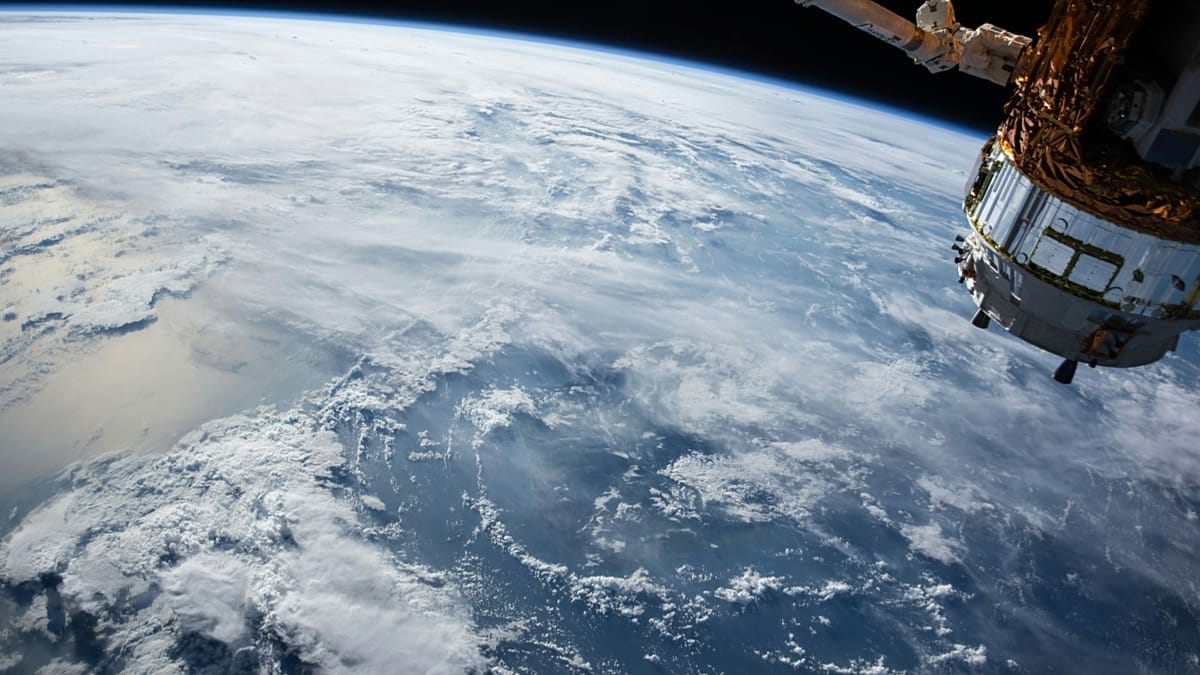
In 1941, two astronauts began the seemingly impossible feat of training a robot to operate a solar energy station in space, one capable of beaming power across the Solar System.

ADVERTISEMENT
ADVERTISEMENT
Of course, this was purely fiction – the dystopian plot of sci-fi writer Isaac Asimov’s short story ‘Reason’. However, less than two decades later, real-life scientists started to wonder whether renewables really could be deployed in outer space.
Last year, researchers at King’s College London found that, by 2050, solar panels in space could reduce Europe’s need for land-based renewable energy by 80 per cent. But, is it really that simple?
What is space-based solar?
Space-based solar power (SBSP) systems comprise a constellation of very large satellites in a high-earth orbit, where the sun is visible over 99 per cent of the time.
These satellites would collect solar power using mirror-like reflectors and beam it to a secure fixed point on Earth (without the help of any robots). Here, it would be converted to electricity and delivered to an energy grid so it could be sent to homes and businesses.
A new study commissioned by the UK’s Department for Energy Security and Net Zero (DESNZ) suggests that small-scale SBSP could become cost-competitive with other commercial power sources as early as 2040, especially if connected to the grid through existing infrastructure at offshore wind farms, for example.
Is space-based solar the ticket to ending fossil fuels?
The world is dragging its heels when it comes to moving away from fossil fuels, despite the boom in renewables.
Transitioning away from oil and gas became a flashpoint discussion at last year’s COP30 climate summit in Belém, despite not being on the official agenda. It saw more than 90 nations backing the idea of a roadmap that allows each country to set out its own targets to phase out fossil fuels – but all mention of this was scrubbed from the final deal.
Still, for the first time ever, wind and solar generated more electricity than fossil fuels in the EU in 2025 – while fossil power has declined from 36.7 per cent to 29 per cent of the bloc’s electricity mix.
“All renewable energy technologies will have a part to play in tackling climate change, especially as energy demand is expected to double by 2050,” Dr Adam Law, a research associate in the Centre for Renewable Energy Systems Technology (CREST) at Loughborough University, tells Euronews Green.
Renewables face intermittency problems for a plethora of reasons, including weather conditions and Europe’s outdated grid. It’s why Britain wasted a staggering £1.47 billion (approximately €1.67bn) by turning off wind turbines (curtailment) and paying gas plants to switch on.
“SBSP benefits from there being a lot more sunlight available in space – 1,367 W/m2 of uninterrupted sunlight, compared to a maximum of 1,000 W/m2 at the equator and an average of about 100 W/m2 in the UK, and satellites in the right orbit see the sun almost all the time,” Law adds.
The true cost of space-based solar
On the ground, solar is considered the world’s cheapest power source. In the sunniest countries, solar costs as little as €0.023 to produce one unit of power – and installation is much cheaper (and quicker) compared to renewables like wind.
But taking the tech out into space won’t be cheap. Recent reports suggest the development of SBSP is anticipated to require €15.8 billion of research and development over four phases to achieve the first gigawatt-scale prototype in-orbit.
“The scale of launching and building these structures in space is immense, so initial costs will be high,” says Law.
However, launch costs have come down “dramatically” to help make SBSP more economically feasible. Law says this is mainly driven by SpaceX and the advent of reusable rockets.
“Driving these costs down is key to realising SBSP,” he adds, noting that making solar cells both affordable and radiation-resistant will be another crucial factor.
While many startups such as Space Solar in the UK and Virtus Solis in the US are developing SBSP systems thanks to government and private funding, maintaining them will also be no easy feat – especially if things go wrong.
“There is the potential for increased orbital debris, so systems will have to be designed with these factors in mind, for example, by using highly modular designs,” Law adds.
The safety of the power beam is another risk to consider. But Law argues its intensity is low enough to prevent harm to humans and wildlife.
Overall, bringing SBSP to life “will be difficult, but that doesn’t mean it’s not worth doing,” he adds.
Of course, sending satellites into space also poses environmental concerns.
In 2024, the American space agency NASA warned that SBSP may produce greenhouse gas emissions comparable to existing renewable energy systems – but fewer emissions than fossil fuels.
Is space-based solar a security risk?
SBSP systems could easily become a target for hostile states who want to damage, degrade or deny a rival’s ability to deliver power. Even plans to construct a fleet of offshore windfarms in the North Sea that connect to multiple European countries have sparked concerns of being “attractive for sabotage”.
While fossil fuel plants have long been considered vulnerable to attacks, a 2023 investigation by public broadcasters in Denmark, Norway, Sweden and Finland discovered that Russia had a programme to sabotage wind farms and communication cables in the North Sea.
It found Russia has a fleet of vessels that are disguised as fishing trawlers and research boats that are carrying out underwater surveillance and mapping key sites for possible sabotage.
“Like other critical national infrastructure, it is a tempting target for cybercriminals, state-sponsored actors, and hacktivists seeking to cause disruption or gain geopolitical advantage,” says Frazer-Nash, a consultancy company that released a report on SBSP’s security challenges last year.
The report highlights the need to design solar power satellites with “inherent security and comprehensive risk mitigation strategies” from the outset.
This includes building multinational partnerships and agreements to share energy and enhance security, continuous threat monitoring, and ensuring supply chains demonstrate a “robust” cybersecurity arrangement.
“Failing to address key areas of security and risk in the early development stages could limit its tantalising potential before it’s begun,” Frazer-Nash states.