
Turn out the lights, the party’s over.
The never-ending pity party for the Orlando Magic’s medical report masquerading as a basketball season has come to an end.
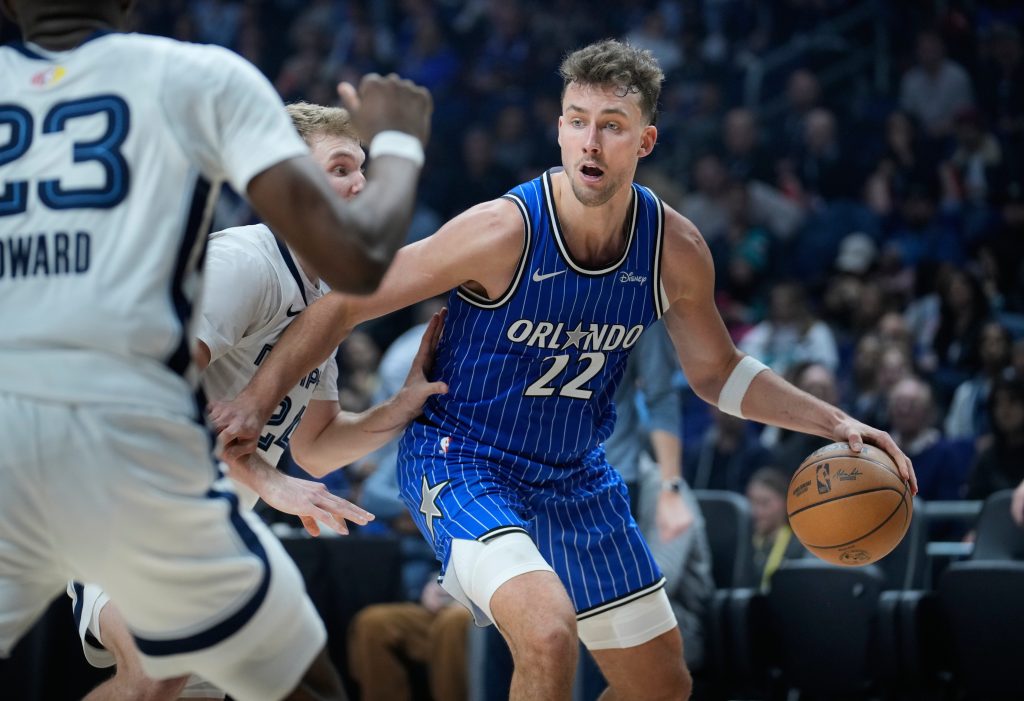
Franz Wagner is sidelined again — indefinitely — after additional soreness from his left high ankle sprain required more rehab. He has now missed 26 of the past 30 games and will be reevaluated in three weeks. It’s the latest interruption in what has become a defining pattern for this franchise: promise delayed, momentum stalled, potential placed on hold.
But here’s the cold, hard truth the Magic must confront: injuries explain circumstances, they do not excuse outcomes.
Yes, Wagner matters. His numbers prove it. In 28 games this season, he’s averaging 21.3 points, 5.8 rebounds and 3.6 assists while shooting nearly 48% from the field. When he plays, the Magic average 117.2 points per game. Without him? 112.7. The difference is real. Orlando is 16-12 with him, 13-13 without.
And yet, the NBA does not pause for your absences.
Look around the Eastern Conference. The Boston Celtics have navigated a season without Jayson Tatum — one of the top five players in the league — and remain near the top of the standings. The Detroit Pistons have surged despite missing Jalen Duren for stretches. Good teams adjust. Great organizations adapt. They don’t wallow in their misery and sit there in the middle of the season waiting for medical clearance to unlock their identity.
For two seasons now, Orlando’s underlying message has been consistent: “Just wait until we’re healthy.” Wait until Wagner, Paolo Banchero and Jalen Suggs share the floor. Wait until chemistry stabilizes. Wait until rotations settle.
The trio has played together in just 14.1% of games over the past two seasons. And yes, in the small sample this year — 148 total minutes — the numbers are electric: 50.9% shooting and 39.6% from 3-point range. That’s not just encouraging; it’s tantalizing.
But potential is a mirage if it never materializes consistently. Availability is a skill. Durability becomes part of identity. At some point, you are not the team you could be; you are the team you repeatedly are.
Right now, Orlando is hovering near the middle of the Eastern Conference at 29–25. That is not failure. It is also not ascension. It is neutrality. And neutrality breeds complacency.
It is fair to question whether the organization handled Wagner’s return properly earlier this season. He rushed back for the first regular-season NBA game in Germany — an historic moment in Wagner’s hometown of Berlin. Then he played again three days later in London before missing 10 more games. A high ankle sprain is notorious for lingering instability and flare-ups. Was the timeline aggressive? Did sentiment override caution? We may never know.
But even if mistakes were made, they cannot define the response.
Because the larger issue is cultural, not medical.
When a team constantly frames its season around who is missing, it subtly lowers its internal standards. Accountability softens and urgency fades. The Magic cannot afford that mindset.
If this roster believes it is building toward contention, then adversity must become a proving ground, not a shield. Banchero must evolve from emerging star into nightly force, independent of circumstances. The same with Suggs and Desmond Bane. And the supporting cast must stretch beyond role-player comfort and embrace expanded responsibility.
Coach Jamahl Mosley and his staff must reflect that urgency as well. Schemes must adjust to available personnel rather than ideal lineups. Defensive intensity cannot fluctuate based on who is in uniform. Offensive stagnation cannot be brushed off as temporary chemistry issues. Innovation must replace explanation.
The Magic returned from the All-Star break with a 131–94 win over the league’s worst team, the Sacramento Kings. It was emphatic, but beating a tanking opponent proves little. Let’s see what happens when they play legitimate opponents. Games against real teams will reveal far more about the Magic’s mindset than any blowout over a bottom-feeder.
Resilient teams treat injury as disruption, not devastation. If the Magic cannot maintain defensive discipline without Wagner, that’s a structural weakness. If their offensive flow collapses without his secondary playmaking, that’s a developmental gap. These are truths to confront, not cover up with excuses.
And there’s a deeper, more uncomfortable thought: if the trio’s health never aligns consistently, then the organization must evaluate durability as part of roster construction. Banking the franchise’s ceiling on simultaneous health that rarely occurs is not strategic patience; it’s optimistic gambling.
None of this diminishes Wagner’s value. He is a foundational piece. His efficiency, versatility, defensive prowess and scoring punch clearly elevate Orlando’s ceiling. But ceiling and floor are different conversations. The Magic’s floor must rise, independent of any one player.
The NBA doesn’t care who’s injured, and opponents don’t try less because your lineup is incomplete. The standings do not adjust for soreness and playoff seedings do not offer a sympathy clause.
For too long, Orlando’s emotional tone has carried a subtle undercurrent of “once we’re whole.” That mindset allows mediocrity to masquerade as patience.
There is still time this season. The record is salvageable. The Eastern Conference middle tier is fluid. A strong stretch could reposition this team dramatically.
But that requires mental and physical toughness. No more leaning on hypotheticals. No more romanticizing what the core looks like in 148 minutes together. No more waiting for perfect alignment. No more sympathy tours. The Magic must decide whether adversity is their identity or their ignition point.
Wagner’s latest setback is unfortunate, but it cannot become the story of the season.
If Orlando wants to be taken seriously — by the league and by its fan base — then this is the moment to rise without him.
In professional sports, excuses age quickly.
The pity party playlist has run dry.
It’s time for the Magic to change their tune.
Email me at mbianchi@orlandosentinel.com. Hit me up on social media @BianchiWrites and listen to my new radio show “Game On” every weekday from 3 to 6 p.m. on FM 96.9, AM 740 and 969TheGame.com/listen