
Two years ago, Sibanye Stillwater mine, located in Stillwater County, was forced to cut nearly 40% of its staff — approximately 700 miners — most high-paying mining jobs that fueled the county and the region’s economic engine.
But last month, the U.S. government announced that the company was successful in its unfair trade case against Russia and a Russian company that seemed to have dumped the rare precious metal on the U.S. market just as the country was beginning its invasion of Ukraine.
The International Trade Administration for the U.S. government announced that it was punishing Russian imports with a 132% tariff that would be added to any incoming Russian palladium. Officials found that the Russian company had unfairly been dumping palladium on the United States, causing the price to plummet by nearly half. Prices dropped from around $2,000 an ounce to less than $1,000.
“That meant every ounce of palladium we were producing was costing us $200,” said Sibanye Stillwater’s Senior Vice President and General Council Heather McDowell.
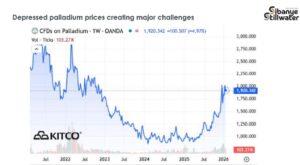 A graphic showing the rise, fall and rebound of U.S. palladium prices, including a period when Russia dumped palladium in the U.S. (Slide courtesy of Sibanye-Stillwater).
That kind of market upheaval would likely have shuttered other operations, but because of Sibanye Stillwater’s footprint as a multinational company, it survived. McDowell said U.S. operations focused on tax credits and the trade dispute. She said Montana’s Congressional delegation, including former U.S. Sen. Jon Tester, worked to get palladium mining included in federal tax code to qualify the company for tax breaks offered to rare metal production, which helped the company.
McDowell also said that she and others worked on a trade case at the International Trade Administration. The case has two parts, first the allegations of palladium dumping by the Russians, which resulted in a preliminary finding that the country had unfairly and illegally dumped Russian palladium into the U.S., likely causing the deflating prices. The ITA’s decision now means that if Russia’s palladium producers try to sell palladium — indistinguishable from the kind that is mined in Montana — it will be hit with a tariff of 132%. For example, if a Russian company tried to sell palladium at the deflated prices, a tariff of 132% would be added to it, likely making it more expensive than its American counterpart.
Moreover, the ITA is also mulling the second part of Sibanye Stillwater’s complaint, which is unfair government support to Russian companies. McDowell said that there’s good reason to believe the Russian government is doing things like allowing palladium producers to disregard environmental laws, labor laws, or even help get shipments through the icy Arctic Ocean by deploying Russian Navy icebreakers, giving the producer unfair advantages that U.S. companies don’t enjoy. A decision on that part of the case is expected any time, and if the trade administration finds in favor of Sibanye Stillwater, it could increase those tariffs even more.
McDowell praised the work of U.S. Sen. Steve Daines’ staff as well as the rest of the Montana Congressional delegation, which put pressure on the U.S. Commerce Department, which oversees trade issues, to take up the case in an expedited manner. McDowell said that helped save the remaining jobs for Russia’s economic actions.
McDowell said that no Russian palladium has come into the country since last July, after the trade sanctions cases began. Representatives of the Russian company and the Russian government did not even appear for the hearing before the International Trade Administration. As palladium dumping stopped, the price of palladium has gradually increased, rising to more sustainable, profitable levels, McDowell said.
“We think this case had the intended purpose and keeping the 132% tariff will keep them from doing it,” she said.
If the sanctions are finalized, they will last for five years, and can be renewed for as long as 20 years.
Sibanye Stillwater is the world’s only operation that is primarily focused on palladium, an element on the periodic table. Palladium is mainly used in catalytic converters on internal combustion engines. McDowell said that 85% of the use of palladium is tied to the automotive industry.
With proven palladium reserves that could sustain operations for decades, Sibanye Stillwater says it’s optimistic that the workforce will increase as the prices rebound, but restarting part of the operations is more complicated than a price on the metals market.
Operations at Sibanye Stillwater happen in two locations, the older Stillwater mine, which began operations in 1986, and the newer East Boulder complex. As the older mining portions operated, McDowell said it takes more to get to the ore — it’s deeper back in the mountain, requiring more time for miners to get set up, and more time and effort to get to it, and bring it out, raising the product input cost and lowering the margins.
She said that before the older portion of the mine reopens, newer equipment and techniques will have to be used — something they’re planning and preparing for — to make operating in the area more efficient and economical.
“Changing the plan and getting the right equipment, we want to be sure we’re close to the $1,000 per ounce (production cost). We’re getting close to it. Right now, we’re at between $1,100 and $1,200, so it needs to come down a bit and we can then open the west side,” McDowell said.
Current palladium production prices are between $1,200 and $1,300 an ounce, while the current market hovers in the $1,600 per ounce range, still down from its previous high of nearly $2,200 an ounce. On Friday, the markets showed palladium trading for between $1,740 and $1,795 with high volatility.
“That’s a good price,” McDowell said. “And it’s sustainable for us. Sure, we’d like it closer to the $2000 level, but it’s far different than the $800 to $1,000 an ounce.”
Recycling and reuse
Domestically, Sibanye Stillwater is heavily involved with palladium recycling. In fact, the company recycles more palladium than it mines and refines. That’s because the elements that are needed for catalytic converters can be used again and again. McDowell said that kind of emphasis on reuse also helps lessen the environmental toll that mining can take.
“We’re now recycling the same palladium that came out of the ground in the 1980s and 1990s,” she said.
The palladium that comes from Montana is unique for several reasons, even though the final product is the same no matter where it comes from after it has been refined to a 99% purity. Sibanye Stillwater is the only place in the world where palladium is mined specifically. The mine also produces platinum and rhodium. However, 78% of its mined metal ores are palladium. Also, Sibanye Stillwater’s palladium ore that is found in Montana is more concentrated, meaning that the company can get more palladium per ton of ore than other locations.
Sibanye Stillwater has either proven or suspected palladium reserves to keep the mine functioning for decades, and McDowell said that the corporation is proud to mine it in a responsible way, including a first-of-its-kind “Good Neighbor Agreement” it produced with neighbors. The mine is located in one of the more iconic and rugged areas in Montana, home to streams for trout fishing, cabins and recreation areas.
While the primary market for palladium currently is for catalytic converters for internal combustion engines, reducing the amount of nitrous oxide, there are growing applications for the metal ranging from medical devices to hydrogen fuel cells.
McDowell said with the soaring prices of precious metals, especially gold, some have turned to buying palladium as an investment.
“Since 2024, we’ve recycled more metal than we’ve mined,” McDowell said.