
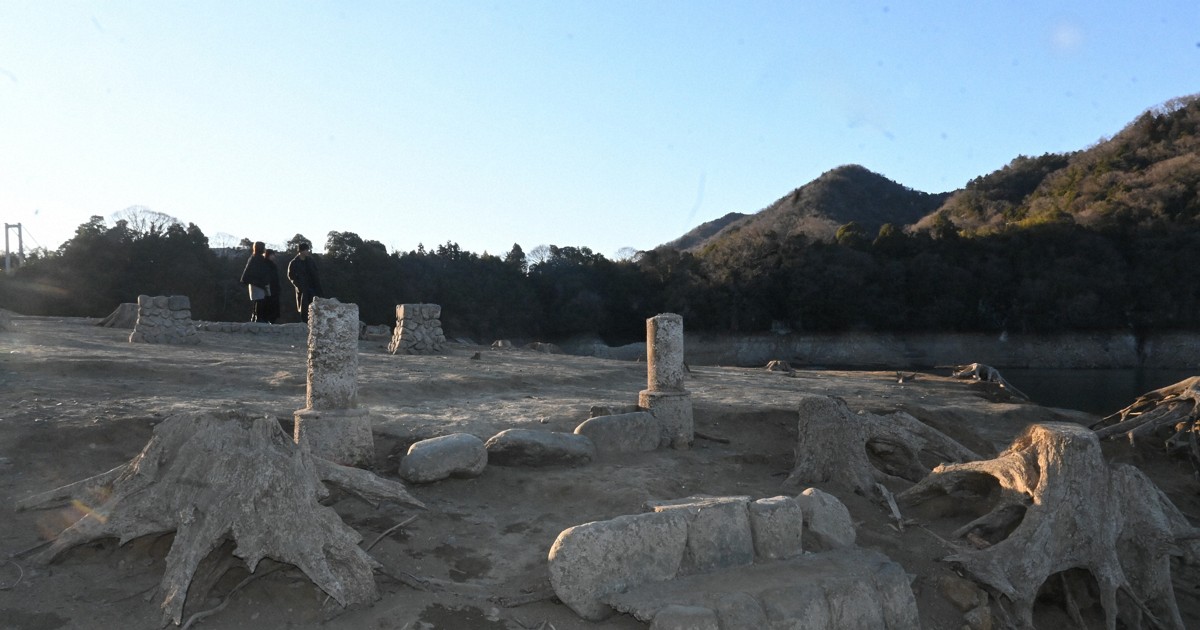
The drop in Lake Tsukui’s water level has exposed the ruins of a settlement, including these remains of what is thought to be a Shinto shrine’s torii gate and some stone steps, as seen in Midori Ward, Sagamihara, Kanagawa Prefecture, on Feb. 3, 2026. (Mainichi/Natsuki Shimizu)
SAGAMIHARA, Kanagawa — Prolonged dry weather has left reservoirs across Kanagawa Prefecture south of Tokyo at less than half their normal capacity, and in one case revealed a settlement lost below a dam lake.
The 54.7-million-cubic-meter Lake Tsukui reservoir in the city of Sagamihara’s Midori Ward was created in 1965 by the prefectural government to provide water for cities including Yokohama amid population growth during Japan’s period of rapid economic expansion. About 300 households from the former town of Sagamiko and nearby areas in the upper reaches of the Sagami River were relocated to make way for the project.
Lakebed — and local history — emerges from the waters
When visited in early February, the water level at the lake — usually lively with anglers at this time of year — had dropped to about 10% of the dam’s capacity, exposing parts of the lakebed and forcing boat rental businesses to suspend operations. Walking across the dry bed, this reporter found stone steps, round pillars believed to be parts of a Shinto torii gate and even a rusted wheel.
An official at the Lake Tsukui commemorative hall, which documents the relocation of the flooded community, said, “We’ve heard there once was an Inari shrine here.” The official noted the pillars were likely from the shrine gate, and added, “Although winter precipitation is generally low, the water has rarely fallen this much.”
The phenomenon has drawn visitors curious about what lies beneath the water. Sachi Yamamoto, 67, who came with her family from Sagamihara’s Minami Ward, said, “I wanted to see what has been sleeping down there.”
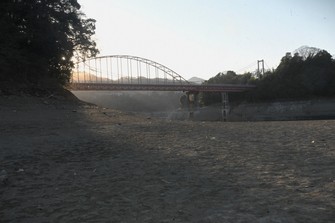
The dried bed of Lake Tsukui is pictured in Midori Ward, Sagamihara, Kanagawa Prefecture, on Feb. 3, 2026. (Mainichi/Natsuki Shimizu)
Kanagawa Pref. calls for water conservation
According to the prefectural government, Lake Tsukui was at 11% of capacity as of Feb. 17. Across the four major dam lakes in the prefecture, the average level has fallen to 38% — roughly half the seasonal norm.
The Yokohama Local Meteorological Office said the water shortfall stems from a record-short rainy season last summer, when a Pacific high-pressure system frequently brought clear skies. Upstream Lake Sagami recorded rainfall of only 222.5 millimeters from June to August 2025, less than half the usual amount. Typical winter pressure patterns where the south Kanto region including Tokyo stays sunny also persisted this season, with January precipitation reaching just 1.5 millimeters.
Prefectural officials said the authorities can currently manage water supply by balancing levels among the four reservoirs, but urged residents to conserve, noting, “Water has become a limited resource, so we ask for your cooperation in saving it.”
(Japanese original by Natsuki Shimizu, Yokohama Bureau)